Newsletter
Newsletter Support JNS

Palestinians celebrate murder of Ronen Hanania

Im Tirtzu tweets in response: “These are our enemies. This is what they do without a state or an Army.”

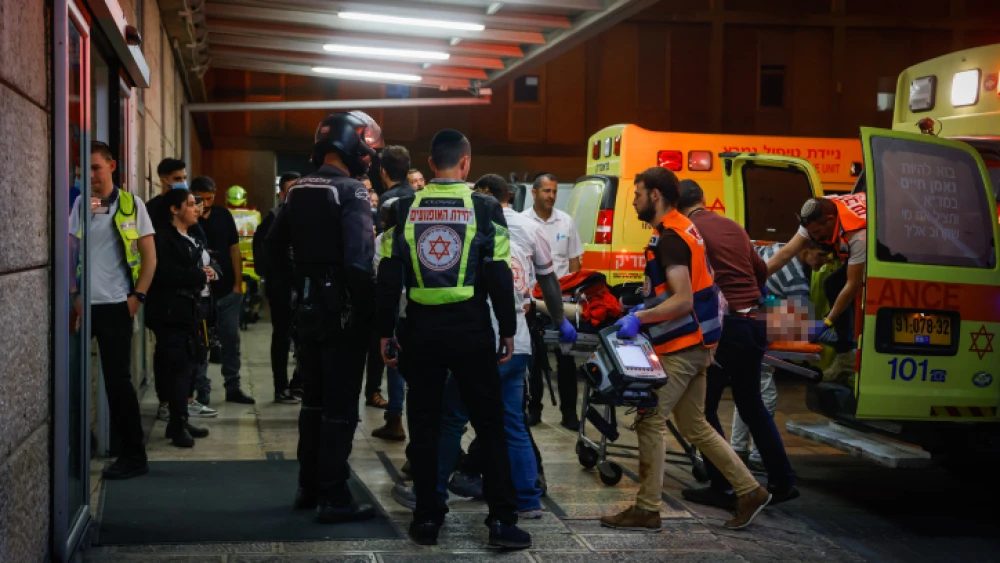
An Israeli man wounded in a terrorist attack near Kiryat Arba is taken to Hadassah Medical Center in Jerusalem's Ein Kerem, Oct. 29, 2022. Credit: Olivier Fitoussi/Flash90.
An Israeli man wounded in a terrorist attack near Kiryat Arba is taken to Hadassah Medical Center in Jerusalem’s Ein Kerem, Oct. 29, 2022. Credit: Olivier Fitoussi/Flash90.

After learning that a Jew had died in a terrorist attack in Kiryat Arba, near Hebron, on Saturday night, local Palestinians celebrated in Ibn Rushd Square, according to a video circulated on social media.

Im Tirtzu tweeted in response to what was claimed to be a video showing a celebration of the murder: “These are our enemies. This is what they do without a state or an Army. We’ve seen the movie, we’re not interested in the sequel.”

The 50-year-old Israeli killed at the entrance to Kiryat Arba has been identified as Ronen Hanania.

The mass shooting was perpetrated by Muhammad al-Jabari, reportedly a member of a new terrorist faction affiliated with Hamas. He was shot dead by security forces.

Jabari wounded three other people—a medic, who is in serious condition; Hanania’s son; and a Palestinian man.

“I would wager that Jews are overrepresented as NRA members versus our percentage of the population,” Ed Friedman, who edits the NRA’s “Shooting Illustrated magazine,” told JNS.
Widow of Yamam fighter Yorai Cohen, who fell defending Israel on Oct. 7, talks about life before and after his death.
The state found that the district failed to protect a Jewish football player and in its subsequent investigation.
“New Yorkers started to ask themselves, ‘What was the motivation of any one executive order?’ Was it driven by self-interest, or was it, in fact, being driven by what it should be, which is public interest?” the New York City mayor said.
Prosecutors said that the man used social media to incite attacks and to promote the terror group.
“At a time of rising antisemitism and an escalating security crisis, demand continues to far outpace available funding,” said Eric Fingerhut, president and CEO of Jewish Federations of North America.
