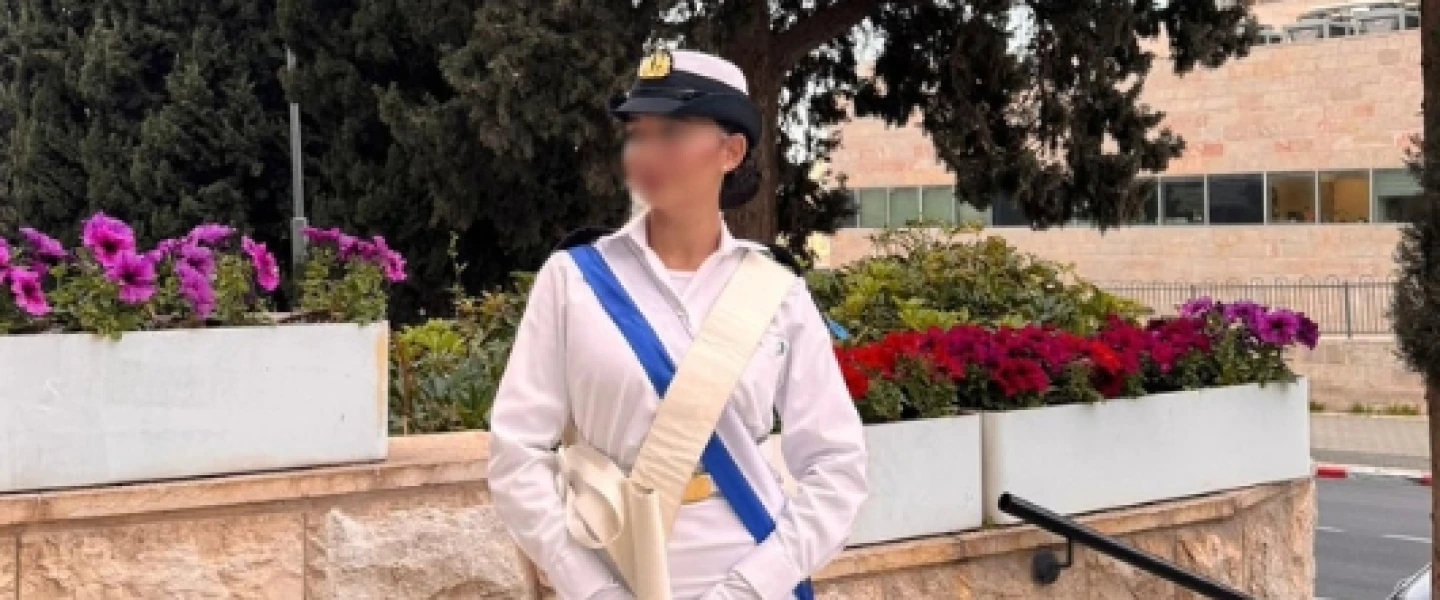
For one lone soldier identified for security reasons as O, the dream began years ago while watching Israel’s Independence Day ceremony from abroad, where her diplomat parents were posted.
“I always watched the ceremony even when I lived abroad,” said O., who now serves in the IDF’s Behavioral Sciences Unit. “I would sit with my grandparents. It was their favorite part of the year. I said, I’m going to be there one day, and my grandparents will be in the audience to watch me.”
This year, O. will join 80 soldiers—30 men and 50 women from various units of the Israel Defense Forces, alongside police officers and firefighters—in performing choreographed flag routines as part of the national ceremony. The performance will incorporate drone filming to capture overhead formations, continuing the longstanding tradition of flag-dancing, a uniquely Israeli expression of national culture.
Rooted in the early Zionist folk dance movement of the 20th century, flag choreography evolved into a hallmark of Independence Day celebrations, symbolizing unity, identity and pride in the Jewish state. Schools and youth groups rehearse for weeks leading up to ceremonies, creating an emotional connection between young Israelis and national traditions.
Because of the ongoing war, officials are still determining whether this year’s ceremony will be held live or broadcast as a prerecorded event. The traditional program includes musical performances, dance segments and ceremonial elements, with military flag-bearers opening the program and participating in the finale.
Unlike in the United States, where the American Flag Code prescribes strict guidelines for the display and handling of the Stars and Stripes, Israelis often interact with their national flag more informally. It is common to see Israeli flags worn as capes or draped over shoulders as expressions of affection and identification with the state.
For many Israelis, waving or dancing with the blue-and-white flag is a declaration of belonging and continuity. The practice can appear unusual to outsiders, but within Israel it reflects a blend of joy, memory and resilience that defines national holidays.
Four female soldier flag-bearers participating in this year’s ceremony all made aliyah as youth and now serve in significant roles in the IDF. Each successfully passed an open audition process that evaluated precision marching and coordination skills.

From the United States to Israel
For Lt. A., 20, who immigrated from New Jersey to Kfar Saba at age 12, adapting to Israeli culture required persistence.
“I was completely American,” she said. “When I got here, I spoke Hebrew like an 8-year-old. Getting up to speed took a lot of hard work. I had a tutor for Hebrew and my family helped.”
She said cultural differences were initially challenging.
“Israelis—compared to Americans—were loud and energetic,” she said. “They call their teachers by their first name. Eventually, I got used to it.”
Today, she works in the army as a social worker assisting fellow soldiers with job placement and housing support. After completing her service, she plans to study psychology.
“Joining the army taught me a lot about myself,” she said. “We learn what we are good at and how to improve ourselves. Doing this ceremony makes us very proud of our country and of the army. Especially now, it’s important.”
Lt. V., a naval officer who moved to Israel from Rockville, Md., at age six, said adjusting to Israeli culture took time.
“I was young, but it was kind of difficult to absorb the culture,” she said, recalling that she did not speak for six months after arriving.
She later embraced Israeli society’s openness and independence.
“Israelis are warm and loving people—very outgoing—and there is a lot of independence for kids,” she said.
Despite severe food allergies that initially complicated her enlistment process, she persisted until she was accepted into military service and eventually became a war room officer in the Navy. She now serves as a commander in the naval officers’ training course and plans to study law after completing her service.
“I watched these ceremonies as a little kid, and I loved the military part,” she said. “People in the audience were cheering. I can’t wait.”
Lt. O., who immigrated at age 16, said she pursued command training immediately after basic training and now trains new recruits.
“They come in on the first day as choppy, normal teenagers,” she said. “They leave as great soldiers.”
She said her experience as a lone soldier shaped her leadership approach.
“When I drafted, I drafted as a lone soldier. I felt my commanders didn’t see me at all,” she said. “I took it as a lesson and pledged to be an excellent commander.”
After completing her military service, she hopes to study business management and possibly follow in her parents’ diplomatic footsteps. For now, she is focused on rehearsals for the ceremony she has envisioned for years.
“I was so excited when they announced the auditions,” she said. “When I told my grandfather that I would be part of the ceremony, he had tears in his eyes.”