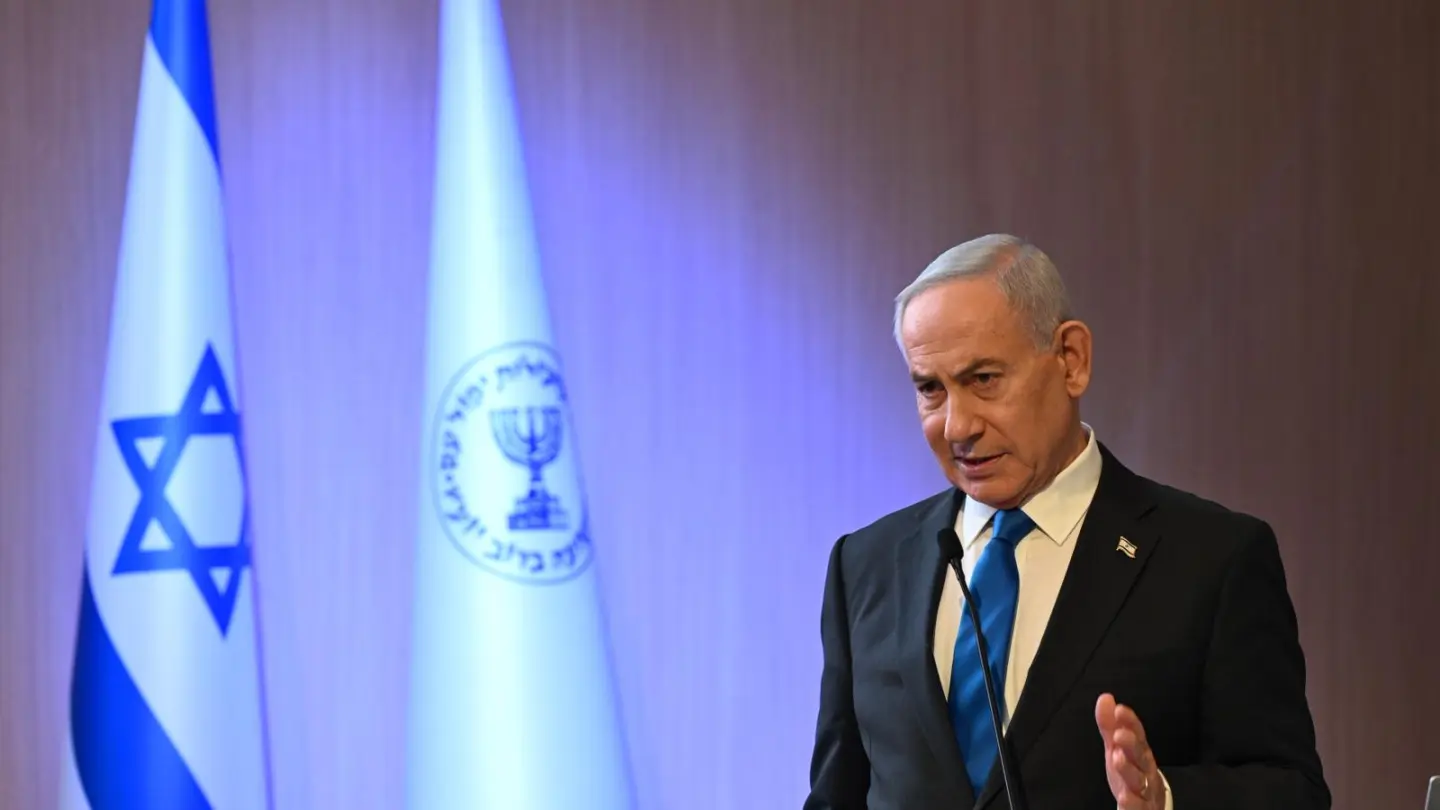
Israeli Prime Minister Benjamin Netanyahu proposed a “hexagon” of alliances in a government meeting on Feb. 22 to confront two regional threats: the “radical Shia axis” and the “emerging radical Sunni axis.” The radical Shia axis refers to Iran’s “Axis of Resistance,” while the emerging Sunni axis centers on Turkey and Qatar.
The ongoing coordinated U.S.-Israeli military campaign against the Iranian regime, known as “Operation Epic Fury,” has been followed by Iranian missile and drone strikes extending beyond Israel’s borders. Attacks affecting Cyprus and Gulf states, such as Bahrain and the United Arab Emirates, underscore how confrontation with Tehran’s axis powers reverberates across the region, reinforcing the logic of broader security coordination.
The partners referenced in the hexagon represent six geographic vectors: India, Arab nations, African nations, Asian nations, and the Mediterranean partners of Greece and Cyprus.
Ongoing diplomatic efforts, such as Israel’s recent recognition of Somaliland, offer insight into how this framework may expand. The move drew sharp criticism from Turkish President Recep Tayyip Erdoğan, who labeled it “illegal and unacceptable,” highlighting Ankara’s unease with Israel’s engagement in the Horn of Africa.
Netanyahu’s remarks came just days before Indian Prime Minister Narendra Modi’s Feb. 25 visit to Israel. Beyond security and economic cooperation, the Israeli premier emphasized expanding collaboration in artificial intelligence and quantum computing, signaling that the hexagon extends beyond traditional military alignment into long-term technological integration.
To understand the logic of the proposed hexagon strategy, it is necessary to examine the structure and tactics of the two axes it seeks to counter.
Iran’s Axis of Resistance encompasses a network of both Shi’ite and Sunni terrorist organizations, including Hezbollah, Hamas and the Houthis. Its doctrine of “unity of fronts” envisions coordinated multi-theater pressure against Israel and U.S. interests. By relying on proxy forces, Tehran projects influence across Lebanon, Syria, Iraq and Yemen while minimizing the risks of direct confrontation.
The implementation of this doctrine has been visible since the Hamas-led terrorist attacks in southern Israel on Oct. 7, 2023, after which Israel faced hostilities across multiple fronts. Yet the limited escalation by Hezbollah in Lebanon to the north and other Iranian-backed groups following Hamas’s Oct. 7 invasion also revealed the constraints of this model. A document recovered by members of the Israel Defense Forces and attributed to former Hamas senior leader Yahya Sinwar suggested that the attack was intended to trigger Hezbollah’s full-scale entry into the war and cause unrest among Israel’s Arab population, a scenario that did not fully materialize.
While the Axis of Resistance remains active, key elements of its proxy network have been significantly degraded, including the collapse of the Bashar Assad regime in Syria in late 2024 and the elimination of key members of Hezbollah’s chain of command. These losses have exposed the limits of Iran’s doctrine of coordinated escalation.
The death of Iran’s Supreme Leader Ayatollah Ali Khamenei on Feb. 28, following joint U.S. and Israeli airstrikes on Tehran, marks a profound disruption to the ideological center of the Axis of Resistance.
Alongside Iran’s axis stands a different challenge: the emerging Sunni Islamist axis led by Turkey and Qatar. Unlike Iran’s network of proxies, this axis does not function as a unified military bloc. Instead, it operates through layered political, ideological and institutional networks.
Turkey has expanded its military footprint in northern Syria, deploying advanced radar systems, in addition to planning ground and air bases. At the same time, Ankara has positioned itself as a political patron of Muslim Brotherhood-aligned actors and has hosted senior Hamas officials. Qatar leverages its financial resources and diplomatic platforms to sustain Hamas governance in Gaza and amplify Islamist narratives through global media networks.
Both state actors project influence by bankrolling and providing political space for Muslim Brotherhood-affiliated institutions, including the International Union of Muslim Scholars and Yemen’s Al-Islah Party. Through their ties to Hamas and support for Muslim Brotherhood-affiliated institutions, Turkey and Qatar extend their influence beyond the Middle East, linking them to a wider transnational ecosystem of NGOs, advocacy groups and religious networks aligned with Islamist political movements.
A report by Israel’s Ministry for Diaspora Affairs alleged that this network has participated in coordinated campaigns to delegitimize Israel and amplify antisemitic rhetoric.
If Iran’s Axis of Resistance seeks to pressure Israel through geographic encirclement and proxy warfare, the hexagon seeks to reverse that geometry. By deepening relationships with Mediterranean partners, Arab states, African governments and India, Jerusalem can expand its strategic depth beyond its immediate borders. A coordinated multifront campaign becomes harder to sustain when Israel is integrated into broader security and intelligence frameworks.
The practical value of this framework lies in the distinct contributions of each vector.
Cooperation with India strengthens defense production and maritime security. Partnerships with nearby Greece and Cyprus reinforce joint exercises, intelligence-sharing and maritime coordination in the Eastern Mediterranean. Expanding ties in Africa, particularly with Somaliland, strengthen Israel’s position along critical Red Sea corridors near the Bab al-Mandab Strait.
Deepening relations with Arab states builds on normalization agreements and enables air- and missile-defense coordination, while engagement with Asian partners diversifies trade routes and strengthens economic resilience.
Countering the Sunni and Shia axes also requires cooperation on the narrative front. Nikita Bier, head of product at X, stated on Feb. 28 that the platform was filtering a wave of Iranian bots, highlighting how digital influence operations now operate alongside military confrontation and reinforcing the need for coordinated strategic communication among hexagon partners.
The hexagon functions as a reciprocal framework in which shared security and technological advantages reinforce collective stability and reduce reliance on reactive, front-by-front responses.
Ultimately, the hexagon reflects recognition that Israel and its allies face networked threats operating across borders, institutions and narratives. By building a counter-network anchored in security cooperation and technological coordination, Israel increases deterrence while reducing isolation. Although the framework is evolving, the strategy signals a shift from reactive defense toward long-term strategic depth.