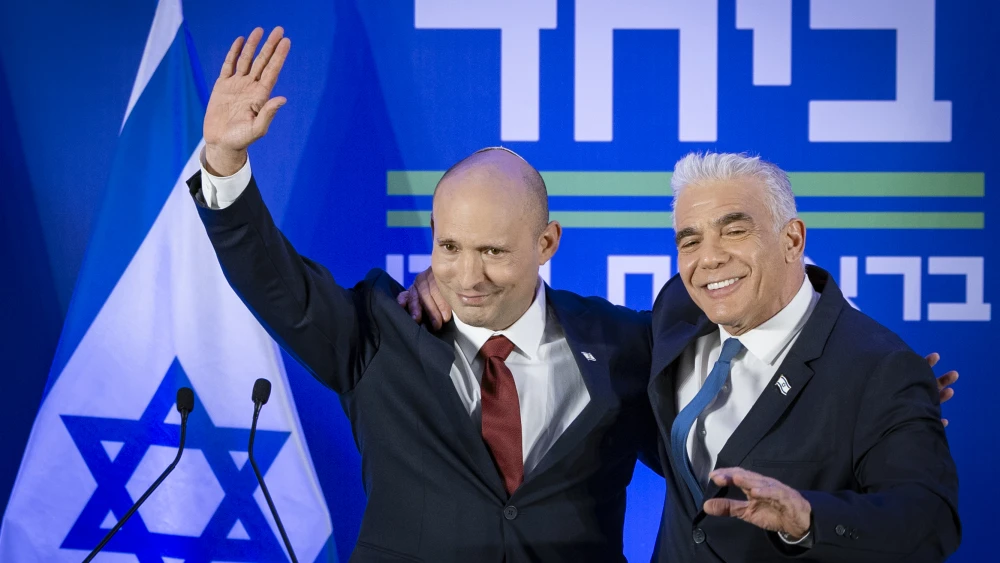

In an attempt to repackage their “anybody but Bibi” brand, Naftali Bennett and opposition leader Yair Lapid—rotating heads of the previous government—have joined forces once again. This time, their ploy is an actual merger of their parties, Bennett’s newfangled eponymous entity and Lapid’s Yesh Atid.
The name of this more comical than unholy alliance is “Together.” To be more precise, it’s called “Together, Led by Bennett.” You know, just to make the hierarchy clear and establish from the outset who’s the boss.
Pretty ironic for an entity whose banner is “unity.” But there’s method to the madness of making Bennett the face of the bloc whose main aim is to oust Prime Minister Benjamin Netanyahu at the ballot box.
Lapid is labeled as a “centrist,” yet he’s really to the left of the Israeli populace. Bennett used to be on the right side of the spectrum and hopes his reputation as such will attract disgruntled conservatives in search of an alternative to the current coalition.
“Unity” has nothing to do with it—other than a shared aversion to nemesis Netanyahu, that is. Oh, and wishful thinking about the nature and direction of the electorate.
“Lapid and I have different opinions on a range of issues, and we’re not hiding that,” Bennett said at the press conference held to announce the fusion. “On the contrary, we’re proud of it. I’m proud of the fact that two leaders with different opinions can fight together for the good of the people of Israel, just as our soldiers fight shoulder-to-shoulder.”
Never mind the disingenuous comparison; what’s a poor metaphor among friends?
The point, he said, is that “our unity is a message to the entire nation. This is the end of the era of division; the era of mending is upon us.”
This is ridiculous on so many levels that it’s hard to know where to start. In the first place, judging by Bennett’s recent policy pronouncements, the ostensible gulf between him and Lapid has all but evaporated.
Secondly, Israelis with contradictory views on crucial matters are never going to cease battling one another ideologically, and no constellation of musical chairs in the Knesset is going to alter that reality.
Contention isn’t a bug in Israel. It’s the operating system. The same has been true of Jews since time immemorial. And false nostalgia about imagined harmonious periods is the stuff of short memories.
Indeed, the idea of a “big tent” or an all-inclusive “umbrella” is a sham. Bennett and Lapid aren’t merely kidding themselves if they imagine an Israel in which different groups aren’t taking to the streets to decry policies they abhor; they’re underestimating the intelligence of the very people they want to woo.
They must be aware that the “unity” they’re plugging is really a vague concept of coexistence cloaked in a campaign logo. True unity exists only in narrow, clearly defined circumstances, such as during wartime or national tragedies, or around foundational principles that command near-universal consensus.
Even then, it’s fragile and often fleeting, as was the case when hostages remained in Gaza. Outside of those moments, what passes for unity is usually just a temporary alignment of interests.
Speaking of which, it’s a “temporary alignment of interests” that’s responsible for the “Together” Party. Bennett is in debt to the tune of some 20 million shekels (approx. $6,800,000), accumulated from his previous parties that failed to get re-elected to parliament.
Lapid, with 25 seats in the current Knesset, can reimburse the public coffers for him, in exchange for a life jacket to keep him from dropping below the threshold in the upcoming election—which polls indicate is a possibility.
The flip side of this manufactured cohesion is the bogeyman of “polarization.” We’re told, ad nauseam, that Israeli society is fractured—as though this diagnosis describes a deadly disease rather than a persistent condition.
Israel is a patchwork of identities, with a culture that prizes fierce debate, mulish stubbornness and a whole lot of chutzpah. It’s a pluralistic mosaic marked by passion born of high stakes. That’s not a flaw to be corrected; it’s a given.