


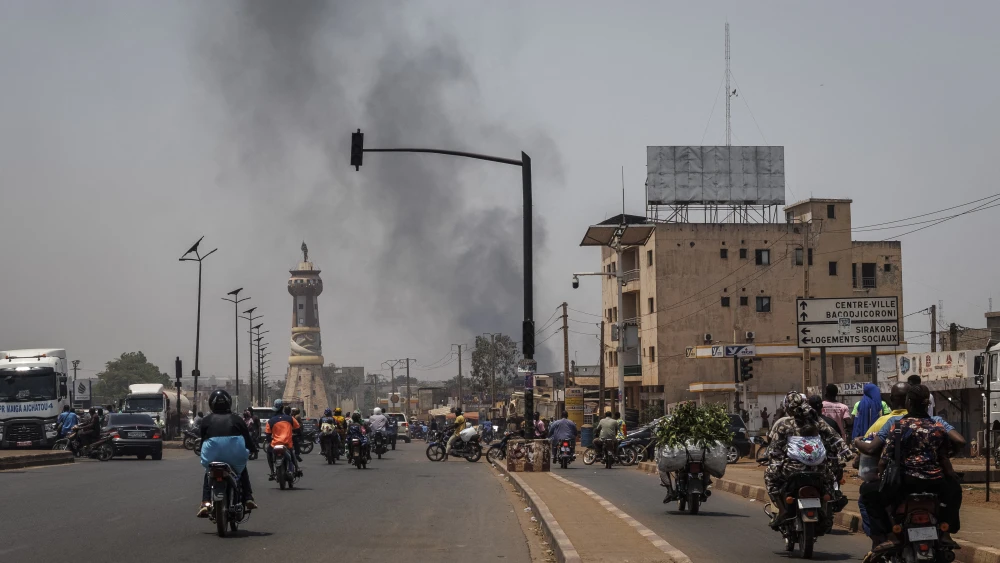

The government of Mali was overthrown last week by ISIS, working in cooperation with local groups. The context is a bit of a winding road.
The story should begin with hundreds of years of French, British, Belgian, Portuguese and other colonialism in Africa—trading slaves, stealing resources, imposing their will. But, for the sake of brevity, go to 2011.
That year, then-President Barack Obama bombed Libya (without congressional approval, by the way), resulting in the demise of Muammar Gaddafi at the hands of a mob and the release of vast stockpiles of weapons. MANPADS, missiles, explosives and more spread across North Africa and the Middle East. ISIS was a beneficiary, along with Al-Qaeda and local rebel groups.
France, the former colonial power, had sent troops to Mali in 2013 for “security operations.” But relations between France and its former colony did not run smoothly, and there was a strong element of anti-French sentiment among the people and the military.
After a military coup in 2021, French President Emmanuel Macron announced the withdrawal of French forces, noting that the troops would remain in the region. Less than a year later, France announced that the 2013 mission would be “reformulated.” (Read: “abandoned.”)
Russia’s Africa Corps (formerly Wagner) entered the picture and remained until last weekend. After the coup and the apparent killing of the Malian defense minister, the Russians announced their departure.
The unraveling is important. First, because ISIS and its allies will now rule an African country. Second, Mali is not the only country under siege. Third, the West (and Russia: see Afghanistan) has again failed to understand the threat, and when Western governments run out of steam, they simply leave the wreckage behind. And fourth, the same faulty logic applied to Mali and Niger (below) is being applied to Israel’s war against Hamas and Hezbollah.
In 2023, there was a coup in Niger, a country USAFRICOM had worked to secure. America had no colonial history there, and relations were good.
The coup reflected the belief of the military government that the United States and its allies were not securing the country. The U.S. response did not address that issue. U.N. deputy ambassador Robert Wood said, “The United States remains gravely concerned by democratic backsliding across the region” and is “deeply concerned by the spread of instability in coastal West Africa.”
Coastal West Africa was not “backsliding.” It was never a secure, democratic region. Between 2013 and 2023, there were 15 coups and 33 attempted coups—some countries experienced multiple coups, including Niger, which had three coups and an attempted one.
According to the U.S. National Counterterrorism Center, the military junta was right to be concerned: ISIS-West Africa controls broad swaths of territory … (It) rejects national borders and seeks to discredit regional governments and eventually replace them with an ISIS-style state … (promoting) sectarian violence and (exploiting) poor economic conditions and social divisions to attract members.
ISIS long ago declared war—military war—on the region. The Western response has been “democracy” and foreign aid. This is not an effective counterterrorism strategy, and without military success, the civilian issues will fester.
This is not, strictly speaking, an “American problem” to solve. The United States left Niger in 2024.
What about Israel?
Attacked for years by similarly radical forces, Israel had taken the methods advocated by France and the United States—work to improve life for civilians, press for democratic advancement, respond militarily to attacks—but not too much. Israel called it “mowing the grass.”
Food, electricity, gas, water, work permits inside Israel, access to Israeli medical care and more were initiated by Israeli governments, left and right. The hope/assumption that the “civilians” could be separated from the “terrorists” and eventually move toward “peace.”
Until Oct. 7, 2023.
The Israeli government determined that there had to be an end to the military and governing capabilities of Hamas and Hezbollah. The response of Macron, former President Joe Biden, British Prime Minister Keir Starmer and other Western leaders was: “Go for a ceasefire. Don’t kill more people. There is no military solution.”
When Donald Trump was re-elected president for a second term, he moved in on Israel’s side and took on Iran, the patron of all the others.
The final chapter has not been written. War is ugly and deadly, and requires patience on the home front. Jerusalem and Washington are facing down terrorists with no moral principles, but also European and other countries that have not yet come to grips with reality.
Appeasement is over. Mali is over.
Israel and America are fighting back.



