Newsletter
Newsletter Support JNS

Orit Arfa

Orit Arfa is an author and journalist based in Berlin. Her first of two novels, The Settler, follows the aftermath of the 2005 withdrawal from Gaza. Her work can be found at: www.oritarfa.net.

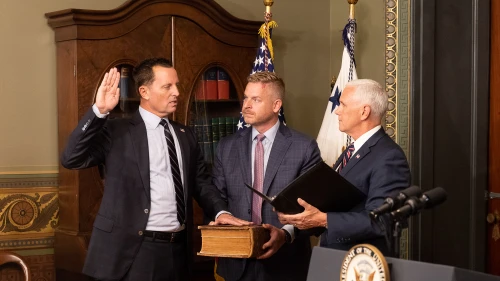
“The Bible talks about: To whom much is given, much is required. And I feel that pressure. You just really concentrate on what you have to do … and there’s a lot to do,” says U.S. Ambassador to Germany Richard Grenell one year after starting his position.
A course designed for high school teachers on the Israeli-Arab conflict now offers a better range of opinions after an immediate outcry that it was biased.
Jewish media, Israeli politicians and community leaders paint a picture of a France where Jews feel unsafe and leaving in droves. Does a selection of Jewish residents think similarly?
Germany’s Free Democrats’ attempt to curb anti-Israel voting patterns fail in the Bundestag, but does it reflect the true opinions of parliament members, and will the right-wing party’s positive support of Israel change the Jewish community’s attitudes towards it?
What explains Germany’s inconsistent efforts in rooting out terrorists from its midst?
A 34-page January 2019 report detailed the personnel and activities of 10 BDS-affiliated organizations that collectively received about 5 million euros from the European Union in some form in the last year.
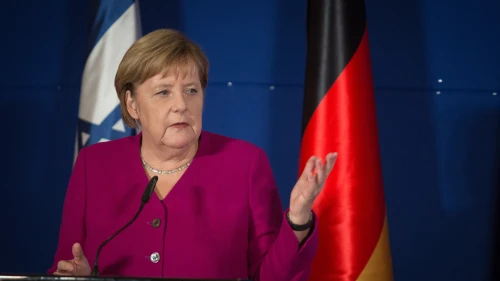
On the heels of several polls alerting to an alarming rise in anti-Semitism, German Chancellor Angela Merkel led the signing of a compact to facilitate migration to Europe. But what does it mean for a European Jewish population that already feels vulnerable?
“Anti-Semitism and anti-Zionism are getting blurred, but they are two sides of the same coin,” said the Austrian leader, noting his country’s laden past regarding European Jewry. “We can’t undo history, but we can do justice to our history.”
Angela Merkel lost her mandate as the party’s leader, in large part due to handling of the refugee crisis, and will not seek the chairmanship at the party’s conference in December.
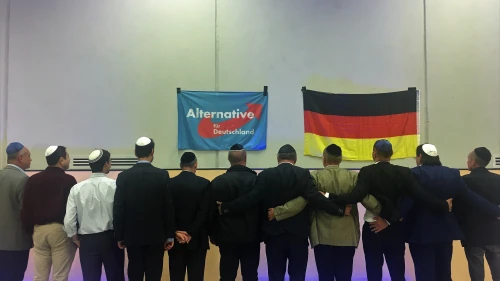
Since its founding in 2013 as a Euro-skeptic party, the AfD has been criticized by the mainstream German Jewish community over concerns of its views on Muslim migrants and country’s Nazi past. Yet Jewish supporters see the opposite. “I prefer to be part of a party that wants to help living Jews, not dead Jews,” said one Jewish supporter.
U.S. Ambassador to Germany Richard Grenell, who is rumored to be one of the candidates to succeed Nikki Haley at the United Nations, himself has traveled to Israel more times than he can count and calls Jerusalem “one of the most fascinating cities in the world.”
Falafel is supposed to represent a universal symbol of peace—the oily bond between Muslims and Jews, even as the Middle East fries in violence. But in Berlin, it has become a cause for concern.