


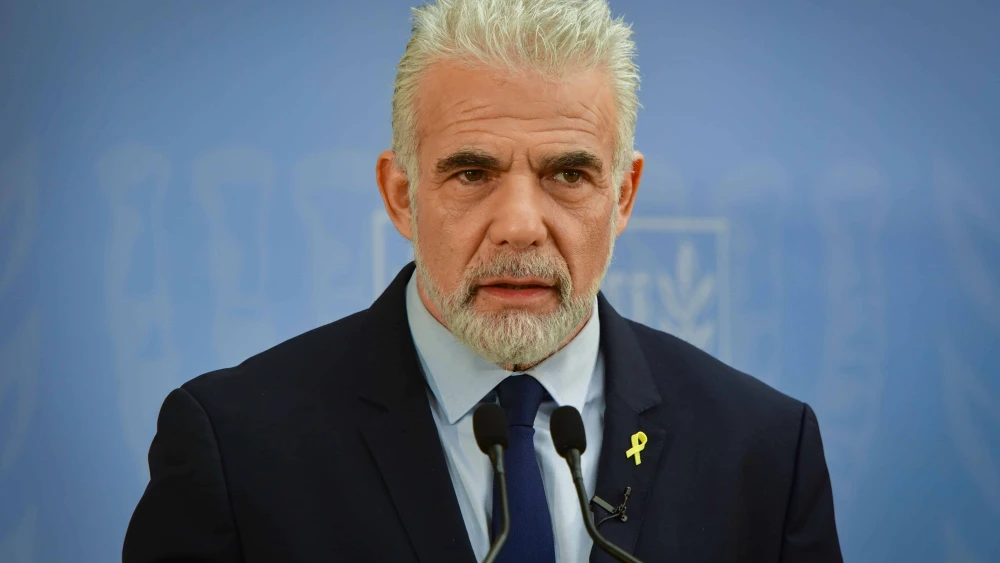
Yesh Atid will cease its participation in the World Zionist Organization’s power-sharing agreement over “corruption,” the party’s leader Yair Lapid said on Wednesday.
“We won’t be there,” Lapid, who is also head of the Israeli opposition, said of World Zionist Congress’s power-sharing agreement. The WZC has convened in Jerusalem to vote on the budget and nominations of the World Zionist Organization (WZO).
“I call on all other parties to consider being a part of the agreement, which is simply an affair of corruption and lowly political horse trading,” Lapid wrote on X.
Yesh Atid will remain in the World Zionist Congress but not participate in deals on how it is run, he said. The announcement likely means the nullification of agreements made between the parties ahead of a final vote, which was scheduled to take place next week.
We “will not be party to any agreement in the Zionist institutions. We will not take budgets, we will not take executive positions, and we will not be part of the deal being put together there,” Lapid said in a statement.
In 2021, Lapid’s sister-in-law Keren Eileil was appointed to a post on the board of directors of the Jewish National Fund (JNF-KKL), which is a subsidiary of the World Zionist Organization. Eileil quit the post following scrutiny and an outcry.
Israel, the United States and the rest of the Diaspora have roughly equal shares of the 525 delegates in the World Zionist Congress. The makeup of the Israeli contingent reflects the results of the country’s latest general election.
Last month, voting was halted at the World Zionist Congress, which is the legislative arm of the 128-year-old World Zionist Organization. Yesh Atid and other parties halted the voting on budget allocation and nominations following Likud’s bid to appoint Yair Netanyahu, the son of Israel’s prime minister, as the head of the WZO’s Information Department.
The nomination was withdrawn and voting resumed this month, including on the allocation of roughly $61 million toward strengthening Jewish presence in Judea and Samaria—a cause opposed by Lapid’s party and the left in Israel and the Jewish world.
The WZO was founded in 1897 by Theodor Herzl. It laid the groundwork for many of Israel’s modern institutions and today acts as a major vehicle through which Jewish communities around the world, including in Israel, can participate in shaping Zionist policy, funding and programs.
The World Zionist Congress in the executive decision-making body of the WZO, convened in Jerusalem every five years and often described as the “parliament of the Jewish people.”
The WZO allocates about $1 billion in annual funding, and the WZC sets priorities for the organization as well as linked institutions that, together with WZO, are known as the National Institutions of the Jewish People: The Jewish Agency for Israel, the Jewish National Fund (JNF-KKL) and Keren Hayesod–United Israel Appeal (KH/UIA).


