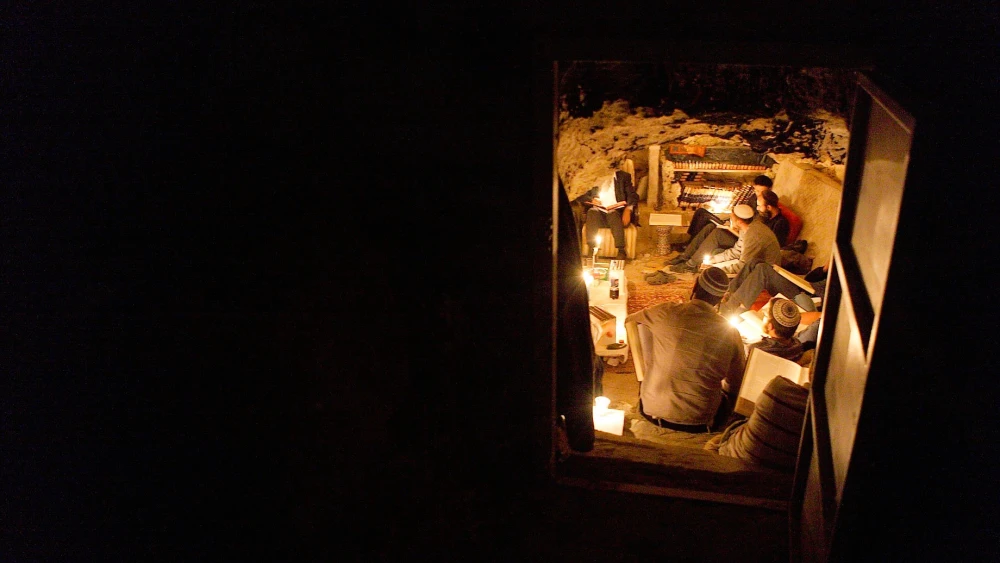

“Hey, why is the rabbi teaching Kabbalah? Isn’t it forbidden?”
Over the years, I have taught many classes on Jewish mysticism, often through the prism of Chabad Chassidic philosophy. But if I used the word “Kabbalah” in the advertising, I received the above question on more than one occasion.
A long time ago, I gave a lecture called “Why is Madonna Studying Kabbalah?” In traditional Jewish fashion, I was trying to answer one question with another.
Remember Golda Meir’s answer when she was once asked, “Why do Jews always answer a question with a question? She replied, “Why not?”
Lag B’Omer is celebrated this week. Literally, it means the 33rd day of counting the Omer, but it recalls the cessation of a plague that took the lives of some 24,000 students of the legendary Rabbi Akiva. It also commemorates the yahrzeit of one of his most famous surviving students: Rabbi Shimon Bar Yochai.
The custom of Lag B’Omer bonfires is mainly attributed to the circumstances surrounding Rabbi Shimon’s passing. His house was filled with a fiery light from the deep secrets of Kabbalah that he was sharing with his disciples as his final teachings in this earthly world. No wonder that he is known as the father of Kabbalah.
And, although this is argued by certain scholars, the traditionally accepted view is that he was the author of the Zohar, the bible of Kabbalah.
So, let me try to answer the question of why rabbis like me may be teaching Kabbalah, seeing that historically, one was supposed to be over 40 years old and learned in classic Torah before being allowed to embark on mystical studies.
Firstly, I am not revealing any “state secrets.” My classes are more of an introduction to Jewish mysticism, and I share basic information and insights that every Jew should know. So many people out there today, especially young people, are searching for spirituality.
How many millions of Jews have disengaged with their Jewish birthright and heritage because it didn’t do anything for them, complaining that they weren’t stimulated by dry, lifeless teachings devoid of spiritual meaning or deeper content? How many tens of thousands of young Israelis and others have we lost because they embraced the religions of the Far East when they discovered some spirituality for the very first time in their lives? Do you have any idea how many Jewish Buddhists there are because of this problem?
Chanting the bar mitzvah trop at 13 isn’t exactly a motivating, inspirational experience. The tedious repetition of words that to a boy can be meaningless, I often equated with yada yada yada, blah blah blah.
(Actually, one of my pet peeves is that boys are taught to chant their Haftorah without being taught what it’s all about. It might contain some of the most amazing e stories in the Tanach, but they are pitifully oblivious.)
Many of those who would teach Kabbalah to people like Madonna are dubious at best and dangerous at worst. But do I blame the singer for seeking it? Not at all.
Yes, it does seem rather bizarre and absurd for the “Diva of Decadence” to be a seeker of spirituality, but any thinking human being should want to search beneath the material superficiality of this world to discover truth, depth and authenticity.
There is the Talmudic story (Chagigah 14b) of four famous sages who “entered the orchard,” meaning they were holy enough to perceive the secret chambers of spirituality in the world beyond. They were Rabbi Akiva, Elisha ben Avuya, Simeon Ben Zoma and Simeon Ben Azzai. In the words of the Talmud, “Ben Azzai gazed and died. Ben Zoma gazed and went mad. Elisha lost his faith. Only Rabbi Akiva entered in peace and came out in peace.”
Too much revelation may be dangerous. But none at all can be devastating, too.
With no deeper insight to the spirituality of Judaism, we will continue to lose adherents to our faith. If our young people find nothing spiritual in their synagogues and temples, if all they see is empty, hollow, repetitious ritual devoid of depth or any inner meaning, can we blame them for becoming Buddhists?
There is a very real thirst and deep-rooted desire for truth, authenticity and something spiritually meaningful. Life has to be more than steak and fries, a good round of golf, or beautifully coiffed hair and nails. Money and material comforts make it easier to live, but they don’t tell us how to live or why we are here in the first place.
Many years ago, an old, European rabbi came to America for the first time. His family took him to the Empire State Building in New York City, all the way to the Observation Deck on the 104th floor, where the cars and the people on the sidewalk look like ants. Afterward, they asked him to share his impressions of the Big Apple. They were certain that coming from a little shtetl, he would be quite overwhelmed.
This was his reply.
“Yes, it was very impressive indeed. But do you know what I learned from this experience? I learned that if we pick ourselves up a little bit, we can see how small the world really is.”
A touch of spirituality from the right sources can raise us up and help us discover how much more there is to life as we know it.