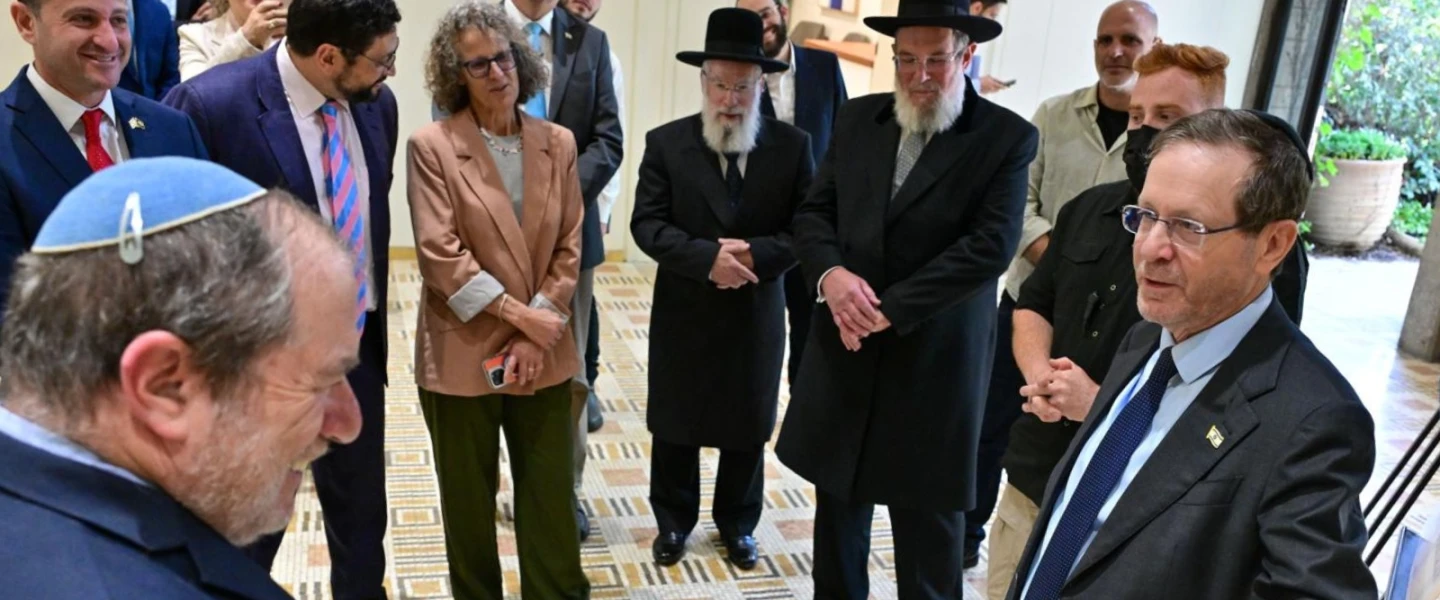
An exhibition launched Sunday at the President’s Residence in Jerusalem is shedding new light on a little-known dimension of Israel–U.S. relations: a century of faith-based diplomacy led by Israel’s chief rabbis.
The display, produced by the Jerusalem Center for Applied Policy and inaugurated alongside President Isaac Herzog, marks 100 years of engagement between Israel’s Chief Rabbinate and the White House. It also coincides with the United States’ 250th anniversary.
Drawing on recently uncovered materials from U.S. presidential archives, the exhibition presents letters, photographs and historical records—many displayed publicly for the first time—documenting interactions between leading rabbinic figures and American presidents from 1924 to 1992.

Among the most notable items is a 1947 letter sent to President Harry S. Truman from the office of then-Chief Rabbi Isaac Halevi Herzog, grandfather of Israel’s current president. The letter references a telegram expressing appreciation for Truman’s efforts on behalf of the Jewish people, offering new insight into the critical days preceding the United Nations Partition Plan for Palestine and the path toward international recognition of the State of Israel.
Another highlight is a handwritten letter dated April 23, 1941, in which Chief Rabbi Herzog sought to engage President Franklin D. Roosevelt to aid European Jewry during the Holocaust. In it, he expressed his wish to convey the “Blessing of Zion” to the American leader on behalf of the Jewish people.
Herzog wrote: “I came over here on a religious mission at the end of January and am due to return, P.G., on May 14th. Before my departure for the Holy Land, I should very much like to impart the Blessing of Zion to the supreme head of this great and noble land,” adding that he wished to do so on behalf of the Jewish community in the land of the fathers and prophets and the Jewish people as a whole.

A telegram was later received inviting the rabbi to visit the president at the White House. On Feb. 2, 1944, Rabbi Herzog sent the U.S. president a telegram in which he wrote, among other things: “From Jerusalem, the city of God, and from within it, all the people of Israel together with lovers of humanity bless you and the American nation on the establishment of the rescue committee [the War Refugee Board] for the struggling survivors, the shattered remnants of European Jewry.”
The exhibition also traces earlier and later milestones, including a photograph from Chief Rabbi Abraham Isaac Kook’s 1924 visit to the United States, and documentation of Chief Rabbi Avraham Shapira’s 1992 meeting with President George H. W. Bush at the White House.
The materials were collected as part of an extensive research initiative, which organizers describe as an “almost unknown historical continuum” of sustained diplomatic engagement by Israel’s Chief Rabbinate with U.S. administrations over decades.
Longstanding ties
The exhibition was inaugurated in the presence of senior Israeli officials, religious leaders and diplomats, including Israel’s Chief Rabbi Kalman Meir Ber and U.S. Deputy Chief of Mission to Israel David Brownstein.
Chaim Silberstein, the founder and chairman of JCAP, said the items on exhibition challenge common assumptions about the origins of the U.S.–Israel partnership. According to Silberstein, 2024 marked the 100th anniversary of the White House meeting between President Calvin Coolidge and Rabbi Abraham Isaac Kook, who was the chief rabbi of British Mandatory Palestine.
“The materials reveal that the partnership between Israel and the United States is not a recent phenomenon,” Silberstein said. “The United States has long been a partner in pivotal moments in the history of Zionism, and the contribution of Israel’s chief rabbis—particularly in shaping relations with U.S. presidents—is clearly reflected.”
Project director Yair Dan said the research highlights the enduring respect shown toward the Chief Rabbinate within U.S. presidential institutions.
Brownstein described the event as a celebration of “deep spiritual and historic ties” between the two nations, adding that the relationship goes beyond a traditional alliance.

“It has become an unprecedented friendship,” he said, expressing hope for continued cooperation in the next century.
Ber emphasized the broader significance of the exhibit, describing it as reflecting not only diplomatic encounters but a deeper historical process.
“The people of Israel are returning to their land, their homeland and their destiny—and the nations of the world are recognizing this,” he said.
In his remarks, President Herzog pointed to shared biblical values as a foundation of the relationship between the two countries.
“I believe that both peoples—in Israel and in the United States—draw from the same wellsprings: the wellsprings of the Bible,” he said.
The president also addressed reports from the United States regarding an attempted assassination attempt on U.S. President Donald Trump, expressing relief that Trump and those present were unharmed and offering prayers for their well-being.
“We are thankful that the law enforcement officer shot during the attack is safe and on the path of recovery,” Herzog said. “From the Holy Land, we pray for the safety and security of the United States of America and its leaders after this heinous attack.”
Herzog also shared personal historical details, including the role of Sidney Hillman, a senior Roosevelt administration official and relative of the Herzog family, in facilitating his grandfather’s 1941 White House meeting with Roosevelt.
Chief Rabbi Herzog was related to Hillman, having married Sarah Hillman, daughter of Rabbi Shmuel Yitzchak Hillman. Hillman leveraged his political access and personal ties to help secure the meeting, enabling Herzog to present urgent appeals on behalf of European Jewry during the Holocaust.
The exhibition is expected to travel to additional venues in Jerusalem and Washington in the coming months.