


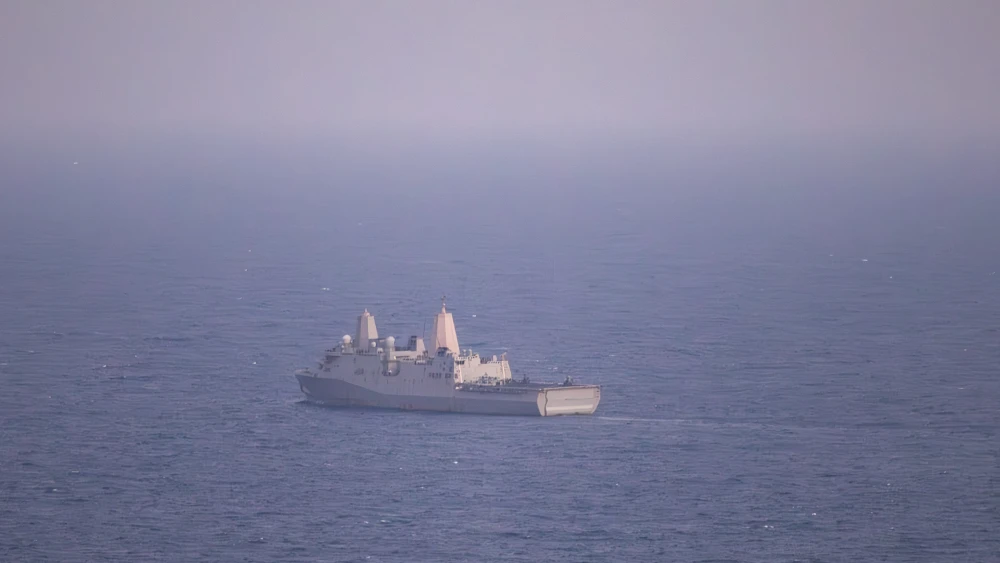
U.S. Central Command said early on Monday that it would begin supporting “Project Freedom” to ensure the free flow of commercial shipping through the Strait of Hormuz, a vital global trade route.
The operation, directed by U.S. President Donald Trump, aims to safeguard merchant vessels transiting the strait, through which U.S. Central Command (CENTCOM) noted that roughly a quarter of the world’s seaborne oil and significant volumes of fuel and fertilizer pass.
CENTCOM said the mission will include guided-missile destroyers, more than 100 aircraft, unmanned systems and about 15,000 personnel.
“Our support for this defensive mission is essential to regional security and the global economy as we also maintain the naval blockade,” said Adm. Brad Cooper, CENTCOM commander.
Trump said late on Sunday that countries whose ships are stuck in the strait have asked Washington to help them leave the restricted waterway, even though they are not involved in the ongoing Middle East conflict.
The United States has agreed to use its “best efforts” to guide those commercial vessels and their crews to safety as part of a new initiative he called Project Freedom, he added.
“For the good of Iran, the Middle East, and the United States, we have told these Countries that we will guide their Ships safely out of these restricted Waterways, so that they can freely and ably get on with their business. Again, these are Ships from areas of the World that are not in any way involved with that which is currently taking place in the Middle East. I have told my Representatives to inform them that we will use best efforts to get their Ships and Crews safely out of the Strait. In all cases, they said they will not be returning until the area becomes safe for navigation, and everything else,” Trump wrote on his Truth Social account.
Trump described the operation as a humanitarian gesture toward neutral countries and Iran, saying many vessels are running low on food and other necessities and will not return to the area until it is safe for navigation.
He added that U.S. representatives are having “very positive” talks with Iran that he believes could lead to broader progress, and warned that any interference with the ship movements “will, unfortunately, have to be dealt with forcefully.”
The deployment follows a State Department initiative, launched with the Defense Department, to boost coordination with international partners through a framework known as the Maritime Freedom Construct.
CENTCOM’s announcement comes amid tensions between the Iranian regime and the United States over the critical waterway, with an Iranian blockade of Hormuz resulting in a retaliatory U.S. blockade.
Iranian Foreign Ministry spokesman Esmaeil Baqaei said on Monday that the U.S. must scale back its demands on the Islamic Republic, warning that Washington “cannot use the language of threats and force against the Iranian nation.” He said “our priority is to end the war,” urged the “other side” to abandon “excessive demands,” and reiterated Tehran’s claim that it is the “guardian and protector” of the Strait of Hormuz.
He asserted in a briefing broadcast by state television and quoted by AFP that the strait was “secure and safe route” for global shipping before the war.
“The international community must hold the United States and the Zionist regime accountable for imposing insecurity on this waterway and for creating problems that are being felt across the world,” he added, referring to the State of Israel.
Iranian state media on Sunday quoted Islamic Revolutionary Guard spokesman Hossein Mohabi as saying that “in the unequal battle we are facing, Iran’s armed forces will be the final victors.”
Meanwhile, Likud lawmaker Tsega Melaku told JNS on Sunday that she believes that Trump “is completely serious about resuming hostilities, and as for Israel’s support for the matter, we simply have no other choice.” She added: “At the end of the day, the equation here is very clear: he needs Israel in this campaign just as much as Israel needs him.”
Jerusalem and Washington launched joint operations against the Iranian regime on Feb. 28, which ended with a ceasefire on April 8.
Israel has demonstrated it can wage a war against Iran on its own and will do so if necessary, Yisrael Beiteinu lawmaker Evgeny Sova told JNS on Monday.
“No one doubts that Israel can initiate—and even conclude—a campaign against Iran largely on its own, especially after a month and a half of joint fighting. But whether that is what will happen is a decision for the political leadership,” Sova said.
“With all due respect to President Trump, there are moments when we must act independently. Our partnership is fundamentally mutual, but in this situation Israel’s interest is to prevent Iran from resuming missile production, reopening storage facilities or deploying missiles—and certainly not to allow time for Iran to recover,” he continued.
Sova stressed that although Trump has said he does not require congressional approval to renew fighting, several legal experts argue that he does, complicating Israel’s ability to rely on U.S. support.
“We need to take this into account. We could find ourselves in a situation where we wait and wait, only for the Americans to say Congress will not grant approval,” Sova said.
“Israel must protect its interests, with all due respect to its partnership with the United States. Our objective is to bring down the regime and ensure it does not survive, because for them, survival is victory. Iran will seek revenge and may wait for a change of administration in the United States,” he continued.
“As long as this regime continues to threaten Israel, we will face repeated rounds of fighting. The worst-case scenario would be a war of attrition between Israel and Iran,” he added.
Sova emphasized the disparity in scale between the two countries, noting that the Islamic Republic has a population of 90 million and spans some 2 million square kilometers, while the Jewish state has about 10 million people and covers roughly 22,000 square kilometers. A war of attrition, he said, favors the larger country.
“If, as part of an agreement, enriched uranium is removed from Iran and a regional arrangement is reached, that would be positive. But if the situation remains frozen at the end of the fighting, with no agreement and no Iranian commitments, then the job is unfinished,” Sova said.
“It is up to us to bring about, by all available means, the fall of the regime—while taking into account the interests of the Americans as our partners,” he added.


