


Israeli Minister of Foreign Affairs Gideon Sa’ar hosted Serbian Foreign Minister Marko Đurić in Jerusalem on Tuesday for the first Israel-Serbia Strategic Dialogue, during which a free trade agreement was negotiated and a permanent economic mission to Belgrade was announced.
On Wednesday, the two leaders are expected to launch an Israel-Serbia Chamber of Commerce.
Sa’ar praised Đurić for his efforts to strengthen relations, noting that under Serbian President Aleksandar Vučić, Israel-Serbia relations have “entered a new phase.”
He also thanked Serbia for its steadfast support since the Hamas-led terrorist attacks in Israel on Oct. 7, 2023.
One of his ministry’s goals is the strengthening of ties with the Western Balkans, Sa’ar said: “Stability in the Western Balkans is of utmost importance.”
Sa’ar said that he and his Serbian counterpart spoke at length about Lebanon and the dangers posed by the Hezbollah terror state, an Iranian proxy “occupying Lebanon while trampling its sovereignty and harming its citizens.”
Hezbollah is attempting to undermine the ceasefire brokered by the United States, which went into effect on April 16, he said. The terror group wants to reassert its dominance over Lebanon—something Israel will not permit.
Honored to host my friend Serbia’s FM @markodjuric, with his distinguished delegation, in Jerusalem for the first Israel-Serbia Strategic Dialogue.
— Gideon Sa'ar | גדעון סער (@gidonsaar) April 28, 2026
We appreciate the steadfast support of Serbia under the leadership of President @avucic since Oct. 7th, 2023.
We’re negotiating a… pic.twitter.com/b6QTmUZ9Le
”Our objectives are clear: We won’t allow Hezbollah to realize its pre-war invasion plans, which they intended to carry out on the eve of this war, too,” he said, referring to Hezbollah’s goal of invading Israel from the north.
Israel intends to clear Southern Lebanon of any terror infrastructure, something the Lebanese Armed Forces said that it would do as part of its obligations under a November 2024 ceasefire, but which it failed to carry out, he added.
The ongoing direct talks between Israel and Lebanon—the first high-level negotiation between the countries in more than 30 years—may lead to a better, brighter future, he said. But for that future to be realized, Lebanon’s government must take “practical steps” to restore its sovereignty against “de facto Iranian control in its territory.”
Lebanon’s efforts so far have been partial and limited to open areas. Terror infrastructure remains intact on private property and in terrorist bunkers. Weapons are still being found within schools and hospitals.
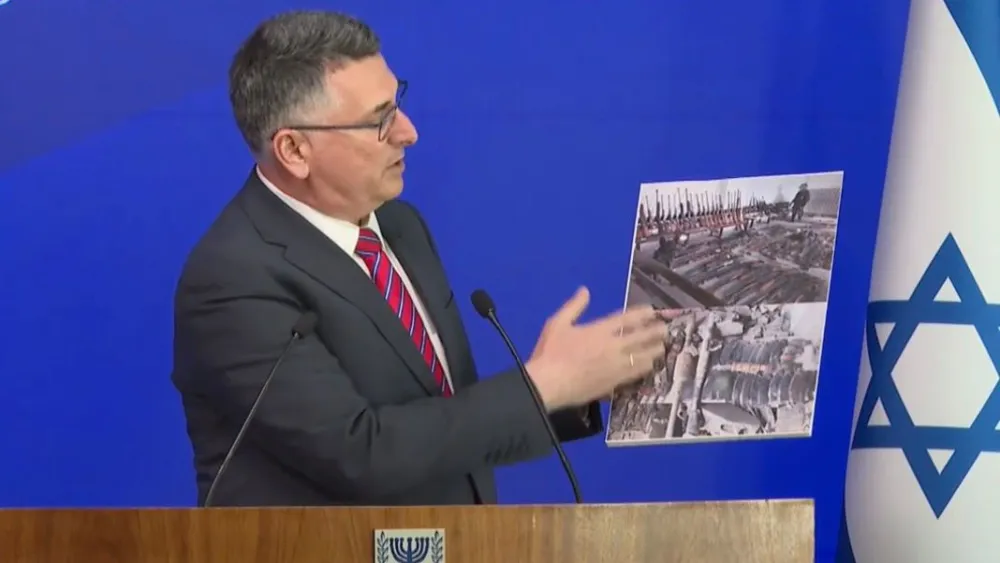
Sa’ar showed visual documentation of Hezbollah weaponry that the Israel Defense Forces discovered throughout Southern Lebanon. He held out the possibility that Israel won’t need to maintain a military presence in the area if the terror groups are dismantled.
However, he warned that Israel’s citizens would no longer tolerate terror groups on their borders, nor “murderous attacks and massacres like Oct. 7.”


