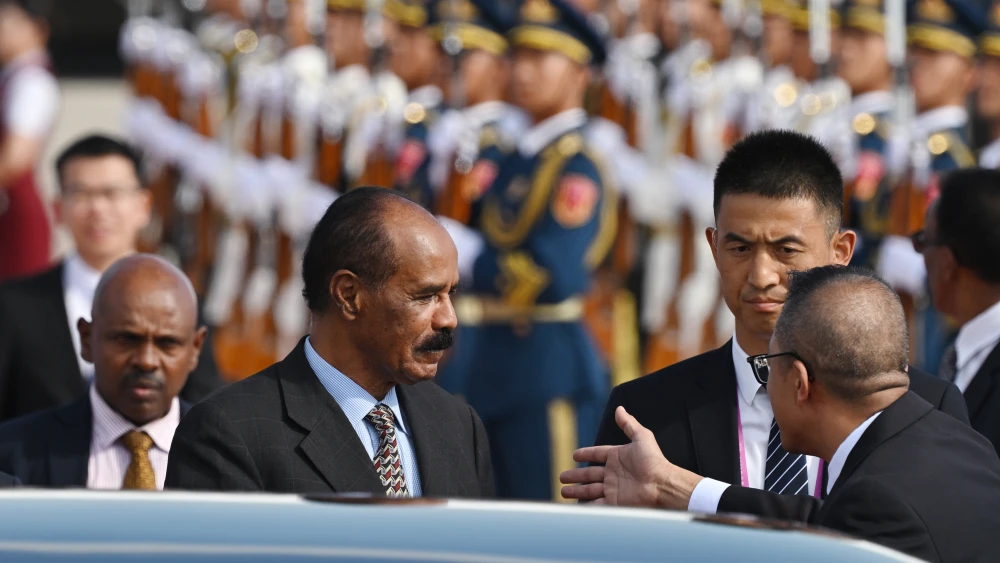

As Washington pushes to reset ties with the Eritrean dictator runs into a hard truth: Isaias Afwerki is a reliable partner of Iran in the Red Sea. Lifting sanctions would not moderate him; it would empower a hostile dictator, strengthen Iran’s position, and further undermine U.S. interests and regional stability.
Since Eritrea’s independence, the dictator has consistently acted in ways that undermine U.S. interests in the Horn of Africa and the Red Sea, fueling instability rather than contributing to regional peace.
This is not an inevitable trajectory, but a deliberate departure from the promise of U.S.-Eritrea relations in the post-independence period, which held potential for cooperation and strategic alignment.
The United States was not an adversary of Eritrean independence. Under the George H. W. Bush and Bill Clinton administrations, Washington shifted from Cold War caution to pragmatic support, helping legitimize Eritrea’s independence through diplomacy and international recognition once it became a political and military reality. In its early years, Eritrea stood as a potential partner in a strategically vital Red Sea corridor.
Yet rather than build on this foundation, Afwerki has chosen a path of sustained hostility. In public remarks, he repeatedly attacks the United States, accusing it of pursuing a “single-minded pursuit of domination.”
This is not rhetorical excess, but a consistent worldview that rejects U.S. leadership and aligns with its rivals. He praises China and Russia as counterweights to American influence, while aligning with Iran, the Houthis, Al-Shabaab and Islamist actors in Sudan.
Under the dictator, Eritrea is often referred to as the “North Korea of Africa.” He has turned the country into one vast open-air prison. Eritreans face arbitrary detention, extrajudicial killings and enforced disappearances, while indefinite national service is widely described as forced labor. Daily life is defined by severe restrictions and a collapse of basic infrastructure, with no access to reliable internet, electricity or water.
The dictator’s external behavior is marked by efforts to destabilize his neighborhood. In Somalia, he supported Al-Shabaab against the American- and internationally backed transitional government, contributing to U.N. sanctions imposed in 2009. He continues to back Al-Shabaab while threatening Somaliland’s autonomy. He also trained 5,000 Somali soldiers and deployed them into Somalia, many of whom later defected to Al-Shabaab.
In Ethiopia, the dictator has engaged with multiple armed factions over time, shifting alliances during internal conflicts to destabilize the country. His opposition to the U.S.-backed Pretoria peace initiative contributed to renewed U.S. sanctions under the Biden administration in 2021.
Under the banner of Tsimdo (“Engagement”), he is actively seeking to overthrow Ethiopia’s prime minister over his partnership with the United Arab Emirates and Israel, pushing the country toward bloodshed and a full-scale refugee crisis.
In Sudan, Isaias Afwerki has aligned with the Muslim Brotherhood, designated by Washington as a Foreign Terrorist Organization, seeking to restore the old regime after the fall of Omar al-Bashir. That regime was associated with genocide and support for groups such as Hamas and Hezbollah, and involvement in attacks against U.S. interests in Kenya and Tanzania.
Since 2008, the dictator’s geopolitical posture has intersected with Iran and its proxies. He is a close friend of former Iranian President Mahmoud Ahmadinejad, a Holocaust denier, who said Israel should be “wiped off the map.” Afewerki is the only non-Muslim dictator who backed Iran’s nuclear program, and provided Iran’s spy ship access to Eritrean territorial waters.
In Yemen, the dictator helped Iran bring the Houthis to power against the U.S.-friendly Abdela Sallie government. He remained silent on Houthi attacks on American and Israeli-related ships inside Eritrean sovereign waters. He is now helping Iran restore the Muslim Brotherhood in Sudan to power—turning Sudan into another Iranian proxy, potentially worse than the Houthis in Yemen.
Beyond ties with Iran, the dictator remains hostile toward Israel, including refusing to accept its ambassador since 2020 and voting against Israel’s observer status at the African Union.
Eritrea could have developed into a constructive partner for the United States. Early trade relations date back to the Italian colonial period, when Eritrea functioned as a Red Sea commercial hub, exporting goods such as hides and mother of pearl while importing American products.
Following World War II, the United States established Kagnew Station in Asmara, operating from 1941 until 1977 as a critical communications and intelligence facility. Eritrea’s geographic position near the Bab el-Mandeb made it strategically significant during the Cold War, and relations between American personnel and the local Tigrinya population were harmonious and cooperative.
But under its current dictator, that potential has been systematically undermined. The Tigrinya nation—historically, a Western outpost in the Red Sea—has a long civilizational history of alignment with Rome against Persia (today Iran) in the sixth century, with the Portuguese against the Ottoman Empire in the 16th century, and with Italy in the 20th century in campaigns in Somalia and Libya. Today, the country is led in a direction that contradicts that legacy.
The Eritrean dictator, like the Houthis—an Iranian proxy—is benefiting from shifting regional alignments, with Saudi Arabia reportedly helping pave the way for sanctions relief. Sanctions lifted during the first Trump administration in 2018 did nothing to change the dictator’s behavior.
Sanctions relief, therefore, would not be a gesture of goodwill met with reciprocity. It would be interpreted as validation of a long-standing pattern of behavior that has consistently undermined U.S. interests and regional stability.
Rather than moderating the dictator’s conduct, sanction relief would strengthen repression at home, destabilize neighboring countries, and deepen alignment with Iran and its proxies, further fueling instability in an already fragile region.
The core reality is straightforward: The Eritrean dictator’s hostility is not episodic but structural. Across every U.S. administration—from Bush to Trump’s second term—the dictator’s behavior has not changed. American policy should be grounded in this reality, and not in the assumption that engagement alone will reverse decades of strategic behavior.