A week before he was killed in a terrorist attack at the Allenby Crossing with Jordan in September 2025, IDF Sgt. Oran Hershko, 20, was traveling in Greece with his father. He created an AI image of a golden retriever puppy sitting in his room and wrote to his family, “Is it too much to ask for a golden?”
A few months after his death, a dog named Goldie, of the exact breed and color he loved, arrived at the family home in Tel Mond in central Israel. “It was like a kind of legacy he left,” says his mother, Michal.
Since Oct. 7, 2023, thousands of bereaved families have been added to the circle of grief in Israel. Alongside financial aid and support workshops, the Friends of the Israel Defense Forces (FIDF) sought to find an additional response—one that enters the home and assists families in their mourning.
The organization turned to the Therapeutic Riding and Canine Institute (TRCI) in Tel Mond, and together they created a first-of-its-kind project in Israel: Kelev L’Derech (“A Dog for the Journey”)—to provide therapeutic dogs for bereaved families.

A presence that fills the void
Michal Hershko, a teacher, shared the family’s story, “We have Mocha, a shih tzu that Oran loved very much. When FIDF approached us, my husband, Avi, and I decided that this time we would take a large dog. That had been the dream of Oran and his sisters, Gaia, 24, and Lihi, 17. They kept saying the house felt empty. We wanted a big dog that you can feel its presence when you hug it, something with weight to fill that void. Today, we feel Goldie’s presence. It’s a grounding experience and provides a sense of security.”
Michal always visits Oran’s grave, located within walking distance of their home, with Goldie. “She comes there with us, lies patiently by the grave, and is simply present. She also wants to play and needs to go out, so you can’t neglect her. She demands attention, which forces us into a healthy routine.”

A silence that must be filled
“Service dog programs for PTSD have existed for years,” explains Alex Ben-Melech, the project manager and a dog trainer at the TRCI institute. “But I hadn’t encountered this specific idea before. It touched me personally because I also lost two friends.”
The project has matched about 40 dogs with families in the past year.
The solution Ben-Melech developed entails three stages: First, the dogs are raised by foster families. Then, they undergo professional training. Finally, after getting to know the bereaved family, a precise matching process takes place based on age, energy, size and specific needs. “I match the dog to that specific family’s need. Some want a dog to go running with; others want a dog to lie down at night and rest its head on their leg. It’s about filling that silence.”

‘Enough with death’
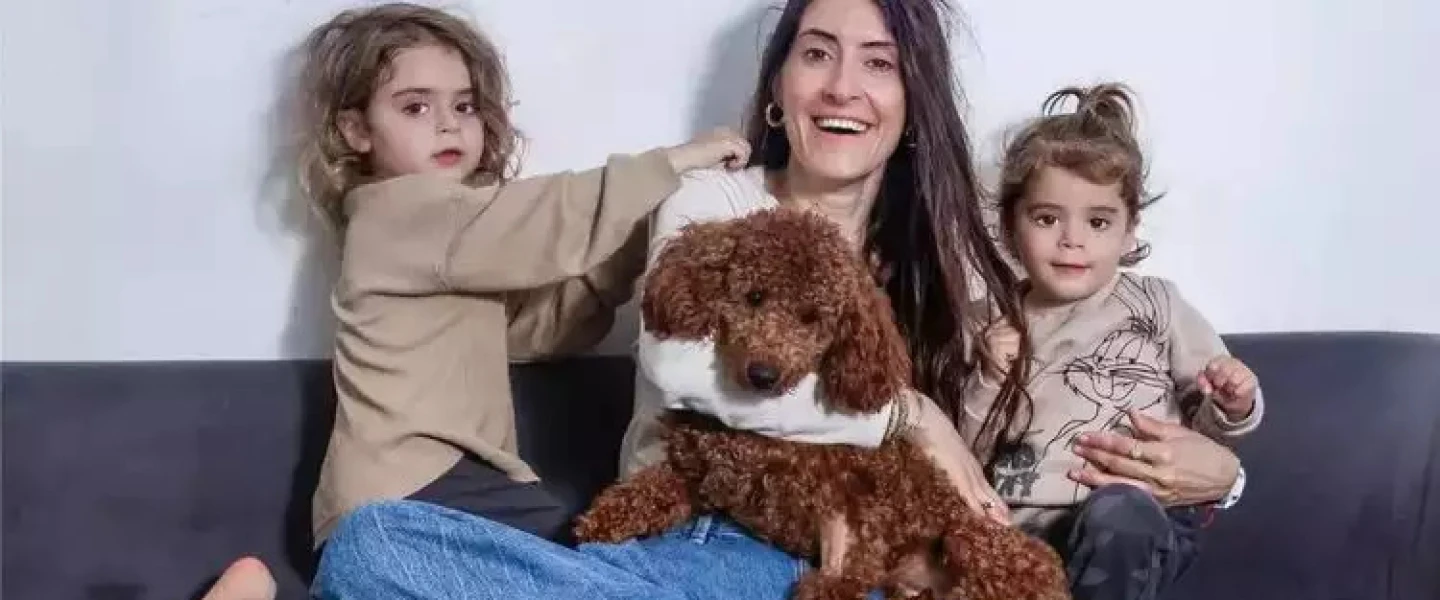
Dana Meir-Yung, a lawyer from Tel Aviv, is the widow of Sgt. Maj. (res.) Ofer Yung, 39, who was killed in February 2025 in a terrorist shooting attack in northern Samaria. Dana was left with two children, aged 2 and 3.
“A few months after Ofer was killed, our family dog passed away. I told myself, enough with death, I need to bring new life into the home for the children,” Dana says. Through the project, she received Monty, a medium-sized hypoallergenic poodle. “He is truly charming, brings joy and interest into the home. The kids love him, and sometimes it feels like he fills a bit of the emptiness I feel in the evenings.”

‘Bringing air back’
Shirley and Tomer Schwartz, from Shadmot Dvora, a moshav near the Sea of Galilee, lost their son, Omri, a paratrooper officer killed in an encounter with terrorists in northern Gaza in December 2023.

The family received Sandy, a Nova Scotia retriever. Their daughter Ella explained, “The only thing we agreed on before joining the project was that she should be able to get us out of bed and maybe bring a smile to our faces. That’s what Sandy does. She makes us smile and gives back a lot of love.”

Brig. Gen. (res.) Liron Donnell, CEO of FIDF Israel, said, “In a single moment, the lives of bereaved families stop, and the house is filled with pain and a void that cannot be filled. Kelev L’Derech was born from the understanding that within the fracture, there is a deep need for points of light. They don’t replace those who are gone, but they do bring air back into the lungs and movement into a routine that had frozen.”
Originally published by Israel Hayom.