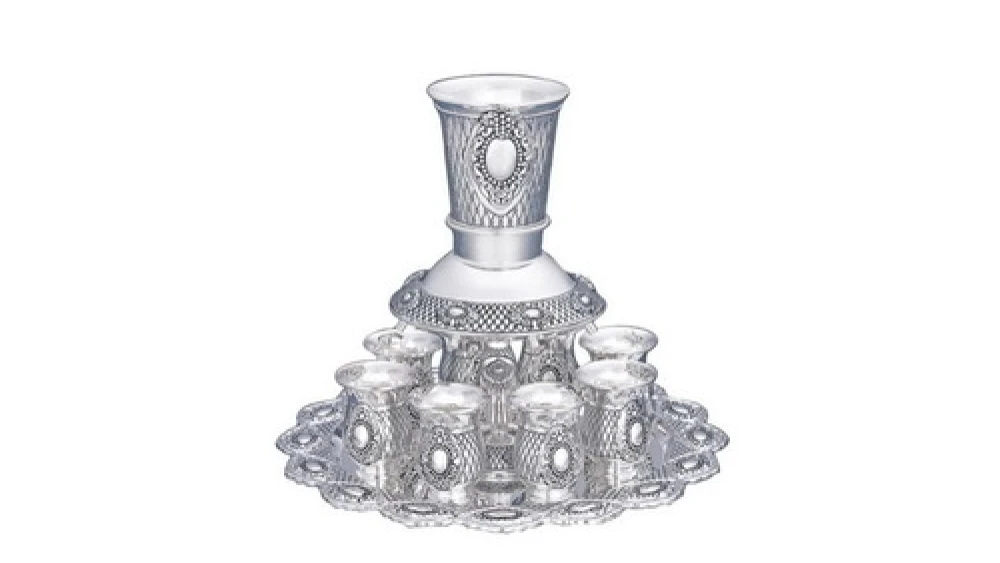
Not another challah board! That’s the collective cry heard ’round the Jewish world when newlyweds receive a Judaica gift they already possess. Don’t be that friend—follow my simple do’s and don’ts for Jewish wedding gifts.
DO…
Be creative
There are inventive spins on Judaica items that are sure to leave a more lasting impression than their traditional counterparts. Kiddush cup? How about a Kiddush cup fountain instead? It includes a center cup as well as 8-12 matching small cups, and when the reciter of Kiddush pours the wine from the center cup into the base of the fountain, the wine trickles down into the small cups. This avoids the clumsiness of pouring Kiddush wine for each person at a large Shabbat meal, and perhaps more importantly, the streamlined process routinely elicits “oohs” and “aahs” from guests. Challah board? How about a challah board breadbasket? This challah board transforms itself into a basket for distributing challah to guests after it is cut, keeping the Shabbat table uncluttered.
Think practically
Mull over this question: What Judaica does the couple really need around the house? More specifically, what does the couple need more than one of? A mezuzah (with a decorative case) immediately comes to mind, given the multiple doorposts in Jewish homes calling for one. Even more practical—and more memorable—is providing the glass cup that the groom will break with his foot under the chuppah, along with a broken wedding glass mezuzah, whose case includes room for those sentimental shards.
Give cash
Are you thinking that cash isn’t sentimental enough, and that the couple won’t “remember you” if you don’t give a unique gift? Don’t talk yourself into that myth. You’ll be remembered quite fondly for your cash gift, with which the newlyweds can buy anything they desire.
DON’T…
Be a copycat
The couple will likely get multiple challah boards, challah covers, menorahs, seder plates, and the like. Don’t join the fray. Be original. Now, I admit, it would be quite unfortunate if everyone followed my advice and the couple ended up with none of these hallowed Judaica fixtures.
Compete with close relatives
The couple’s parents or other close relatives may purchase them silver Shabbat candlesticks or a Kiddush cup, or the bride and groom may have had these items passed down in their family over time. Don’t even think for a second that you can compete with bubbe and zaidy!
Duplicate the registry
This goes for non-Judaica items, and was a major pet peeve for me when I got married in 2013. “Duplicating” the couple’s registry—for instance, getting dishes or silverware not listed on the registry—ensures three infuriating outcomes:
1) You’re getting the couple something they don’t need, because someone more compliant than you will (wisely) buy the dishes requested on the registry.
2) The couple won’t be able to exchange your redundant gift for something they do need because it came from a store unbeknownst to them.
3) Your gift will enter the notorious “re-gift closet.” This creates a vicious cycle. By re-gifting your gift, the couple repeats your error of gifting an unregistered standard household item. The gift proceeds to be re-gifted for perpetuity.
Here’s a dirty little secret: For couples, the point of making a registry is not just to get all the household items they need, but also to create the potential to exchange a string of registry items for more expensive items that you wouldn’t have the gall to put on the registry… like a couch. Why should your unwanted gift that cannot be returned spoil the couple’s efforts to implement this wonderful strategy?
Honestly, these are all just pointers. Any gift is deeply appreciated, and it’s the thought that counts. At the end of the day, it isn’t the presents, but your presence—at the wedding, if you can be there, or through your continued friendship—that matters.
—With reporting by my wife