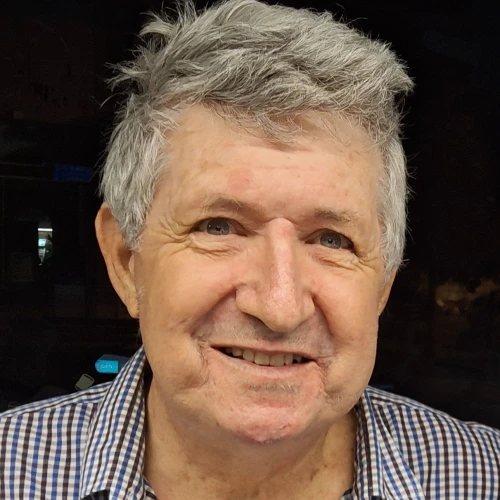
A decade ago, 30-year-old Avi Miller would never have imagined standing in a Tel Aviv studio, looking at his artwork as part of a national exhibition.
As a teenager growing up in a Haredi family in Jerusalem, he made the difficult decision to leave full-time Torah study in a yeshivah and enlist in the IDF Paratroopers Brigade—a choice that isolated him from his family and, for a time, left him entirely alone.
“After eight months, my commander realized that I simply wasn’t going home when everyone else was, and he applied for me to become a lone soldier,” he said.
Years later, standing among nearly 200 artists contributing to the “A Plate of Hope and Color” exhibition, Miller’s story has come full circle—his personal journey is now part of a collective act of support for soldiers like himself. His grandfather was the late sculptor, professor Dan Meller, and his father was a gifted painter.
“I met my grandfather at a relatively late age, and only then did I discover that he was also an artist and sculptor,” Miller said.
His piece, “The King’s Son and I,” reflects that lineage. “Over the years, I understood that there is nothing more important than family, and today I am once again in respectful and loving contact with them,” he said.

During the period when that connection was severed, the Lone Soldier Center in Memory of Michael Levin—the largest and longest-established organization in Israel dedicated to soldiers serving without immediate family support—became his primary support network.
Levin was a U.S.-born lone soldier who moved to Israel to serve in the IDF’s Paratroopers Brigade and was killed in action during the Second Lebanon War in 2006 at the age of 22, becoming a symbol of dedication among lone soldiers from abroad.
For Miller, participating in the exhibition is also a way of paying it forward. “When people help you during difficult moments, it teaches you the value of giving,” he said. “Today, when I am in a more stable place, it feels natural to give back.”
An exhibition rooted in home
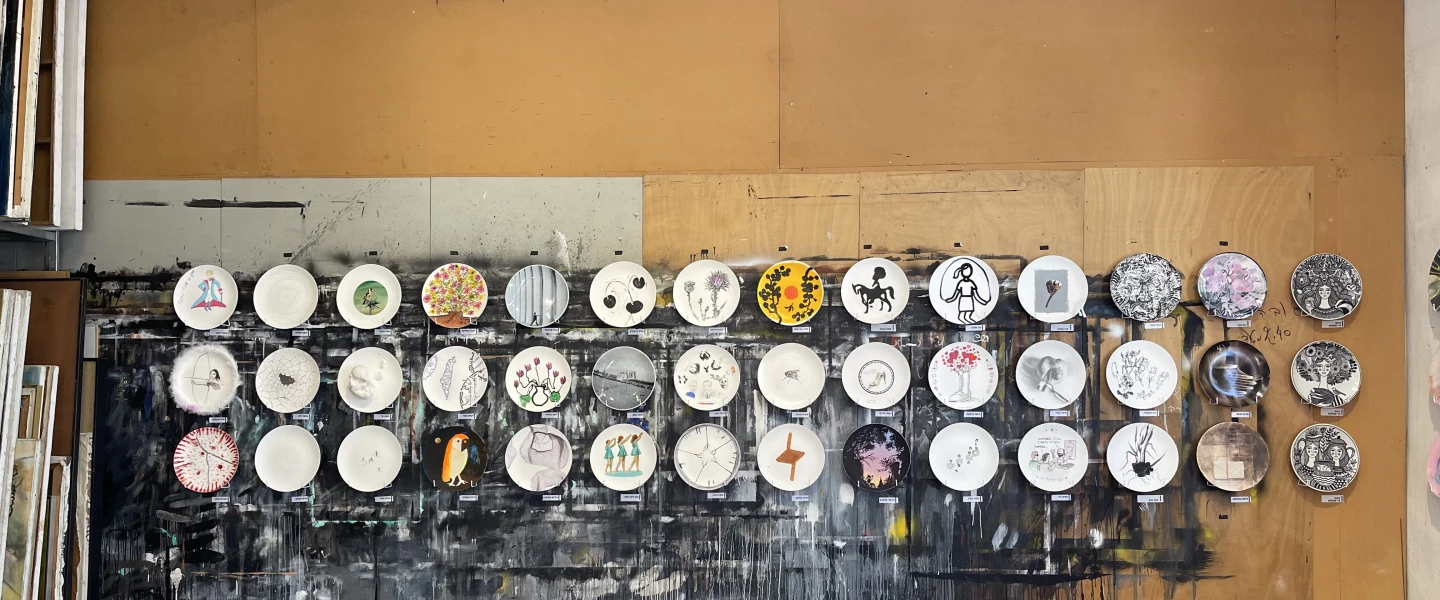
“A Plate of Hope and Color,” which opened on May 1 at the Uri Lifshitz Studio in Tel Aviv, brings together some 230 original artworks created on white ceramic plates by leading Israeli artists, all in support of the Lone Soldier Center.
The concept is simple but deeply symbolic. A plate evokes the idea of home—the family meal, the Shabbat table, the warm kitchen that lone soldiers so often go without.
Some come from abroad, leaving behind friends and family to enlist in an army in a country they feel is worth defending with their lives. Others, such as Miller, were born in Israel but grew up without a stable family network. All serve selflessly, but without the safety net most soldiers take for granted.
The center supports some 5,000 soldiers at any given time, offering mental health care, a warm home, hot meals and community assistance that extends from enlistment through five years after discharge.
The exhibition is the brainchild of the center’s president, Drorit Nitzani, who recruited curator Ronit Reik and designer Tami Chomsky to transform the idea into a full-scale cultural event.
“Each of the artists received a ceramic plate and was asked to create their own personal ‘serving’ on it—a circular format, with no beginning and no end, that breaks away from the familiar canvas and invites freedom and creativity,” said Nitzani.
Speaking at the opening gala on May 1, she described the emotional experience of watching the project unfold: “One of the most moving moments for me was opening the plates as they came back from the artists, again and again. Every plate was a surprise. A whole world.”
Art beyond the canvas
The participating artists span Israel’s cultural landscape, including painters, sculptors, graphic artists and musicians, reflecting the diversity of Israeli society—Jewish, Druze and Arab alike.

Among them are artist Nirit Takele, Michal Rovner, sculptor Micha Ullman, Larry Abramson, Jan Rauchwerger, Yair Garbuz, Eli Shamir, Danny Kerman, Shai Azoulay, Boaz Noy, Vardi Kahana, cartoonist and illustrator Michel Kichka, Ilit Azoulay and Miriam Cabessa.
Well-known figures from the worlds of music and culture have also contributed, including singers Riki Gal, David D’Or, Yehudit Ravitz, Yehuda Poliker, Ivri Lider, Arkadi Duchin, Einat Sarouf and Liat Levi Kopelman.
“The plate became a surface for creation, just like a canvas. It was not an object to be beautified, but a conceptual field of action,” said curator Ronit Reik. “This exhibition is not only about presenting art, but about showing art’s ability to rally around a greater cause and offer hope.”
Artists were asked to work outside their comfort zones on an unfamiliar surface—round, symmetrical, with no obvious “top” or “bottom.”
In a sense, this mirrors the experience of the lone soldier: arriving in an unfamiliar environment and learning to adapt, create and find footing without a map. For Takele, participation was deeply personal.
“The IDF protects Israel’s people,” she said. “As someone who served, I deeply respect anyone who chooses to defend this country, especially lone soldiers who come from abroad or serve without family here. If I can support them through my art, I do so wholeheartedly.”

Multi-award-winning singer-songwriter Ivri Lider described his contribution with characteristic warmth. The words on the plate he designed, he said, were “love” and “great success.”
“I was very happy to take part in this project, which is really very important and beautiful, with a very, very important purpose. The organization is amazing, and I’m happy to do what little I can to contribute and help.”
Appreciation from afar
The exhibition has also drawn responses from beyond Israel’s borders. Ari Gottesman, a former lone soldier and marketing executive originally from the United States who now lives in Tel Aviv, spoke to its broader significance.
“Seeing the artists and creative people in Israel standing behind us lone soldiers doesn’t only mean something to us on a personal level of making us feel less alone,” he said. “It also provides powerful, authentic tools that we can use to challenge the false narrative being told about us back home.”
He added: “In it, we can show the diversity of Israel, the complexity of emotions, and share the stories in a way that serves them up on a plate that is easy to digest, savor, and learn to appreciate.”
Also offering her perspective was Sherri Zigman, chairperson of the board of the Jewish Federation of Utah, who attended the opening gala as her daughter prepares to enlist as a lone soldier.
“Going to a fundraiser especially for her upcoming community meant so much to me,” she said. “I was so moved by the many beautiful plates and artists’ expressions at the Plates of Hope exhibit—art on every plate representing support for soldiers far away from home.”
Source of strength
Ayelet Nahmias-Verbin, chair of the Fund for Victims of Terror of the Jewish Agency for Israel and a former member of Knesset, placed the exhibition in a wider context.
“Plates of Hope and Color dedicated to the Lone Soldier Center is another moving display of the strong solidarity of Israeli society to those who are carrying the heavy load for all of us,” she said. “This is a source of strength for us all.”
Each plate in the exhibition is priced at 2,000 NIS, with all proceeds going directly to the Jerusalem-based Lone Soldier Center in Memory of Michael Levin, which is due to open a new home in Tel Aviv in the near future. Works are available for purchase at the gallery and online for a limited time. The exhibition is open at the Uri Lifshitz Studio in Tel Aviv through May 8.