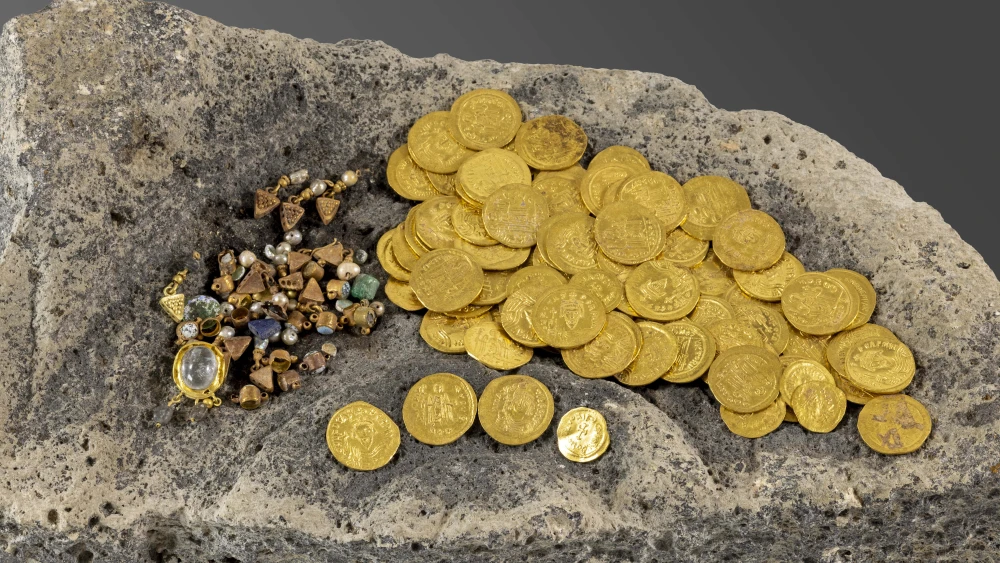
Israeli archaeologists have uncovered a Byzantine-era treasure of nearly 100 gold coins and earrings near the Sea of Galilee, the University of Haifa announced on Thursday.
The hoard, unearthed in July during excavations at the ancient city of Hippos (Sussita) and dating to the 6th century CE, was discovered when a metal detector operator with the dig picked up a signal near a large stone at the site.
As the stone shifted between two walls, the signal grew stronger and gold coins began to emerge one after another.
“The device went crazy. I couldn’t believe it—gold coins started appearing one after another,” said Edie Lipsman, the metal detector operator.
The find includes 97 pure gold coins and dozens of fragments of gold earrings inlaid with pearls, semi-precious stones and glass, the university said.
“This is one of the largest hoards from the Byzantine period discovered on dry land in Israel, and its uniqueness lies in the combination of jewelry and gold coins from the reigns of different emperors,” said University of Haifa expedition co-director Michael Eisenberg. “In addition, remnants of fabric were found on some of the coins—a trace of the cloth pouch in which the hoard had been hidden.”
The coins date from the reign of Emperor Justin I (518–527 CE) to the early years of Emperor Heraclius (610–613 CE).
Founded by the Greek Seleucids on a hill about a mile east of the Sea of Galilee, the city of Hippos was a major Christian center and episcopal seat during the Byzantine period (330–636 CE), with at least seven active churches.
Fearing for their safety during the Arab conquest of 614 CE, residents of many Christian cities, including Hippos, hid valuables in the hope of recovering them after the fighting.
Although Hippos survived the Arab invasion, a devastating earthquake in 749 CE destroyed the city, which was subsequently abandoned.
“Gold is a noble metal, and when you find coins and jewelry nearly 1,400 years old that look new, it is a rare experience,” Eisenberg said.