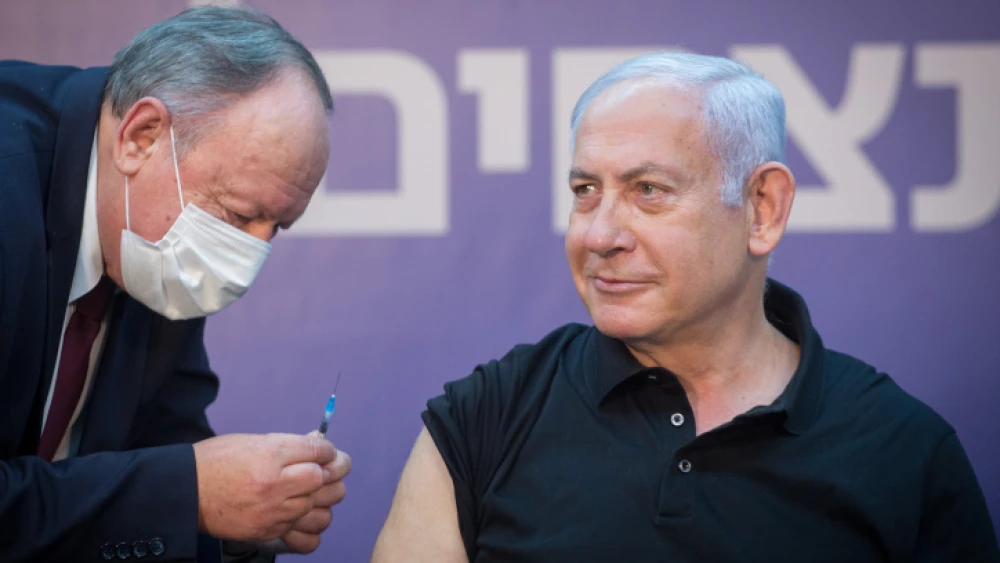
Israeli Prime Minister Benjamin Netanyahu and Health Minister Yuli Edelstein received the second dose of Pfizer’s coronavirus vaccine on Saturday night.
“I’m sure all the Israeli citizens about to receive the second dose of the vaccine are as emotional as I am,” said Netanyahu. “Through Israel’s vaccination campaign, we will be able to reopen our economy quickly; the bars, the restaurants, the gyms, schools, synagogues, the theater. We will do this through a ‘green passport,’ about which I will provide details later on.”
For that to happen, said Netanyahu, he needs Israelis both to get vaccinated and adhere to Israel’s tightened third lockdown.
“We’re doing this together,” he said. “We got into the coronavirus together, and we will be the first to get out of it, and we will be stronger than ever.”
Netanyahu has set a target of having the entire Israeli population, aged 16 and over, inoculated with both doses of the vaccine by the end of March.
Edelstein said, “Three weeks ago, we received the first dose [of the vaccine] ... and 1.8 million Israelis have already received [it].”
He went on: “Starting this evening, Israel’s citizens will also receive the second dose. We are getting closer to the light [at the end of the tunnel]. Let’s all take precautions so that we become the first country in the world to have a majority of its citizens inoculated. Right now, 20 percent of the population has already been vaccinated and 70 percent of the high-risk population. Most medical workers have been vaccinated. Many [members of the] security forces have been vaccinated. Let’s continue on this path to put this disease behind us. We can do it with your cooperation.”
Following concerns that the country would need to postpone the second vaccine, Israel reached an agreement with both Moderna and Pfizer that would see the pharmaceutical firms move up their vaccine deliveries. Moderna’s first delivery of more than 100,000 doses landed in Israel on Thursday.
Due to the logistic complexity of transporting Pfizer’s vaccine, Moderna’s vaccines will be administered to the housebound. Unlike the Pfizer vaccine, which has to be kept at a temperature of minus 70 degrees Celsius, Moderna vaccines only need to be stored at -20C. Once the vaccine has thawed, it can be kept in a fridge for up to 30 days, in contrast to Pfizer’s five-day maximum storage.
On Thursday, Netanyahu announced that a new agreement had been signed with Pfizer that would see the pharmaceutical giant begin to deliver millions more vaccines beginning Sunday.
In return for speeding up the delivery of the vaccines, Israel will share its data from the vaccination campaign with the pharmaceutical company and the World Health Organization, though officials emphasized that no personal data would be provided.
Reportedly impressed with the speed and efficacy of Israel’s vaccination campaign, as well as its computerized database, Pfizer hopes to use the Israeli data to gain insight into the efficacy of the vaccine in different population groups and prove its vaccine’s ability to quickly bring an end to the pandemic.
This article first appeared in Israel Hayom.