Newsletter
Newsletter Support JNS

More than 800 civilian victims of Hamas massacre identified

A total of 1,400 people were killed in the Oct. 7 cross-border invasion launched from Gaza.

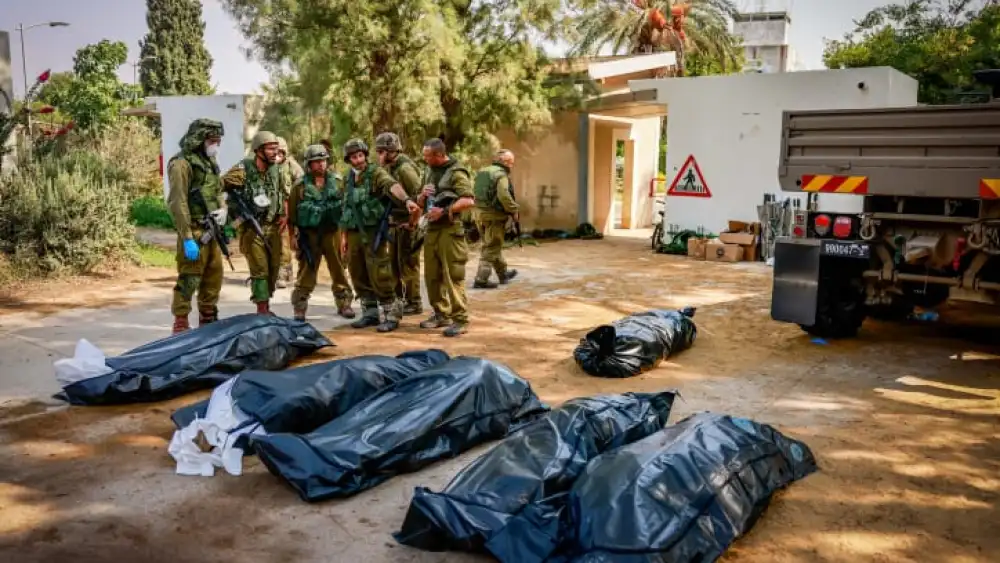
Israeli soldiers remove corpses in Kibbutz Kfar Aza, near the Gaza border, Oct. 10, 2023. Photo by Chaim Goldberg/Flash90.

Israeli authorities said on Thursday that 808 civilian victims of Hamas’s Oct. 7 assault on southern Israel have been identified.

Police said this represents 84% of the civilians believed killed during the attacks.

Authorities have encountered difficulties in identifying scores of additional bodies that were burned or mutilated.

A total of 1,400 people were killed in the cross-border invasion, in which Hamas terrorists raped, tortured and butchered men, women and children in Israel’s southern communities.

Hundreds of Israeli soldiers and security forces were killed during battles spanning 48 hours to retake Gaza border towns from Hamas.

So far, 701 victims have been buried.

On Thursday, the Israel Defense Forces announced that it had contacted the families of 224 hostages taken by Hamas back to Gaza on Oct. 7.

As many as 500 terrorists affiliated with Hamas and Palestinian Islamic Jihad trained in Iran leading up to the attack, according to The Wall Street Journal.

“The most powerful response we can offer is not conflict but proudly and peacefully enjoying the food, atmosphere and togetherness that these wonderful businesses bring to Philadelphia,” the Jewish Federation of Greater Philadelphia said.
“It’s an evolving trend that shows greater signs of permanence than temporary quality,” Dan Diker of the Jerusalem Center for Foreign Affairs told JNS.
“We’ll show up strong, with pride and solidarity, and keep the focus on peaceful support,” Yehuda Sichel, who owns Huda in downtown Philadelphia, told JNS.
“We have seen what happens when hatred of Jews moves from the fringes of society into organized political power,” Rabbi Steven Burg of Aish told JNS.