


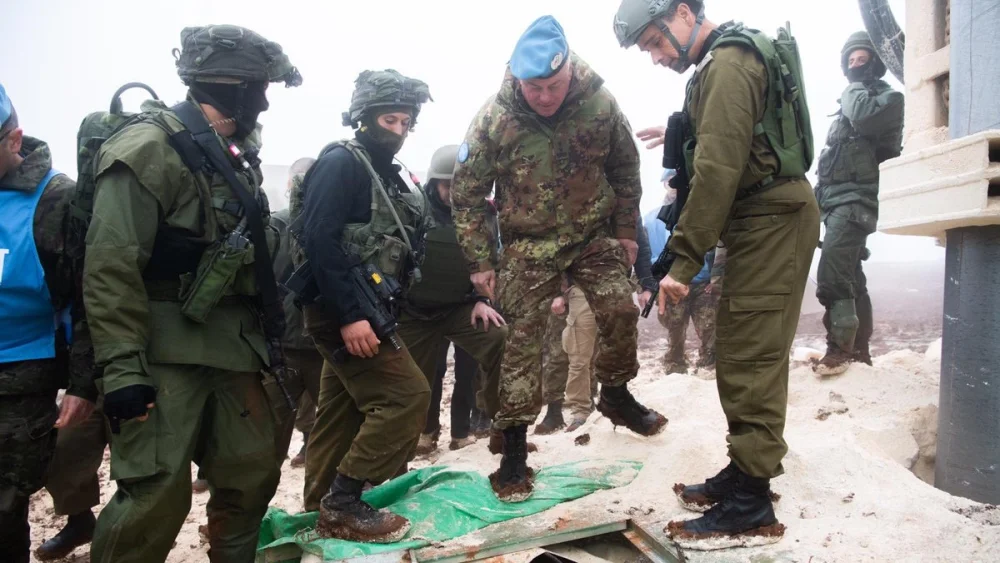
As the U.N Security Council is set to vote Thursday on whether to extend the mandate of the U.N. Interim Force in Lebanon (UNIFIL), Israel and the United States are pushing for the peacekeeping force to be granted greater authority.
Unlike years prior, this year the council will formally review the size of the force, and according to U.N. officials, consider cuts.
UNIFIL, the 10,500-strong military force established in 1978 to preserve the buffer zone between Israel and Lebanon, has seen its mandate limited in recent years, undermined by the rule of Hezbollah, which is considered to be a terrorist group by the United States, United Kingdom, Israel, Canada, Argentina, Paraguay and Bahrain. Australia, France and Germany classify only Hezbollah’s military wing as a terrorist entity.
With an annual budget of $490 million, the force, according to the United States and Israel, has become irrelevant due to the dominance of the Iranian-proxy terrorist group in southern Lebanon and near Israel’s borders.
Israeli ambassador to the United Nations Danny Danon plans to push the world body to give UNIFIL more authority to counter Hezbollah and will request the Lebanese government to curtail weapons-smuggling to terror groups like Hezbollah, which has built tunnels into Israel and is stockpiling weapons it vows to use against the Jewish state.
While Israel “holds the Lebanese government exclusively responsible for Hezbollah’s terrorist activity on its soil,” noted Danon, “UNIFIL is still required to take responsibility and act with decisive force within its mandate.”
Hezbollah currently has the majority of seats in the Lebanese parliament with current Lebanese President Michel Aoun among its supporters.
“While the Israeli interest is largely served [by the peacekeeping force],” noted Danon, “UNIFIL must still be able to exercise its mandate freely and without restriction.”
Spokesperson for the Israeli embassy in Washington Elad Strohmayer recently argued that “Hezbollah restricts UNIFIL from carrying out its role as a U.N. peacekeeping force. ... With this upcoming vote at the U.N. Security Council, we have the opportunity to actually give UNIFIL the ability to do what it is supposed to rather than, yet again, automatically renewing its mandate.”
The U.S. administration has also expressed its insistence that the peacekeepers should provide further details in reports to the United Nations regarding the limits imposed on them by Hezbollah.



