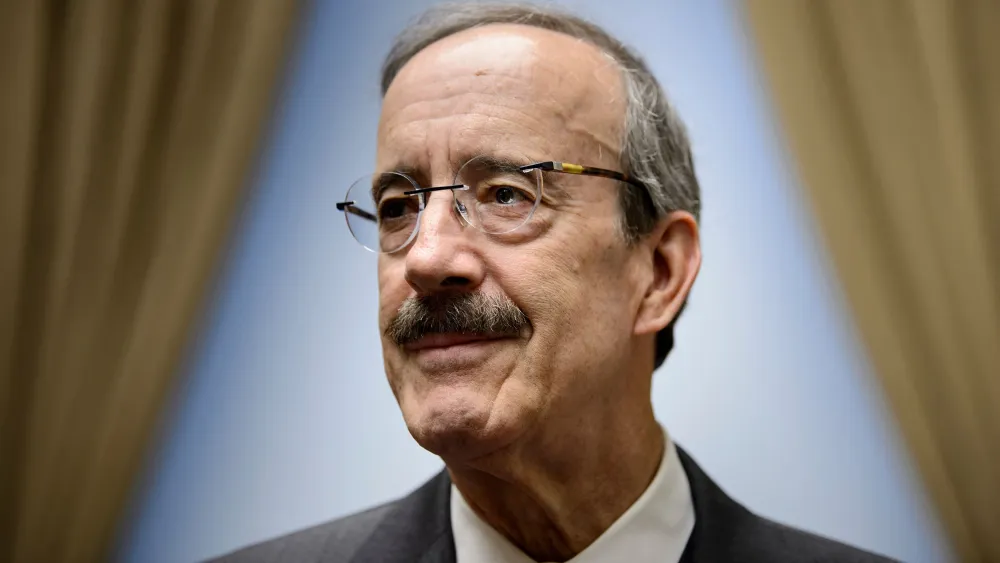

Rep. Eliot Engel, who passed away on April 10 at the age of 79, knew the heights of Washington well. For more than 32 years in the U.S. House of Representatives, he rose to chair the powerful House Foreign Affairs Committee while representing his district in the Bronx, N.Y., with distinction, including the synagogues of Riverdale, where our own congregation is situated.
He was widely regarded as one of the leading liberal voices in Congress. His advocacy for Kosovo and the Albanian people, and his insistence that America stand with them in their struggle against Serbia, has become part of his enduring legacy.
One of the true tests of leadership is not simply standing with the powerful; it is standing with the vulnerable. That was a defining feature of Engel’s life. He raised his voice for the indigent, both in America and abroad, as well as for American veterans—our heroes, too often forgotten. In a word: If there was a need, you could count on him to be there.
Acknowledging the congressman’s noble contributions, a major memorial will soon be held, no doubt to be attended by the who’s who of New York and even national politics.
But standing at the entrance to the cemetery before his modest graveside service, I could not help but recall the words of Pirkei Avot (“Ethics of Our Fathers”): “Be careful in your dealings with the ruling authorities, for they do not befriend a person except for their own needs … they appear as friends when it serves their interests, but do not stand by a person in the hour of distress.”
The past six years were difficult for Engel and his family. After a bruising electoral defeat, he was unfairly portrayed as having strayed from his liberal ideals. Little mercy was shown, even as it became clear that he was quietly struggling with his health.
Yet he carried himself with dignity, reminding us that the measure of a public servant lies not only in how one handles victory, but in how one endures defeat. As he battled Parkinson’s disease, the congressman to whom so many had turned for help was, too often, left to face his own struggles alone.
What stood out most to me, however, was that for all his universalism, he never forgot where he came from. He never forgot his Jewish roots, his family’s history shaped by European pogroms or his unwavering commitment to the State of Israel. On many occasions, he told me that one of the great privileges of serving in Congress was the opportunity to affirm the vital importance of the American-Israeli alliance.
He did so publicly, from the Well of the House, and privately, in moments witnessed by few. I recall looking up from the Western Wall during the Gulf War in the early 1990s, as Scud missiles fell on Israel, and seeing Engel approaching with his assistant. When others were leaving, he was running toward.
In more recent years, as some of his liberal colleagues distanced themselves from Israel, Engel remained steadfast—fierce and unapologetic in his defense of the Jewish state. He understood something that eludes many: that a strong sense of identity and a deep connection to one’s roots do not stand in tension with a universal mission. It is, in fact, a prerequisite for it.
Like all politicians, Engel understood the importance of being seen and heard, but he was a humble man at heart. In all the demonstrations I was involved in organizing, he never used his clout to demand the microphone upon arrival while others were speaking, as other politicians often did. Nor did he enter rooms announcing himself. He listened. And when called upon, he spoke with clarity and purpose.
I think of a High Holiday service when Engel chose not to move from synagogue to synagogue to be seen, but instead remained seated for hours, praying quietly alongside our community.
The Talmud teaches that after one’s time in this world, we are asked: “Did you act faithfully?”
Engel can answer in the affirmative. He was faithful to his family, whom he often said were his highest priority. He was faithful to the America he loved. He was also deeply and enduringly faithful to the State of Israel, for which he fought day in and day out.
It has been said that more important than the dates etched on a gravestone is the dash between them—the sum of a life lived.
Eliot Engel’s dash shines brightly. It reflects a rare synthesis of action, conviction, dignity and humility.
May his memory be a blessing.
Originally published in “The Jerusalem Post.”