In the Eshkol region, tucked between Beersheva and the Gaza-Egypt border, life is measured in seconds—the time it takes to reach a shelter, the pause between sirens and the fragile quiet that never lasts. But since Oct. 7, 2023, alongside the trauma, there is a determined insistence on rebuilding both the physical structures and emotional support that sustain a community.
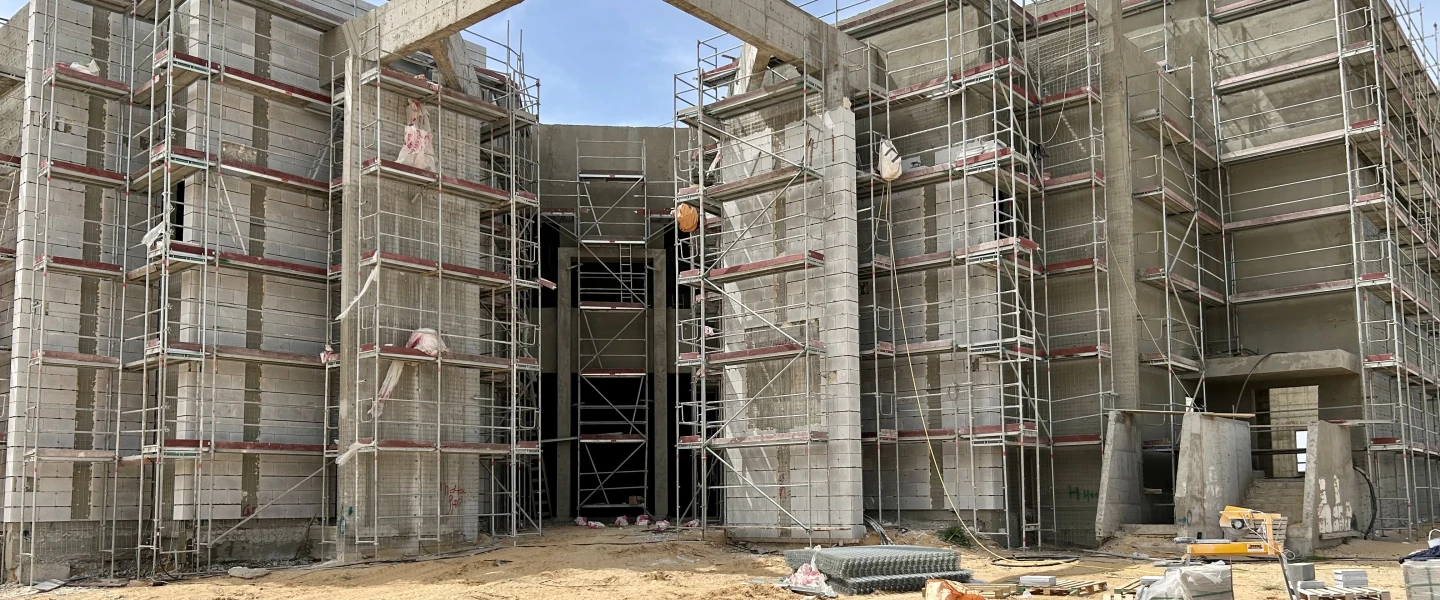
At the center of that effort is the new JNF-USA Eshkol Resilience Center that is expected to open in the summer of 2026. At the moment, the Eshkol Therapy Institute operates on the grounds of the Eshkol Regional Council in a small building with several treatment rooms, but just a few steps away, the new expansive, reinforced two-story building is taking shape to accommodate the needs of the growing population.

Healing in the shadow of war
The demand for mental health services has surged by hundreds of percent since Oct. 7, according to the center’s director, Hila Halevi.
“People need therapy in order to be stronger tomorrow,” Halevi explained at the construction site. “Until now, therapy often took place in cramped, fortified rooms that are functional, but inadequate for the scale of need. The expansion is designed not only to accommodate more patients, but to broaden the very definition of care: group therapy, family counseling, animal-assisted therapy, movement and art therapy. In a place where trauma is ongoing, historical, traditional models simply aren’t adequate.”
Before Oct. 7, five staff members were serving a population of around 16,000, Halevi told JNS. Today, there are dozens, supported by hundreds of therapists rotating in from across the country.
“There is no protocol,” she said. “There’s no guidebook for treating people who are still in trauma, who know it’s only a matter of time before the next escalation.”
For families in the region, trauma is ongoing. Kitty Berdichevsky is an eight-year-old from Kibbutz Nir Yitzhak who learned to conquer her fear of the dark by lighting a fire during an outdoor therapy session organized by the Therapy Institute.
Her mother, Hila, told JNS how she spent 14 hours in a safe room on Oct. 7 with her husband and three children while terrorists moved outside their window. Her six-year-old son has been in therapy since he was two because of the ongoing missile attacks from Gaza, well before Oct. 7.
Therapy, Berdichevsky says, is not a one-time intervention but an ongoing process, something that evolves as the trauma itself evolves. “It’s not something you see right away,” she explains. “But you see the tools they take with them.” As Berdichevsky talks with JNS, Kitty holds on to a knitted doll she has named Avraham, as both comfort and companion.
Halevi likens trauma therapy to providing a wheelchair: first a necessity, then a tool for regaining independence. Residents are seeking not only relief from trauma symptoms, but also for skills to deal with the daily reality of living under ongoing stress.

Building for the future
That determination to go on is visible in Shlomit, a community served by the Eshkol Council, in the Halutza region, less than a mile from the border with Egypt. Evacuated on Oct. 8, most of the residents returned as a group in March 2024. Four members of Shlomit’s First Responder Team were killed on Oct. 7.
Michael Gottesman, a founder of Shlomit, describes his neighbors as people who are driven by a vision of building a thriving community with a high quality of life that strengthens one of Israel’s longest borders.
Gottesman told JNS that Halutza residents are determined not only to restore the communities to how they were before Oct. 7, but to expand and improve. That means providing the best possible cultural and educational services, equal to those available in the center of the country.
Here, JNF-USA is funding one of the most ambitious projects in the region: a 30,000-square-foot fortified community center and adjacent synagogue. Gottesman said, “It’s like a JCC in America,” but with reinforced walls and missile protection.
The imposing building will house a library, hydrotherapy facilities, an auditorium and amphitheater, café and day care space—an acknowledgment that resilience is not just psychological, but physical, social and communal.
The synagogue is expected to open within the next few weeks and accommodates 650 people. The striking sanctuary is spacious and filled with natural light from the thirty-foot-high windows behind the ark that look out over Shlomit’s sandy terrain.
It’s an investment in the future, according to Yedidya Harush, JNF’s liaison for Negev community development. “We call this the Revival Region,” he told JNS. “We were hit hard on Oct. 7, but this place has to rise again.”
Harush, a reservist in an elite IDF unit who helped defend his community on Oct. 7, compares the situation in the area to an olive, bitter in its raw form but transformed through pressure into something valuable.
“That’s kind of who we are,” he said. “Something very difficult happens, but out of it comes something meaningful.”
Despite everything, the Halutza communities along the border are growing. Harush explains as he races on a four-seater ATV between rows of greenhouses filled with pineapples, dragon fruit, spinach and lettuce.
“You would think that because of the war, everything would just be gone,” Harush remarked. Instead, there is abundance and experimentation.
Waiting lists for housing stretch into the hundreds, Harush said.
“If you had said this on Oct. 9, it would have sounded crazy,” Harush added. “But now, two years later, people want to come.”
Harush is convinced that “thousands of families are waiting to come down here. Five years from now the population will be doubled. That’s why we need a community center.”
Tuvia Eden, 42, left Jerusalem to live in Shlomit with his wife and five children. Today he is a successful grower of cherry tomatoes who got his start through the Young Farmers Incubator Project that provided initial land, greenhouses and training.
Eden, an IDF tank corps reservist, returned home from the hospital in a wheelchair just moments before the interview with JNS. His leg was shattered two weeks earlier during a battle with Hezbollah terrorists in Lebanon.
Doctors told him to expect a full recovery if he keeps his leg completely immobilized for the next month. Despite his injury, Eden told JNS he feels optimistic about the future, particularly about the future of the Halutza communities with the new facilities that are drawing more residents there.