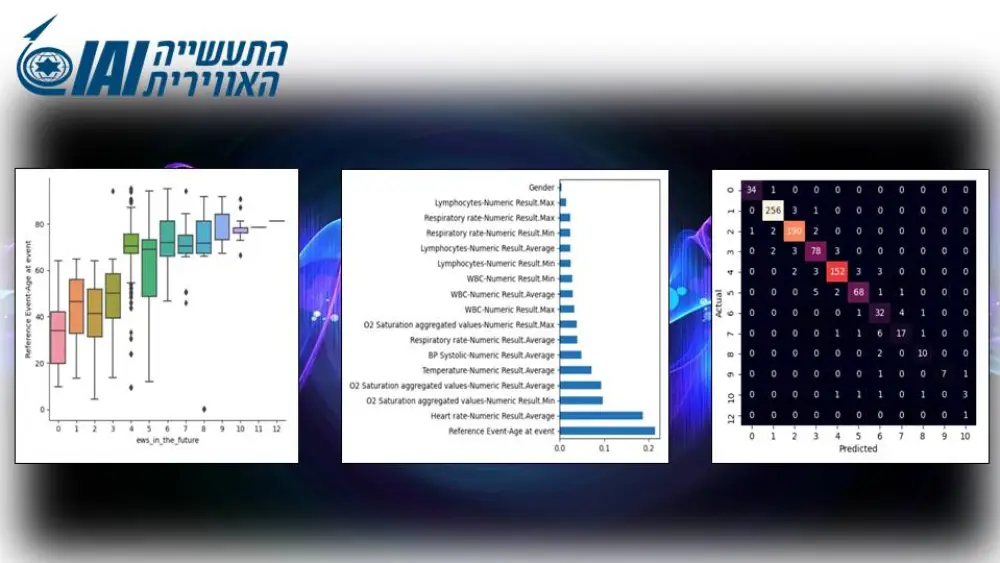
Israeli defense company Israel Aerospace Industries (IAI) has developed a model that predicts changes from one day to the next in the medical status of COVID-19 patients, using artificial intelligence, big data and machine-learning technologies.
In a statement, IAI said that “the predictive capabilities can alert medical staff to the possible deterioration in the patient’s condition, thus enhancing patient care and flagging the cases with higher chances of medical escalation and significantly improving the patient outcome.”
The model was developed by researchers and engineers at IAI’s Innovation Center in the company’s Systems Missiles and Space Group.
Dr. Einat Klein, chief innovation engineer at IAI’s Systems Missile and Space Group, told JNS that the model is part of IAI’s broad effort to assist the medical system in its war against the pandemic.
She said that machine-learning and data-science personnel at IAI called upon their knowledge and experience to develop a model in cooperation with the Sheba Medical Center at Tel Hashomer.
Sheba has received the highest number of COVID-19 patients in Israel, and it made available significant amounts of data to IAI, which then used that information to help build the model.
“The need arose from the hospital,” said Klein. “They spoke of a need to be able to forecast the deterioration of patients. One of the characteristics of the disease is sudden deterioration. A patient can feel well one moment and then suddenly deteriorate. These surprises are very complex, and doctors are dealing with a relatively new disease, which is not a simple struggle. They have to make decisions under uncertain conditions.”
IAI’s challenge, she added, was to build a model that truly succeeds in forecasting deteriorations in patients ahead of time. Part of building the model involved figuring out which medical readings could be used to make that forecast. Doctors and IAI personnel joined forces to select the right readings.
“The model succeeds by basing itself on the medical signs of patients up to the day the readings were taken and can then forecast what their situation will be tomorrow,” said Klein.
A short-term forecast of a few hours would not be useful to doctors, while a long-term prediction of a week ahead would not be credible, she stated. “But a day or two ahead is a forecast that is both relevant and helpful to doctors. In the end, the model can provide a forecast of the patient’s situation from one day to the next with fairly high credibility.”
IAI’s experience in using innovative algorithms meant that it could make the transition to the medical world, although this was supported by input from medical professionals. Personnel who usually work on defense projects also found themselves reading medical books to help get a better grasp of the new world they were operating in.
“It was a moving experience for us to make this change,” said Klein.
Hundreds of ventilators being produced
Currently, the system is still at a stage of being a model, and it is now in the service of the Sheba Medical Center, which can move it forward.
IAI’s Systems, Missiles & Space Group has a long record in air-defense systems, missile and satellite systems. The group also co-built the “Beresheet” spacecraft that traveled to the moon on Israel’s first unmanned mission to land there.
In April, IAI’s Systems Missiles Space group added a new production line—one that produces hospital ventilators.
IAI teamed up with Ra’anana-based Inovytec, which specializes in the production of emergency medical systems, to get the new production line going quickly.
The new cooperation program—conducted together with the Defense Ministry’s Directorate of Production and Procurement, and the Ministry of Health—is seeing hundreds of ventilators being produced, giving Israel a domestic mass-production capability.