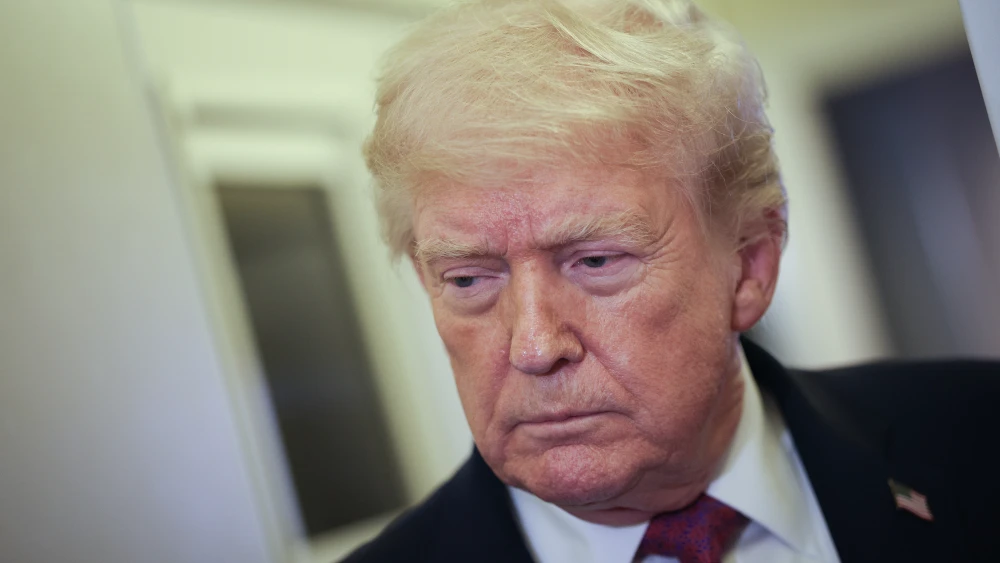
U.S. President Donald Trump confirmed on Wednesday that there was “no time pressure” for Iran to return to the table for ceasefire talks, as Washington presses Tehran to present a unified proposal.
Speaking to Fox News’ Martha MacCallum, a day after extending the ceasefire indefinitely with the Islamic Republic, Trump said that the 3-5 day window reported earlier was “false.”
Trump on Tuesday announced he was extending the April 7 truce with Iran, which was set to expire the next day, “until such time as their proposal is submitted, and discussions are concluded, one way or the other.”
“Based on the fact that the government of Iran is seriously fractured, not unexpectedly so and, upon the request of Field Marshal Asim Munir, and Prime Minister Shehbaz Sharif, of Pakistan, we have been asked to hold our attack on the country of Iran until such time as their leaders and representatives can come up with a unified proposal,” Trump wrote in the post on his Truth Social platform.
White House Press Secretary Karoline Leavitt told reporters on Wednesday that the Trump administration was “maintaining and generously offering a bit of flexibility to a regime who has been completely tarnished because of ‘Operation Epic Fury.’”
“There’s obviously a lot of internal division—this is a battle between the pragmatists and the hardliners in Iran right now, and the president wants a unified response,” she said.
However, Leavitt stressed that “Operation Economic Fury” against Tehran would continue, saying the U.S. military was “completely strangling their economy through this blockade” of the Strait of Hormuz.
United States Central Command, which is responsible for the Middle East, announced on Wednesday night that it had directed 31 vessels to turn around or return to port since the start of the blockade on April 13.
“The majority of vessels have complied with U.S. directions,” it stated, adding that most ships that were turned around were oil tankers.
Earlier on Wednesday, Trump claimed Iran was losing approximately $500 million per day due to restrictions on the strait, saying the Islamic regime is seeking to reopen the strategic waterway as financial pressure mounts.
“Iran is collapsing financially! They want the Strait of Hormuz opened immediately — starving for cash! Losing 500 million dollars a day. Military and police complaining that they are not getting paid. SOS!!!” the president posted on Truth Social.
Meanwhile, the Pentagon has informed Congress that it could take up to six months to fully clear the strait of mines deployed by Iran, and that the operation is unlikely to be carried out before the end of the war, The Washington Post reported on Wednesday.
A senior Defense Department official shared the estimate during a classified briefing with lawmakers of the House Armed Services Committee on Tuesday, three officials familiar with the meeting said.
Committee members were said to have been told that Iran may have deployed 20 or more mines in and around the Strait of Hormuz, including some that were floated remotely using GPS, making it more difficult for U.S. forces to detect the munitions as they are deployed.
A Pentagon spokesman called the information “inaccurate” in a statement to The Washington Post, accusing the newspaper “car[ing] more about advancing an agenda than truth.”
The Strait of Hormuz is one of the world’s most critical maritime chokepoints, through which a significant portion of global oil shipments pass, meaning disruptions can significantly affect global energy markets.
Iran opened fire on three vessels and seized two of them in the Strait of Hormuz on Wednesday, the Associated Press reported.
British maritime security agency UKMTO reported that an Islamic Revolutionary Guard Corps gunboat opened fire on a container ship off the coast of Oman, resulting in heavy damage to its bridge. The crew was reportedly safe.
In a second incident, an outbound cargo ship was fired upon off the Iranian coast, with no injuries or damage inflicted on crew or vessel, according to UKMTO.
The Nour News outlet affiliated with Tehran’s Supreme National Security Council reported that the IRGC attacked a Greek-owned vessel named Epaminodes after it had “ignored the warnings of the Iranian armed forces,” per the BBC.
A second ship, named Euphoria, was also attacked with the third identified as the Panama-flagged MSC Francesca, the report continued.
IRGC Naval Command said that both Epaminodes and Francesca had been seized after “operating without the necessary permits and tampering with navigation systems,” the BBC added.