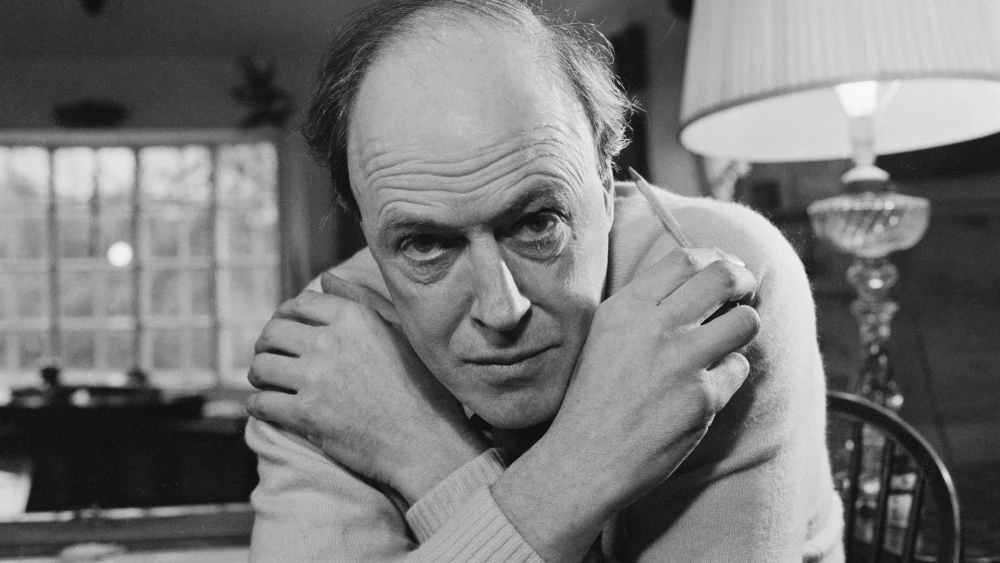

If only every person who hates Jews were as open about their biases as author Roald Dahl (1916-1990). The famed children’s writer, who earned literary immortality with books such as Charlie and the Chocolate Factory, Matilda, James and the Giant Peach, The Fantastic Mr. Fox and The BFG, was widely acclaimed as one of the 20th century’s greatest storytellers, as well as among its best-selling authors. A cultural icon in his own time, his fame has continued decades after his death. So, too, has his notoriety; he was also an unabashed and self-identified antisemite.
That aspect of his life story is given a thorough examination in the hit play “Giant” by British playwright Mark Rosenblatt, which recently opened on Broadway at New York’s Music Box Theater after an award-winning run on London’s West End.
Ripped from the headlines
Antisemitism has been surging throughout the West since the Hamas-led Palestinian Arab terror attacks on Israel on Oct. 7, 2023. It has only grown during the two-and-a-half years since then as the Jewish state has been waging war on those terrorists, their Hezbollah allies and their Iranian sponsors. That has made the play’s topic even more relevant, as those flocking to sold-out performances to see actor John Lithgow’s brilliant star turn as Dahl are asked to absorb more than two hours of the title character’s mix of charm, wit and monstrous bile. Audience members walk away contemplating the difficult dilemma that his behavior posed for those who profited from publishing his books or lived with him. Indeed, with Israel being blasted for bombing Gaza, Iran and Lebanon—just as was true more than 40 years ago, when the events of the drama unfolded, and Israel was in the world’s crosshairs—it could be said to be ripped from the headlines.
“Giant” presents the truth about the author in a way that leaves no wiggle room about acknowledging the depths of his hatred. We can wonder what caused a man who was responsible for so much work that was as life-affirming as it was delightful to go down that dark road. And we can also puzzle over the questions about how to separate a decent person’s disgust with his views from how they feel about his books and whether they can think about them the same way once they witness his antisemitism.
Even as the play basks in generally well-earned praise from critics as well as audiences, its topicality is deceptive. For all of the skills of the playwright, director and cast, it doesn’t offer much that is of use in navigating a world in which many of Dahl’s horrible ideas about Israel and Jews, which were considered beyond the pale in his lifetime (these days, no longer considered disqualifying), have been mainstreamed. They have become not merely commonplace, but are now a fashionable orthodoxy whose adherents dominate the worlds of academia and culture while also gaining an increasingly secure foothold in politics.
Respectable antisemitism
The trouble is that, unlike Dahl, most of those who are currently spreading hatred of Jews in academia, popular culture and politics are doing so while also claiming to oppose such prejudice. They are, they insist, just “criticizing” the Israeli government and its leaders, calling into question their right to self-defense.
But peel away that veneer, and the real issue becomes transparent: their battle is against the existence of Israel itself. While seeking to legitimize the war to eliminate the one Jewish state on the planet and oppose efforts to strip its enemies of the means to achieve that vile goal (such as the Iranian nuclear program), they tell us that they like Jews and wish to defend them—or, at least, the “good” ones who condemn Israel, rather than the “bad” pro-Israel or Zionist ones.
Even as they float conspiracy theories that could have been lifted out of The Protocols of the Elders of Zion, popular podcasters on the right, like Tucker Carlson, and those on the left, like Hasan Piker, deny that they are antisemites. New York City Mayor Zohran Mamdani, whose entire career has revolved around his obsession with destroying Israel and stigmatizing its Jewish supporters, does so while attending Passover seders that conveniently leave out any message of the essential element of Jewish identity relating to the land of Israel.
But not so Dahl. He was ahead of his time in terms of a popular figure taking up the cause of Jew-hatred. That marked him as an outlier in polite society during his lifetime. Meanwhile, much of what he believed is now so prevalent that it is a surprise when one encounters a famous writer or artist who resists the demand to virtue-signal their animus for Israel.
Escaping cancellation
Dahl made clear his hatred for the State of Israel—and all Jews, for that matter—in 1983, when he wrote a review praising a book about the 1982 Lebanon War and again in an equally infamous interview with The New Statesman magazine. In an essay published in the Literary Review, he didn’t just engage in one-sided and unfair criticisms of Israel’s part in that conflict; he also vented his belief that the Jewish state and its supporters were analogous to the Nazis. Indeed, he aimed his poison pen at a broad array of targets in such a way as to blame Jews everywhere for the supposed crimes of Israel, not the least of which was its creation.
For this, he was widely criticized. Still, despite his own conviction that Jews ruthlessly silenced and punished their opponents, he didn’t suffer much, if at all, for exposing his bigotry so brazenly. His books continue to sell briskly—with many having been made into movies—and he was never accorded the pariah status that one might otherwise think would be given to someone who utters such vile language and holds such hateful views. The worst of the repercussions was that he was denied a knighthood from the British government and offered a lesser honor instead, which he refused. Nor did Tom Maschler, the Jewish publisher who had championed his work and considered him a friend—himself a child survivor of the Holocaust—disavow him.
In 2020, some 30 years after his death, his family and the Roald Dahl Story Company that controls the rights to his work issued an apology for his antisemitism. The admission was prompted by a belief that amid the ex-post facto cancellations of many famous figures for past sins of racism, real or otherwise, amid the moral panic that swept the West after the death of George Floyd in Minneapolis, Dahl’s legacy might also suffer.
But they were wrong to think that the mobs toppling statues during the Black Lives Matter summer of 2020 were interested in punishing Jew-hatred or wanted retrospective atonement for it. And in the wake of Oct. 7, Dahl’s anti-Israel diatribes don’t seem as shocking as they did back in the 1980s.
The author’s reaction to the 1982 First Lebanon War, in which Israeli forces sought to push the terrorists of the Palestine Liberation Organization out of their strongholds in Southern Lebanon and Beirut, was, after all, a preview for the fighting now going on with Hezbollah. Until then, the PLO operated as a state within a state, using Lebanon as a base from which it could launch both deadly terrorist raids and missile attacks on Israel, as Hezbollah terrorists also did.
Lebanon in 1982 was the moment when the tiny, embattled and besieged Jewish state started being viewed as the “Goliath” of the Middle East while the Palestinians, who stubbornly refused to make peace with the Jews, were dubbed the new “David.”
The screed was, in equal turns, ignorant about the Jews, Israel and the Middle East conflict. But Dahl’s controversial essay didn’t just engage in the usual bashing of the Israeli government and its efforts to fend off terrorist opponents. He saw the creation of the Jewish state as illegitimate and wrong. He wrote that the Jews were sympathetic when they were the victims of the Nazis, but had become a race of “barbarous murderers.”
He raged at their temerity for acting in the same way any sovereign state would behave when placed in a similar situation. He viewed any Jew who would not join him in supporting Israel’s destruction as being equally guilty. Dahl’s boundless sympathy for Palestinian and Lebanese killed or injured in the war against Israel was rooted in complete indifference to Israeli victims of Arab terrorism.
As respected historian Paul Johnson wrote at the time in The Spectator, it was “the most disgraceful item to appear in a respectable British publication for a very long time.”
Antisemitic hypocrisy
Some 43 years after its publication, what ought to strike the reader is how similar much of it is to so much contemporary “criticism” of Israel. Indeed, how different is it from contemporary attacks on Israel published in “respectable” publications in Britain or the United States about Jerusalem’s efforts to ensure that Hamas, and its Hezbollah and Iranian allies, can’t perpetrate another Oct. 7? The writers who denounce Israel’s existence in The New York Times or The Guardian are perhaps more cautious about also venting age-old tropes of antisemitism. But the podcast conspiracy-mongers on both left and right who speak to far larger audiences are not.
In “Giant,” a fictional character—a Jewish woman who works for Dahl’s American publisher—is assigned the task of pushing back at the author. She is a “good” “progressive” Jew who sees Israel as flawed and agrees with its government’s detractors. But she does point out that Israel didn’t behave any differently than Britain did when it was attacked in World War II.
The mention of the fire-bombing of Dresden is also telling. It was an arguably defensible military raid in the context of a total war against Adolf Hitler’s Germany, albeit one that resulted in indiscriminate slaughter that was far worse than anything Israel has ever done. Had someone actually said that to Dahl, it might have stung a man who was a decorated pilot in the Royal Air Force during the Second World War, and thus a hypocrite for saying that only “barbarous” Jews and Nazis behave in this manner. More of that would have made the analogy between Dahl’s rants and today’s “criticism” of Israel even more obvious.
But Dahl’s real sin in the play is for merging his loathing of Israel with his equally venomous animus toward all Jews.
The version of Maschler depicted in the play is eager to downplay his friend’s indiscreet signaling of his prejudices and allow them both to get on with the business of publishing books and making money. He also wants nothing to do with Israel or the struggles of the Jews, even as his pal Roald goads him, like the playground bullies the publisher encountered as a child. He believes that Dahl’s brilliance justifies any effort to make the controversy go away with minimal gestures of contrition that the author doesn’t want to make.
The play’s Maschler is the sort of Jew whose complaint about the post-Oct. 7 wave of antisemitism is that it leaves so little room for those who just want to get on with their lives, without being drawn into the drama of Israel-related hate. Like the American sales rep, he may even agree with some of Dahl’s Israel-bashing, even if it goes too far for their taste. But the author’s pathological need to bully and demean Jews is too great to accommodate them.
It is only in the play’s final scenes, when Lithgow acts out the actual transcript of Dahl’s New Statesman interview, that the full portrait of his character is revealed. Having indulged in the crudest of stereotyping and claiming that Hitler was likely justified in thinking ill of the Jews, he owns the label of antisemite. That leaves neither the audience nor those in Dahl’s life with the ability to deny that he is anything other than a hate-monger.
It may be, as some critics have noted of Lithgow’s performance, that Dahl was a Shakespearean character who is a mix of good and evil that epitomizes the complexity of the human condition. As I wrote at the time of his family’s apology, his antisemitism shouldn’t mean that we ought to cancel his books. Great art has nothing to do with good character. That is something that is proved over and over again in the examination of the lives of great musicians, painters, and, yes, the authors of beloved children’s books.
A distinction without a difference
Dahl was also living proof that once you remove the thin veneer of justifiable concern about any misdeed that Israelis are supposed to have committed, the gap between anti-Zionism and antisemitism is revealed to be a distinction without a difference. And that is why so much of the commentary about this play and antisemitism in general is still asking the wrong questions about the subject.
Some 78 years after the birth of the modern-day State of Israel, we should no longer be trying to draw distinctions that will allow Israel-bashers to avoid being tagged as what they really are: antisemites. Instead, we should be noticing the painfully obvious similarities that unite all anti-Zionists, whether they are as uncivil as Dahl or not.
Those who cheer for or rationalize attacks and violence, including the largest mass slaughter of Jews since the Holocaust that took place on Oct. 7, as well as deny Israelis the right to defend themselves against those who pledge its repeat, are on the same level as Dahl.
Are students or college professors who chant for Jewish genocide (“From the river to the sea”) or terrorism against Jews wherever they live (“Globalize the intifada”) really idealists who should be accorded the respect that sophisticated theater-goers are forced to retrospectively deny to a nasty old man who thinks the Jews deserved the Holocaust?
Is the contemporary journalist or politician who traffics in blood libels about Israelis committing a mythical “genocide” someone to agree to disagree with? Is that akin to how we are expected to react to an open neo-Nazi who does so in a less dignified manner?
The real lesson to be drawn from “Giant” isn’t the answer to the age-old debate about what to think about good art created by bad people. Nor is it a guide about how to behave when a favorite childhood author turns out to be a rotten bigot.
It is this: Those who embrace the cause of Israel’s destruction and the genocide of half of the world’s Jewish population that goes with that belief don’t deserve the benefit of the doubt when it comes to evaluating their character. Some may act in a less repugnant manner than Dahl and pretend to oppose antisemitism even as they support it, as is the case with the mayor of New York. Others are less civil or arguably even crazier, as might be said of some anti-Israel podcasters. But they are all part of the same evil cause. And they all deserve the same opprobrium a decent society should accord to antisemites like Roald Dahl.
Jonathan S. Tobin is editor-in-chief of JNS (Jewish News Syndicate). Follow him: @jonathans_tobin.