


Hatem Bazian, founder of Students for Justice in Palestine, tweeted a retort to CNN cable-news anchor Jake Tapper on May 11, 2023, whining that Tapper’s report on a “Nakba 75” event, held by Rep. Rashida Tlaib (D-Mich.), “was racist and anti-Palestinian.” He must have thought he was blasting Tapper anonymously from the Jewish Voice for Peace Twitter account, but he was actually doing so from his own personal account. The post ends by asserting, “As Jews who believe in human rights and justice, we demand you do better.”
Keeping his private Twitter account and his JVP Twitter accounts separate proved too much for Bazian; his cover was blown.
Ilan Berman, senior vice president of the American Foreign Policy Council, noted that Bazian’s screw-up should have proved embarrassing for him, but instead probably “will be forgotten immediately.”
It was. But this cannot continue.
Bazian is the driving force behind a quasi-academic activist effort to stifle speech and writing about Islamism and to portray research into Islam as inherently hateful. In this capacity, he is the founder of the Islamophobia Research and Documentation Project at the University of California, Berkeley; president of the Islamophobia Studies Research Association; and editor in chief of the Islamophobia Studies Journal. He is also co-founder of the American Muslims for Palestine (AMP); co-founder of Zaytuna College, where he is professor of Islamic Law and Theology; and a faculty affiliate at the Rutgers Center for Security, Race and Rights.
JVP fits neatly into his network.
Bazian identifies himself as the co-founder or founder of SJP when he was a graduate student at Berkeley, though the first SJP was founded in 1993 by Osama Qasem as a moderate alternative to the university’s more extremist Muslim Students Association (MSA). “We oppose illegal settlements, not the peace process,” an SJP member told the Berkeley media at a rally in 1995, where MSA students shouted, “We are your nightmare, Israel,” and spat on Hillel counter-protesters.
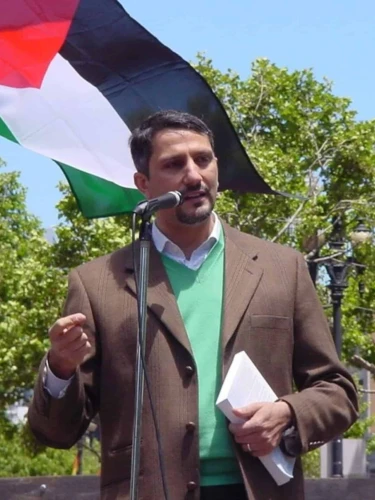
SJP eventually fell apart from a lack of interest in 1999, when the group was unable to meet the four-student minimum for official club status. That changed with the onset of the Second Intifada in Israel from 2000 to 2005.
An article in Arab America claims that Bazian founded SJP in 2001, when he “renamed and redesigned the club formerly known as GUPS, General Union of Palestinian Students.” Once Bazian was at the helm, SJP was no longer a moderate alternative to MSA. In 2004, Bazian called for an “intifada in America.” SJP echoed his call.
In 1996, three students at Berkeley (Julie Iny, Rachel Eisner and Julia Caplan) co-founded Jewish Voice for Peace. In 1996, JVP was not anti-Zionist and did not advocate a boycott of Israel. Today, it openly embraces Islamists and antisemites. It’s hard to imagine 1996-era JVP members donning keffiyehs and calling for the destruction of Israel, but JVP members today do so regularly.
Pinpointing the precise date when JVP came under Bazian’s control is a difficult task. Perhaps it came in 2011, shortly after National Students for Justice in Palestine was formed and organized its first national conference at Columbia University. According to Dina Omar, one of NSJP’s original members, fundraising efforts for travel expenses fell short, so Bazian’s AMP and JVP “chipped in to cover flights for some of [SJP’s] members.”
Or perhaps it came in 2015, when JVP endorsed the anti-Israel BDS movement, or in 2019, when JVP declared itself “anti-Zionist.”
Whatever the date, Bazian decided that, unlike his takeover of SJP, no name change was necessary for his takeover of JVP. In fact, he depended on the illusion of Jewishness to amplify and validate the message that all his organizations espouse.
Andrew Pessin, professor of philosophy at Connecticut College, calls this tactic “Jew-washing,” noting how anti-Israel Jews always begin their denunciations of the Jewish state with the phrase “As a Jew … ,” implying that Jews can’t possibly be antisemitic.
Had Bazian not deployed the “As Jews” trope, his giveaway tweet would not have given him away.
In spite of the word “peace” in its name, JVP is not interested in peace. It is, obsessed with destroying Israel. JVP’s messaging today is every bit as antagonistic to Israel as SJP’s messaging.
As a Nov. 28, JVP Instagram post claims that “anti-Zionism is anti-colonial and anti-imperialist. We must lead with this framing if we wish to dismantle Zionism.” Like SJP, JVP portrays Israel as an apartheid state committing genocide that must be eradicated through a “right of return” for some 7 million so-called “Palestinian refugees” born after 1948.
Since the Hamas-led terrorist attacks in southern Israel on Oct. 7, 2023, JVP has become the most important front for SJP. At schools where SJP chapters are suspended or banned, many continue to operate under the guise of JVP.
At the University of Rochester in New York, where the SJP chapter was “derecognized” in February 2023 but still operates with seeming impunity, JVP enables the outlaw SJP to participate in campus events. As recently as Nov. 12, the university’s recognized JVP chapter and its derecognized SJP chapter jointly held a screening of a film titled “5 Broken Cameras.” The two Instagram accounts (SJP.UR and JVP.UR) posted identical messages on Nov. 10, under the heading “SJP X JVP.”
In 2018, I suggested that JVP should be called the Jewish Voice for Palestine because of its relentless promotion of a Palestinian state. But since the “Jewish” part of the name is clearly a misnomer, “The Voice for Palestine” is more accurate. And since we know that Hatem Bazian runs the operation, an even better name would be “The Fake Jewish Voice for Palestine.”
Or perhaps we could just call it what it is: SJP.


