


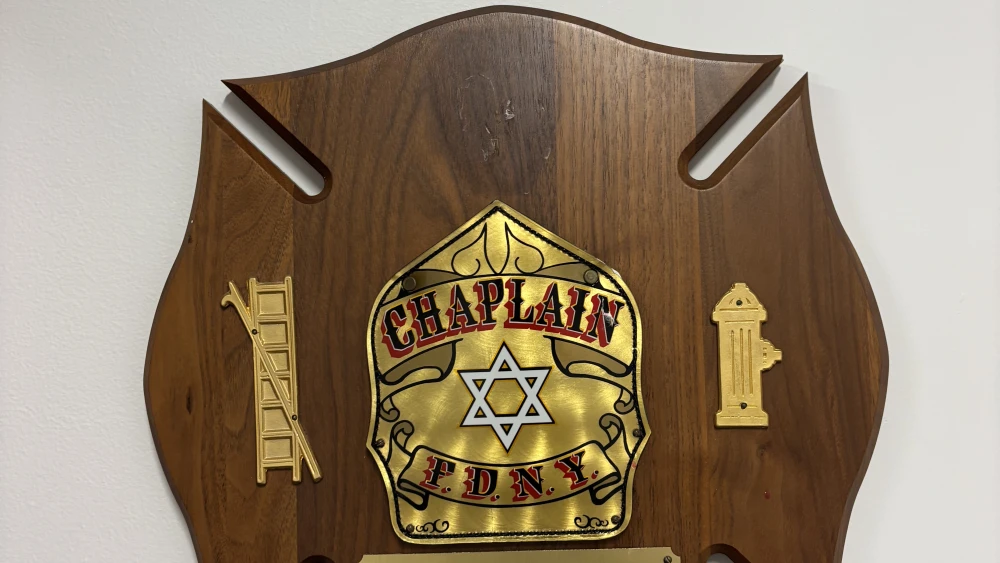
When Robert Tucker, the New York City fire commissioner, asked Rabbi Joseph Potasnik if he would be the department’s chief chaplain, the latter had no idea what exactly he was being offered.
“I told him, ‘What does that mean?’” the septuagenarian rabbi told JNS.
The role, a first in the New York City Fire Department’s 160-year-history, puts Potasnik, who has served as a chaplain in the department for more than 25 years, atop its chaplaincy corps.
The rabbi told JNS that he agreed to take the position after confirming that it came with no added compensation. “I love this, and I don’t want any funding for doing this,” he said he told Tucker. “I accept this as a great honor.”
Tucker, who is Jewish and announced his resignation after Zohran Mamdani was elected mayor of the city, has said that he has yet to hear from the anti-Israel mayor-elect. (JNS sought an interview with Tucker.)
Speaking with JNS in his New York Board of Rabbis office in midtown Manhattan on Nov. 25, Potasnik said that his job has involved “a recognition of the importance of seeing each other through a lens that sees the goodness in other people.”
“We all have different traditions, but we all have fundamental values that unite us,” he said. “Having the relationship with the other chaplains makes it very special, because we all work together.”
Ordained at Yeshiva University, Potasnik holds a law degree from Brooklyn Law School and serves as executive vice president of the New York Board of Rabbis, the largest interdenominational rabbinic body in the world, with more than 800 members.
He was also the rabbi of Congregation Mount Sinai in Brooklyn Heights where he began in 1972. (The synagogue is now defunct.)
The roles add up, but Potasnik told JNS that he is “never too busy.”
As chief fire chaplain, he is on call one day a week but is reachable at all hours. The job brings both “sorrow and celebration,” from line-of-duty deaths to promotions and family milestones, he said. “You have to show up.”
“We have what’s called a ‘theology of presence,’” he told JNS. “I always tell rabbis. You can be the greatest preacher, but if you’re not there for people during those important moments, you haven’t fulfilled your responsibility.”
Much of his day-to-day involves simple visits to firehouses, where he may talk with firefighters about faith or just stop in to say hello. “You go and say, ‘Just checking in,’” he said. “A hug. A handshake. Showing them that you care, that they matter.”
‘Perpetuate their Jewish legacy’
Raised in Lynn, Mass., Potasnik is the only child of two Holocaust survivors. Each of his parents, who met after the war, lost a spouse and children—five in total—during the Shoah.
It was for those siblings whom he never met, he told JNS, that he opted to enter the rabbinate and commit himself to a life of public service.
“I grew up in a home where I saw pictures of five kids, and I would ask myself: ‘Why did you survive? You made it. They didn’t. What are you going to do for them?’” he said. “I thought that by going into the rabbinate, I would perpetuate their Jewish legacy.”
“The things they couldn’t do as Jews, I could do,” he said.
His childhood home was crowded with people of many faiths, who helped his parents begin again. Alongside members of the local Jewish Community Center were nuns from St. Mary’s Church who took his parents under their wing and were regular guests at the family’s Passover seders.
They were “part of our extended family,” he told JNS.
“Growing up in a setting where it was commonplace to have Jews and non-Jews at the table, for me it was an easy connection years later to FDNY,” he said. “I’m a chaplain, who happens to be Jewish, in a department that is predominantly non-Jewish.”
Two years after beginning his chaplaincy in 1999 at the request of then-mayor Rudy Giuliani, the Sept. 11, 2001 attacks “changed everything” for Potasnik.
In the weeks that followed, he stood at Ground Zero beside John Delendick, a longtime FDNY chaplain, offering prayers as recovery teams carried remains from the rubble. They also comforted relatives, many of whom he remains in touch with today.
Later, he sounded the shofar, the ram’s horn traditionally blown on Jewish High Holidays, at the site. Christians gathered around him.
“They said, ‘This is a moment for us as well,’” he told JNS.
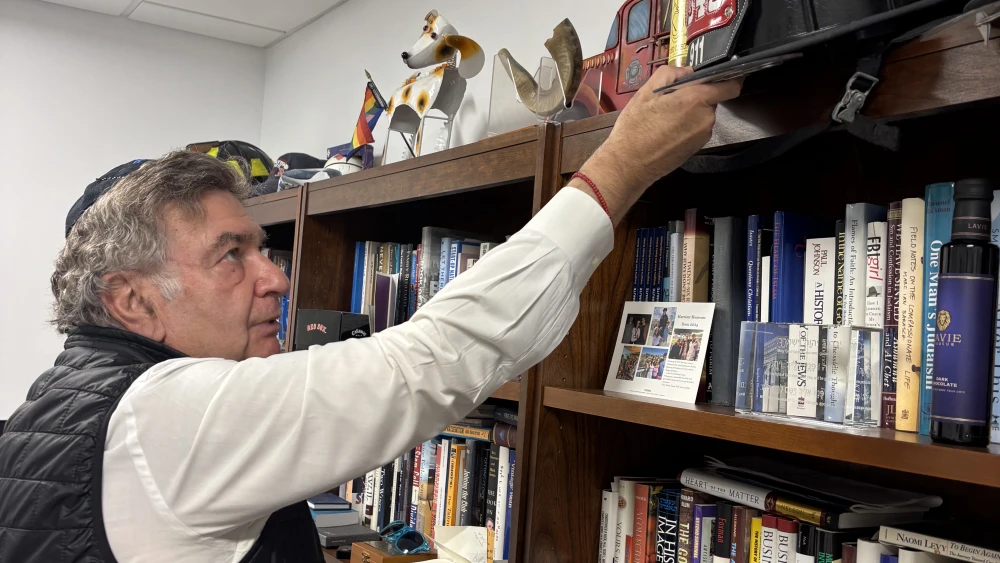
Potasnik keeps three New York City fire helmets on his shelves. One belonged to a firefighter who died on 9/11, although he does not know whose helmet it was, he told JNS. (The other two say 343, the number of firefighters who died on Sept. 11.)
His office is lined with memorabilia from his more than 40 years in New York City public life: a weathered photo of a Chanukah menorah lit at Ground Zero, FDNY kippot and two framed pictures of him with former President Bill Clinton.
“Don’t wear a name tag when you meet the president,” Potasnik quipped, directing JNS to the large, white name tag plastered across his chest. “You’ll look stupid.”
He draws inspiration from the very people he serves.
“I’ve never heard a firefighter say, even on a day off, ‘I’m too busy,’” he said. Many have died while rushing in to save lives when they were off duty, he added.
“There’s a statement in Jewish tradition: a person of ruach is a little crazy.”
“It means ‘committed,’” he said. “If you’re a person with ruach, you’re committed to the cause. Who’s more committed than firefighters, who are ready to sacrifice their lives to save lives?”
Firefighters, he said, are “blessed with faith.”
“They don’t need me to teach them to appreciate their faith,” he said. “Faith matters to most firefighters I’ve met over the years.”
Many firefighters are children or grandchildren of firefighters, continuing a family legacy, a nachala, he said, using the Hebrew for “inheritance.”
“Because a legacy is ongoing,” he said. “It doesn’t end when a person’s life ends.”
“A loved one may have been taken, but the next generation says, ‘I’m going to continue.’ ‘I want to be just like you, Dad,’” he told JNS, referencing Harry Chapin’s 1974 song “Cat’s in the Cradle.”
‘You want to be in the room’
About 30 minutes into the conversation, which ran about an hour, Potasnik shared one of his signature “one-minute sermons,” which he delivered on 1010 WINS for more than 25 years.
In the spirit of Thanksgiving, he described the concept of “unclaimed funds,” money owed to people that goes uncollected. “There’s such a thing as ‘unclaimed gratitude,’” he told JNS. “You don’t realize some of the blessings you have in your life, faith, family, friends. So claim them. Relish them.”
Potasnik also hosts a radio show, “The Rev and the Rabbi,” which airs Sunday mornings on WABC Talk Radio at 8 a.m. The show is recorded weekly at ABC Studios with Rev. A.R. Bernard.
The partnership, he said, has given him “the chance to be the Jewish guy in the room, surrounded by a number of non-Jews,” which has been “very enlightening.”
On Tuesday, it was announced that Potasnik was one of five rabbis tapped for mayor-elect Mamdani’s 400-member mayoral transition committee. (It was in his New York Board of Rabbis capacity, not FDNY.)
Potasnik, who is the only Jewish clergy member to serve on the transition committees of both Mamdani and Mayor Eric Adams, will sit on the incoming mayor’s emergency response committee. (Mamdani has said that he would have the Israeli prime minister arrested, and his press secretary recently suggested that a Nefesh B’Nefesh event encouraging Jews to make aliyah constituted a “violation of international law.”)
While JNS was still running a recorder, the rabbi took a call from a representative at the mayor’s office, who asked him about his decision to be on Mamdani’s transition team.
“You want to be a constructive voice in the room,” he told the caller. “I was at a meeting with the fire commissioner and the union head. I said, ‘Here’s the mayor. You have a choice. You want to be in the room.’”
Potasnik later told JNS that “I’m really not allowed yet to say anything in detail.”
“We haven’t been assigned specific responsibilities. We’ve just been named to a committee,” he said. “I think I’m on emergency response. That’s all I know so far.”
“We’re going to have meetings, but once again, it gives you an opportunity to have a voice,” he said. “There’s a famous movie, ‘The King’s Speech,’ where King George VI says, ‘I have a voice.’ You have a voice. You have an opportunity to be in the room and to engage in constructive conversation.”
“If you’re not at the table, imagine who will be,” he told JNS. “You want to be in the room.”
While Potasnik hopes to carve out a bit more rest in his new role, he is eager to continue serving what he sees as his purpose.
“They say God rested one day a week, so I’d like to have a little time to rest,” he told JNS. “But you know what? I love what I do. I just want to keep doing it as long as I can. They say, ‘If you love what you do, you never work a day in your life.’ So let’s continue.”
Potasnik recalled asking Sister Jean Dolores Schmidt, a nun he met who lived to 105, how she described “longevity.”
“She said, ‘You have to wake up every day with purpose,’” he told JNS. “You have to feel you’re doing something meaningful.”
“So what do I want to do?” he said. “I want to live life with purpose.”


