


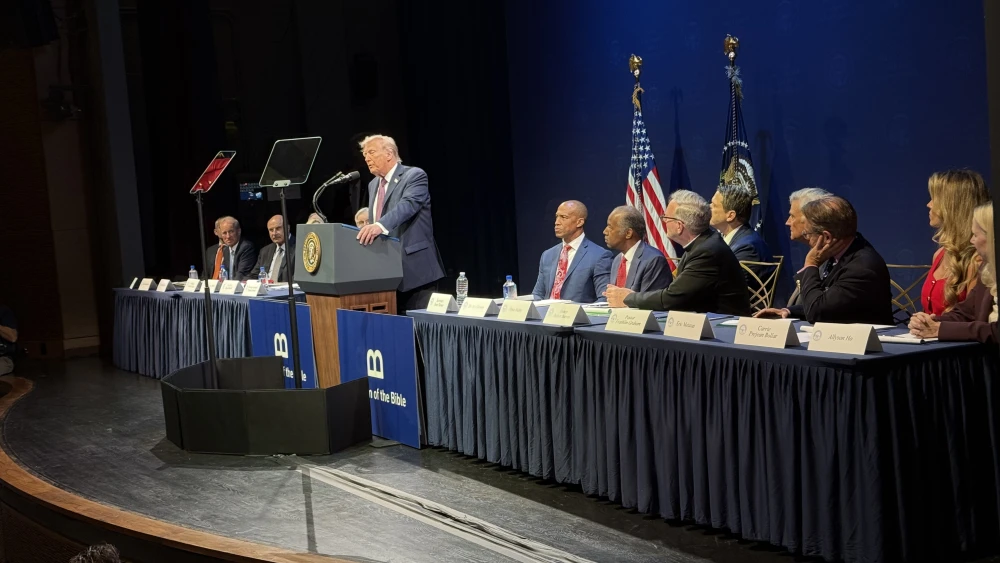
U.S. President Donald Trump had been warming up the crowd of several hundred in a Museum of the Bible theater for about 10 minutes on Monday when he turned to the founders of the private museum several blocks south of the National Mall, Steve and Jackie Green.
“The job they’ve done is just incredible. I want to say their entire family is here,” Trump said. “They founded this beautiful museum to honor the most widely read book in history, and the job they’ve done is amazing.”
“They built it up, and it was a labor of love. Well, it’s nice that he’s rich as hell, too. It always helps,” Trump said. “Where are you guys?”
Told that Steve was sitting in the back row of the front section and Jackie was a few rows ahead, Trump smirked. “They don’t even get good location,” he said. “If I did the Museum of the Bible, it wouldn’t be as successful, but I’d be sitting right here,” he said, pointing to the front row. “No, I’d be sitting up here,” he added with a laugh, pointing with both hands to the stage.
“I’m right where I wanted to be. Not in the front seat,” Steve Green, president of Hobby Lobby, which operates 1,000 stores in 48 states with more than 46,000 employees, told JNS of the second public hearing of the Religious Liberty Commission at the museum.
Green told JNS that the commission approached the museum about hosting some of its hearings. “We were happy to work with them to facilitate,” he said.
“I had heard that we were going to hear some stories, and in one sense, I’m sad that we have to have this meeting,” he told JNS. “But excited that we have a president and a commission that are specifically looking into religious liberty.”
Green is optimistic for the future. “You have to constantly be vigilant,” he told JNS. “We have to continue to protect the freedoms we have.”
He noted that the museum has an 1809 letter that Thomas Jefferson penned in the last full month of his presidency, in which he wrote that “no provision in our constitution ought to be dearer to man than that which protects the rights of conscience against the enterprises of the civil authority.”
“Obviously, religious freedom was very dear for him. He was very passionate about religious freedom and enshrined it in our Constitution,” he told JNS. “We have to continue to protect it.”
‘Never too young’
New York archbishop Cardinal Timothy Dolan delivered an invocation at the opening of the hearing. “I’ve been thinking my enthusiasm for serving on this commission really doesn’t come—you might think it would, but it really doesn’t come from my role as pastor of the Catholic flock of New York or from my own Catholic faith, however priceless both of those are to me,” he said.
“It comes because I’m a committed American citizen who strives to practice the biblical virtue of patriotism, who rejoices in the wisdom of our founders that rights come not from governments, but from God,” he said. “That the job of government is to protect our freedom, not to give them or take them away.”
Lydia Booth told the committee about an experience as a third-grader in a public school in Simpson County, Miss., when school reopened after the pandemic.
“That year was hard for everyone. We had to wear face masks all day, keep our distance, and things didn’t feel normal,” she said. “But I found something that gave me comfort. My favorite face mask. It was black with hot pink letters that had three simple words on it: ‘Jesus loves me.’ For me, those words meant something really special.”
Though she said that classmates wore masks with sports team logos or “Black Lives Matter,” Booth said administrators told her and her parents that she couldn’t wear the religiously themed mask. One administrator even edited a mask policy document shortly before sending it to Booth’s mother as proof that the mask allegedly violated policy, the student said.
“It took over two years before the district finally settled the case, agreeing to protect all students’ rights to express their faith. I was only 9 years old when this happened, but through it all, I learned something I’ll never forget,” she said. “You’re never too young for your voice to matter. If I had stayed silent, nothing would have changed. But because we spoke up, other students can wear messages of faith and love without the fear of being silenced.”
Justin Aguilar, who said that he recently graduated as valedictorian of his public high school class, described being told to remove references to Jesus from his graduation speech.
“They didn’t want his name to be on my paper. They just simply crossed his name out,” Aguilar said. “It broke my heart. These weren’t just lines on a paper or words that were crossed out, but Jesus is part of who I am. I was not allowed to mention the name of my friend—the person who means so much to me.”
“To every school teacher, administrator and district leader, you don’t have to censor students. You don’t have to be afraid of religious speech,” he said. “I believe if more teachers and school officials knew what the law actually required, they would feel more confident to reject calls of censorship.”
Dan Patrick, commission chair and lieutenant governor of Texas, told attendees that “one of our goals is to make sure America knows their rights.”
“We know the phrase that no one should come between a doctor and a patient. Well, the president believes, and we believe, no one should come between God and a believer. We know that if you’re sick, no one would say, ‘Don’t go to the doctor.’ And no one should say to someone who’s troubled and lost and searching that you cannot search for God,” he said. “No one in government or the private sector should tell you when to pray, where to pray or who to pray to.”
Eric Metaxas, a writer and radio host who is part of the commission, said that “there is nothing more important than religious liberty, and it is because most of us in this room—and most people in the country—do not understand that as a fact that we need to have this commission.”
“I look forward to the day when we don’t even need to think about a president delivering executive orders to tell us what we can and cannot do, because we already know what we can and cannot do,” he said. “But I praise the Lord that we do have a president that understands that and is opening the door.”
‘Rough people, bad people’
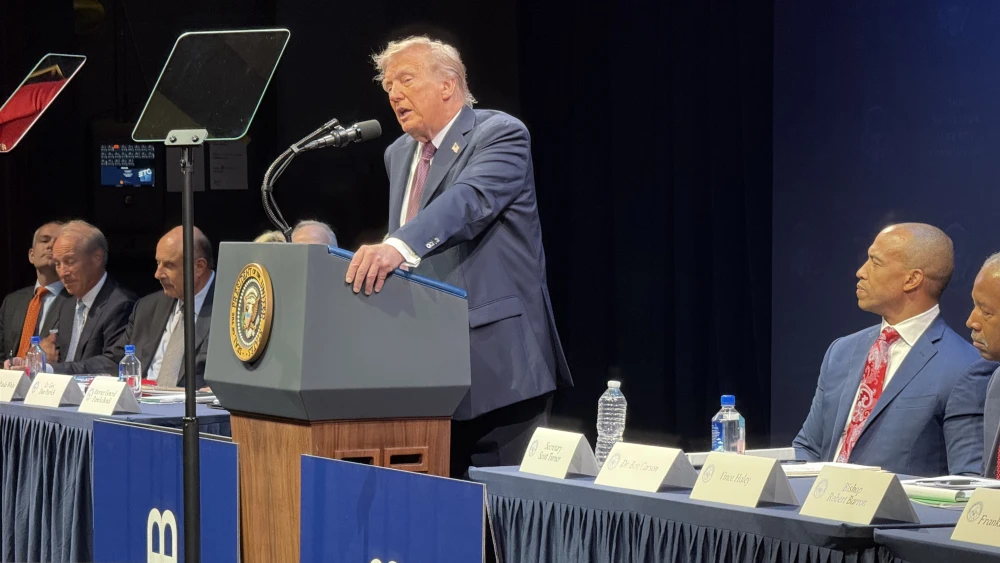
Pam Bondi, the U.S. attorney general, introduced Trump at the event, which also featured Pastor Paula White, a senior adviser to the White House Faith Office, as well as television host Phil McGraw (“Dr. Phil”), Samaritan’s Purse CEO pastor Franklin Graham, former presidential candidate Dr. Ben Carson (commission vice chair) and Catholic Bishop Robert Barron.
“For most of our country’s history, the Bible was found in every classroom in the nation. Yet in many schools today, students are instead indoctrinated with anti-religious propaganda, and some are even punished for their religious beliefs,” Trump said during remarks that often drew applause and standing ovations. “Very, very strongly punished. It’s ridiculous.”
The president said that the U.S. Department of Education will “soon” issue guidelines for “protecting the right to prayer in our public schools.”
Trump said he wants to hear from the commission members, even though he doesn’t want to hear from “a lot of people.”
“They come from a different place than me. I come from a business place, where there’s a lot of rough people, bad people. Not really religious people,” Trump said. “There are some, but you’re the people that I want to hear from. That’s why we go to church on Sundays, or we go to wherever we are—to listen to people of faith.”
Trump also said that he created the first U.S. Justice Department task force to counter anti-Christian bias.
“For those people that are a little bit naive or not well read, there is a tremendous anti-Christian bias. We don’t hear about it. We don’t think about it,” he said. “You hear about antisemitic, but you don’t hear about anti-Christian. Now you have a strong anti-Christian bias, but we’re ending that rapidly, I will tell you.”
Trump also discussed his efforts on school choice and holding schools accountable for Jew-hatred. He noted that Leo Terrell, chair of the federal Task Force to Combat Antisemitism at the U.S. Justice Department and a civil-rights attorney of 35 years, was in the crowd.
“We’re getting hundreds of millions of dollars in settlements,” Trump said. “Leo called me up, ‘Sir. You can do better than that.’ I said, ‘What am I going to do?’ I’m going to get one where he really likes it,” Trump said. “Everyone else says, ‘That’s amazing.’ Except for Leo. He says, ‘Sir. You could have gotten more.’ Oh, good. Thanks, Leo.”
Trump noted that Columbia University’s $200 million settlement, “in fines and penalties,” was “unprecedented.”
“Many more settlements are soon to follow, and they’re going to be behaving because they understand we’re coming back,” Trump said. “They would not let you have your voice. They wouldn’t let the people in this room—any of them—have the voice, because that’s not the voice they wanted to hear from. They wanted to hear from a very sinister voice.”
Trump added that his administration will curb anti-religious hate.
“The Trump administration will have no tolerance for terrorism or political violence, and that includes hate crimes against Christians, Jews or anybody else,” he said. “We’re not going to allow it.”



