


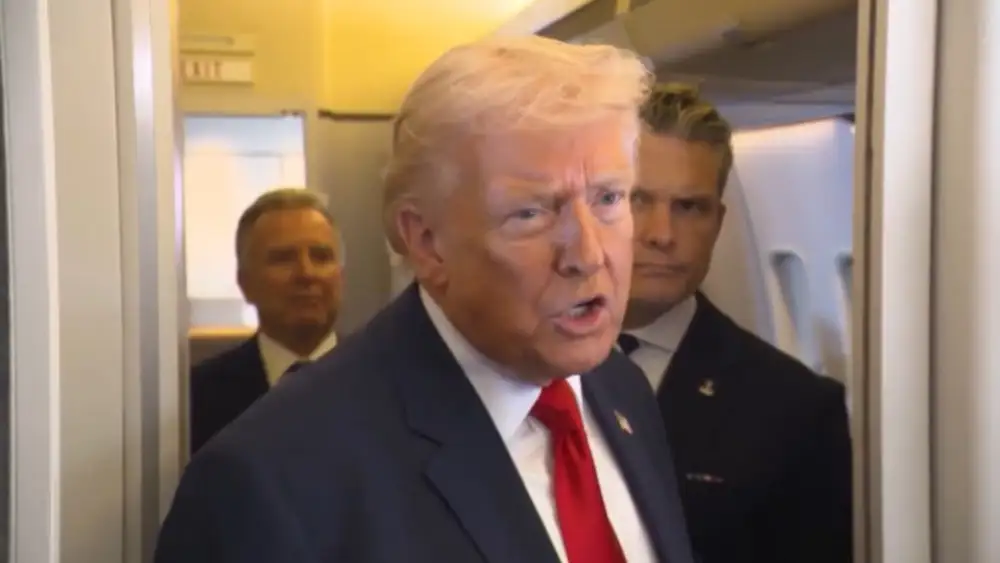
U.S. President Donald Trump emphasized to reporters aboard Air Force One on Saturday what he meant by his Friday Truth Social post, in which he said, “There will be no deal with Iran except UNCONDITIONAL SURRENDER.”
“It’s where they cry uncle, or when they can’t fight any longer and there’s nobody around to cry uncle,” the president said on his way back from Dover Air Force base to attend the transfer of six U.S. service members killed in an Iranian drone strike.
“That could happen, too, because we’ve wiped out their leadership numerous times already,” he said.
“So it’s if they surrender or if there is nobody around to surrender, but they’re rendered useless in terms of military.”
🚨 BREAKING: President Trump defines unconditional surrender in Iran as "when they CRY UNCLE"
— Eric Daugherty (@EricLDaugh) March 7, 2026
"It's where they cry uncle, or when they can't fight any longer and there's nobody around to cry uncle!"
"That could happen, too, because we've wiped out their leadership numerous… pic.twitter.com/xRuKLVevM8
Trump said he did not rule out sending U.S. troops to Iran but stressed it would happen only if he felt it was fully justified. The president initially avoided the question before acknowledging the possibility.
“Could there be? Possibly for a very good reason,” he said when asked about deploying American ground forces in “Operation Epic Fury.” He added that if the United States ever took such a step, Iran would already be “so decimated that they wouldn’t be able to fight at the ground level.”
Trump also left open the possibility of using U.S. forces to secure Iranian nuclear material. He noted the sites had been totally obliterated, but it would “be a great thing” if the U.S. could secure the material, suggesting it could be “something we could do later.”
U.S. special envoy to the Middle East Steve Witkoff, flying with the president, told press that the negotiations he led with the president’s senior adviser and son-in-law Jared Kushner had been going nowhere.
Speaking of the Iranian negotiatiors, Witkoff related: “They said, ‘We have the inalienable right to enrich.’ They bragged about having 60% enriched fuel—enough for 11 bombs. They told me and Jared ‘We’re not going to give you diplomatically what you couldn’t take militarily.’”
.@SEPeaceMissions on Iran: "They said, 'We have the inalienable right to enrich.' They bragged about having 60% enriched fuel — enough for 11 bombs. They told me and @jaredkushner, 'We're not going to give you diplomatically what you couldn't take militarily.'" pic.twitter.com/0oJC1rEYJ6
— Rapid Response 47 (@RapidResponse47) March 8, 2026



