Newsletter
Newsletter Support JNS

UMass Amherst reviews event it plans to host after learning organizer boycotts Israel

A spokeswoman for the public school told JNS that it “fundamentally opposes academic boycotts of any kind.”

University of Massachusetts Amherst
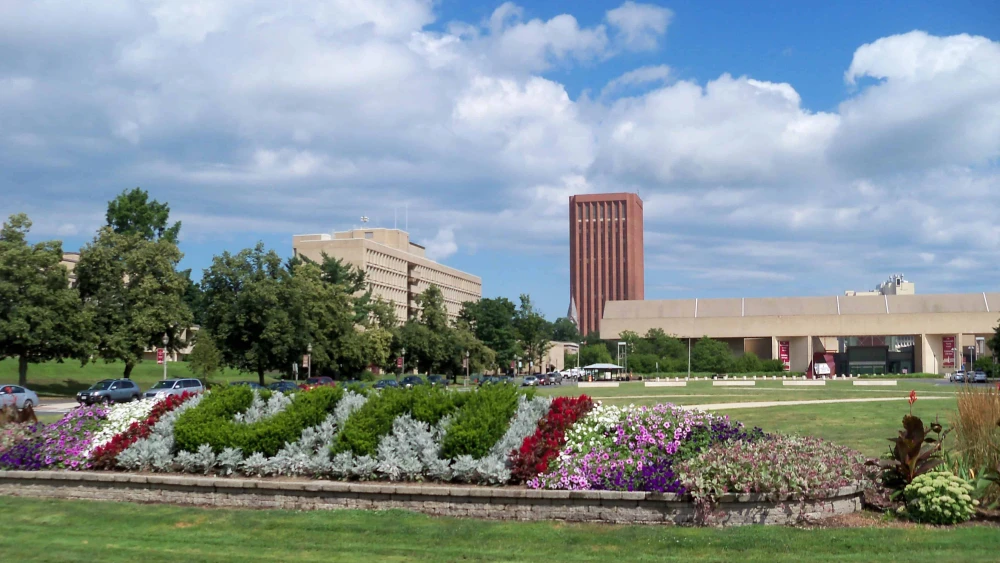
The University of Massachusetts Amherst, the flagship campus of the UMass system, in Amherst, Mass. Credit: AlexiusHoratius via Wikimedia Commons.

The University of Massachusetts Amherst, a highly ranked public school, is reviewing an upcoming conference that it plans to host in November after learning that the organizer excludes scholars who receive funding from Israeli institutions.

“The university has the matter under review,” Emily Gest, associate vice chancellor for news and media relations at the university, told JNS.

“The University of Massachusetts fundamentally opposes academic boycotts of any kind, including the BDS movement,” Gest said, referring to the movement to boycott Israel.

The Coalition of Women in German, a more than 50-year-old group based at the University of Notre Dame in Indiana, which doesn’t state the size of its membership, is scheduled to hold a conference at UMass Amherst from Nov. 6 to Nov. 9.

Rory Lancman, senior counsel at the Louis D. Brandeis Center for Human Rights Under Law, wrote to the university on Wednesday asking it to stop the group’s boycott policy.

“Israeli scholars must be allowed the same opportunities as scholars from every other country,” Lancman wrote. He added that the group “effectively bars Israeli students and academics from attending and participating” in the conference.

Gest told JNS that “the university does not condone viewpoint discrimination, nor does it exclude individuals from participation in academic conferences or events based on their beliefs.”

“Consistent adherence to these principles means oftentimes hosting conferences and speakers, with whose views some in our community may disagree,” she said.

Aaron Bandler is an award-winning national reporter at JNS based in Los Angeles. Originally from the San Francisco Bay Area, he worked for nearly eight years at the Jewish Journal, and before that, at the Daily Wire.
“What started a little more than 30 years ago as basic relations of seller and buyer has evolved dramatically to the highest level,” said former Israeli Ambassador to India Ron Malka.
Alan Meltzer praised the Jewish-non-Jewish collaboration behind Stuttgart’s “Anti-Anti 2.0” initiative and held talks with leaders in Baden-Württemberg.
The U.S. secretary of state will travel to the UAE, Kuwait and Bahrain to discuss regional priorities, including the U.S. agreement with Tehran and efforts to secure the Strait of Hormuz.
“It cannot be overstated that ISIS continues to pose a threat to U.S. interests, both domestically and abroad,” said Reid Davis, the FBI Special Agent in Charge in North Carolina.
“He was a giant of a man who helped shape the U.S. economy for decades under presidents of both parties but was always honest in acknowledging his mistakes,” his widow Andrea Mitchell told NBC.
Rapid, tech-driven strikes killed Tehran’s top commanders in seconds and secured air superiority in hours, the Rafael chair and former minister said.
Benny Gantz, JNS editor-in-chief Jonathan S. Tobin, Gilad Erdan, Mosab Hassan Yousef, Nissim Black and leading voices in security, diplomacy, media, law and Jewish communal affairs headline the summit’s third day in Jerusalem.