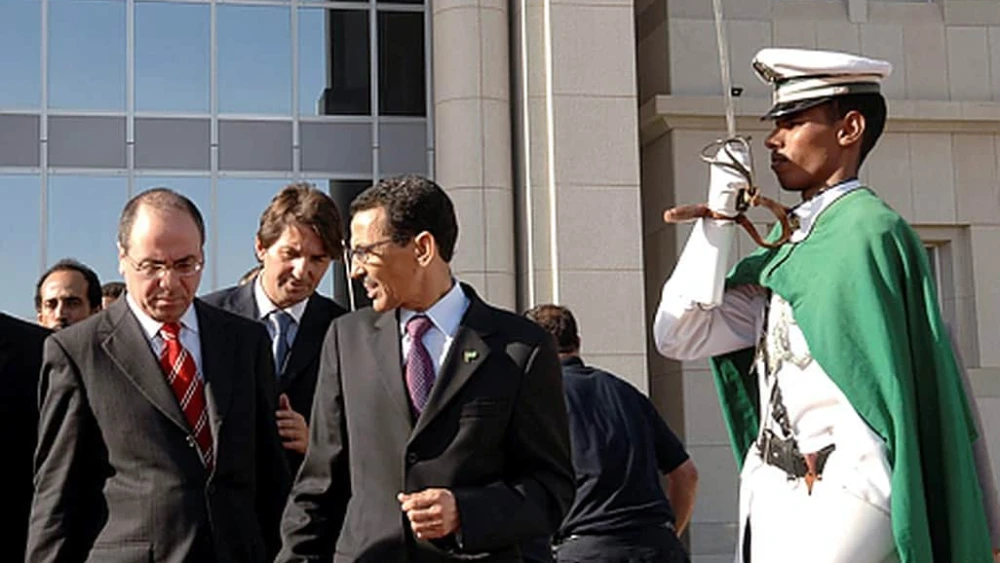
A pro-Iranian website reported on Monday that high-ranking Israeli and Mauritanian intelligence and security officials recently held a clandestine meeting mediated by the United Arab Emirates.
In recent months, Arab media has been rife with reports suggesting that Israel is actively pursuing normalization with countries such as Mauritania, Somalia, Niger, Indonesia and Libya with U.S. involvement.
Mauritania and Israel had diplomatic relations from 1999 to 2010. But Nouakchott severed relations, following strain over a 2009 Israeli military operation in the Gaza Strip.
According to the Lebanon-based monthly newspaper Al-Khandak, David Meidan, a former Mossad official who currently works in the Israeli Prime Minister’s Office, met with an adviser to Mauritania’s intelligence chief.
The meeting—held at the official residence of Emirati President Sheikh Mohamed bin Zayed—was also arranged with the help of Muhammad Dahlan, a former Fatah official and rival of Palestinian Authority leader Mahmoud Abbas, according to the report.
Dahlan, a former high-level figure within Fatah, was the P.A.’s Gaza “strong man” when Hamas violently seized control of the Strip in 2007. He had a falling out with P.A. leader Mahmoud Abbas as he regained influence and was expelled from Fatah in 2011. Dahlan was later tried in absentia in Ramallah on charges of corruption. Dahlan, who lives in the UAE, says the charges are politically motivated.
Meidan was Israel’s emissary for negotiations related to the 2011 Gilad Shalit prisoner exchange. Israel released 1,027 Palestinian and Arab-Israeli security prisoners in exchange for the soldier, who was abducted by Hamas in 2006.
Mauritania’s relationship with Israel has been a tumultuous one. In 1999, the Western African nation became the third country, following Egypt and Jordan, to formally recognize Israel. Those ties were strained by the Gaza conflict of 2009, and under pressure from Iran, Nouakchott broke off relations the next year.
Despite opposition from some Muslim clerics in Mauritania in recent years against normalizing relations with Israel, Mauritania supported the Abraham Accords, in which the UAE, Bahrain and Morocco normalized relations with Israel in 2020, being joined a year later by Sudan.
Israel’s role in Mauritania has historically revolved around medicine, agriculture and communications. In recent years, Tehran has submitted a number of economic projects in Western Africa aimed at bolstering Iranian influence in the region.
Israeli officials refused to comment on the Al-Khandak report.