Israeli Prime Minister Benjamin Netanyahu ordered the cancellation of traditional Lag B’Omer celebrations on Mount Meron in the Upper Galilee, scheduled for May 4–5, amid ongoing Hezbollah attacks.
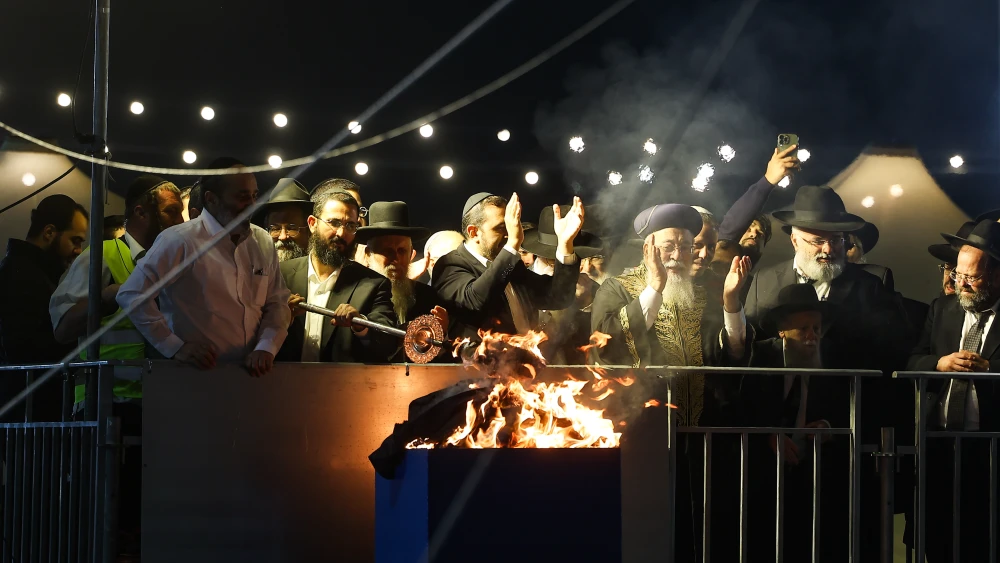
The annual celebrations at Mount Meron on Lag B’Omer mark the anniversary (hilula) of the death of Rabbi Shimon Bar Yochai, a second-century Jewish sage and mystic. The event usually draws tens of thousands of mostly Orthodox Jewish pilgrims who gather at the tomb for traditional bonfires, prayer and music.
Cabinet Secretary Yossi Fuchs noted in an overnight letter to ministers on Sunday that “following several security assessments on the matter, and in light of the [Israel Defense Forces] Home Front Command’s updated defensive policy limiting gatherings to up to 1,500 people, the celebrations of the hilula of Rabbi Shimon bar Yochai at Meron will not take place this year with large participation, but rather in a symbolic format only, in accordance with the defensive policy, which is not expected to change by the time of the hilula.”
Fuchs’s missive cited fears of a mass-casualty event “due to the fragility of the ceasefire with Lebanon, the site’s proximity to the Lebanese border, rocket fire toward the area and the difficulty of conducting large-scale evacuations of participants.”
Hezbollah began firing rockets, missiles and drones at Israel on March 2, in retaliation for the Jewish state’s targeted killing of Iranian Supreme Leader Ali Khamenei. Khamenei was killed in the opening strikes of “Operation Roaring Lion/Epic Fury” against the Islamic regime on Feb. 28.
In response to the terrorist organization’s violation of the U.S.-brokered Nov. 27, 2024, truce agreement, Jerusalem launched an aerial campaign against Hezbollah and ordered IDF troops to advance and take control of additional areas in Southern Lebanon to halt cross-border attacks.
Jerusalem and Beirut on April 16 agreed to a 10-day ceasefire following mediation by U.S. President Donald Trump. Last week, the two countries agreed to extend the ceasefire for three more weeks following historic direct talks in Washington, D.C.
However, Netanyahu on Sunday accused Hezbollah of “essentially disintegrating the ceasefire” through its incessant attacks.
“Therefore, as far as we are concerned, what obligates us is the security of Israel, the security of our soldiers, and the security of our communities,” the premier said. “We are acting vigorously according to the rules we agreed upon with the United States, and incidentally, with Lebanon as well.”
The IDF will maintain its freedom “not only to respond to attacks, which is obvious, but to thwart immediate threats and also to neutralize emerging threats,” he added.