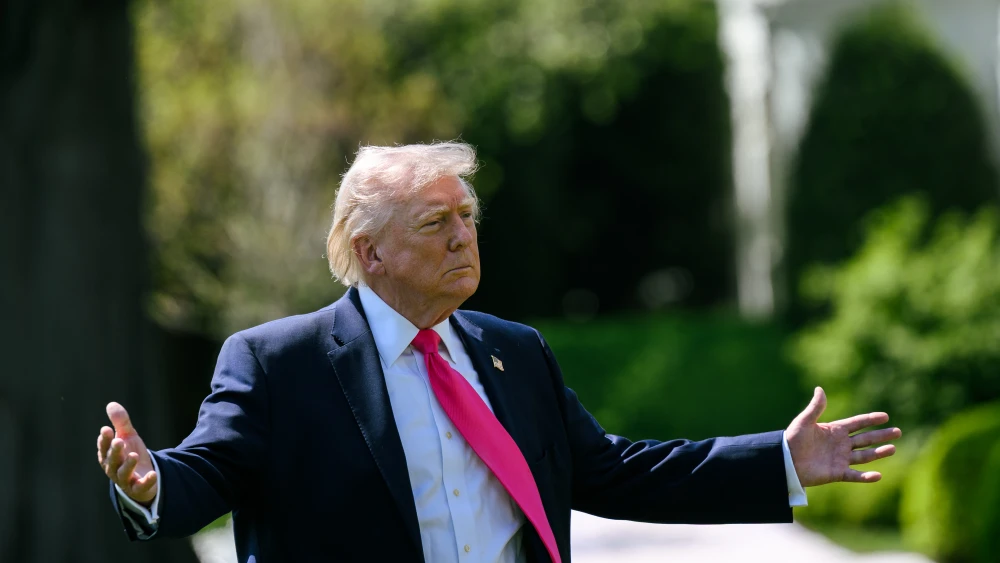

This is the third time someone has tried to kill Donald Trump—twice in 2024, and now in Washington, where in 1983 Ronald Reagan was also the target of a shooting attack and was wounded. On other occasions, Iranians have also tried to reach and eliminate the American president. As Trump said in an elegant press conference as a survivor, those who try to do something exceptional often risk their lives; they anger their enemies.
Many American presidents have been the target of fierce hatred, fueled by anti-Americanism, envy and ideology. The Vietnam War and the Iraq War brought endless insults upon Presidents Bush and Lyndon Johnson—both were labeled Nazis, baby killers, imperialists.
But with Trump it is different: it is mockery, rejection, fear. The drive to remove him from the international stage is not confined to left-wing demonstrations, even if it is not irrelevant that the attacker is said to have admired former Vice President Kamala Harris.
The hope to see him disappear is psychological; the irritation and rejection are far more intense than usual and are shared by large numbers of politicians. Dislike of him creates alliances that would otherwise not exist in Europe.
The declaration that one cannot stand Trump has become almost a prerequisite for social acceptance. Of course, it is legitimate to reject his policies, but often what disturbs people is that he is American, that he is wealthy, that he has a beautiful wife and the mannerisms of a spoiled cowboy.
His disruption of the world order is unwelcome because it challenges a balance that is more imagined than real—the idea that peace will come from a presumed reconciliation between the Christian and Islamic worlds. Trump has touched this point.
The war is long, he takes his time, and this is immediately seen as weakness. He reacts to Iranian aggression in the Gulf and is blamed for energy disruptions; he challenges Iran’s possession of enriched uranium and makes it a central objective, yet he is told—despite evidence, including from the IAEA—that it does not exist.
Trump has envisioned a world in which Iran is finally defeated. Imagine such a world—one without the execution of women, homosexuals and dissidents; without powerful weapons aimed first at destroying Israel and then the rest of the “Satans” that refuse to convert to Islam; without mass attacks on Americans and Jews worldwide; without terrorist armies like Hamas and Hezbollah poisoning the international system.
The road is long, but who has said it is “illegal”? Bill Clinton bombed Kosovo for 78 days, Barack Obama bombed Libya, Joe Biden struck the Houthis and Iraqi militias. None of them consulted Congress, nor the United Nations, nor NATO.
This does not mean one must like Trump, and his war clearly seeks concrete advantages for his country, as well as limiting Russian and Chinese power—both key backers in the Middle East conflict. But his actions offer no justification for becoming a target of international scorn, ridicule or incitement to violence.
Yet even before his election, Emmanuel Macron warned against his arrival, Olaf Scholz said that “the United States does not guarantee security,” Josep Borrell insisted Trump is “unpredictable,” and Kaja Kallas even declared that “the free world needs new leaders.”
From this emerges a vulgarity in which only harsh insults are acceptable—“fascist,” or condescending dismissal, “poor fool.”
Thus, Robert De Niro shouts, “F*** Trump;” Madonna says, “I have thought a lot about blowing up the White House,” and Johnny Depp asks, “When was the last time an actor assassinated a president?” Italy, for its part, has become a champion of grotesque portrayals of Trump that spill over into street-level hostility.
No one seems to know anymore who he really is: a president who, whatever criticisms may be made of any political leader, has attempted the bold and revolutionary path of confronting the Iranian regime—the most odious of dictatorships and the most dangerous to the world to which we belong.