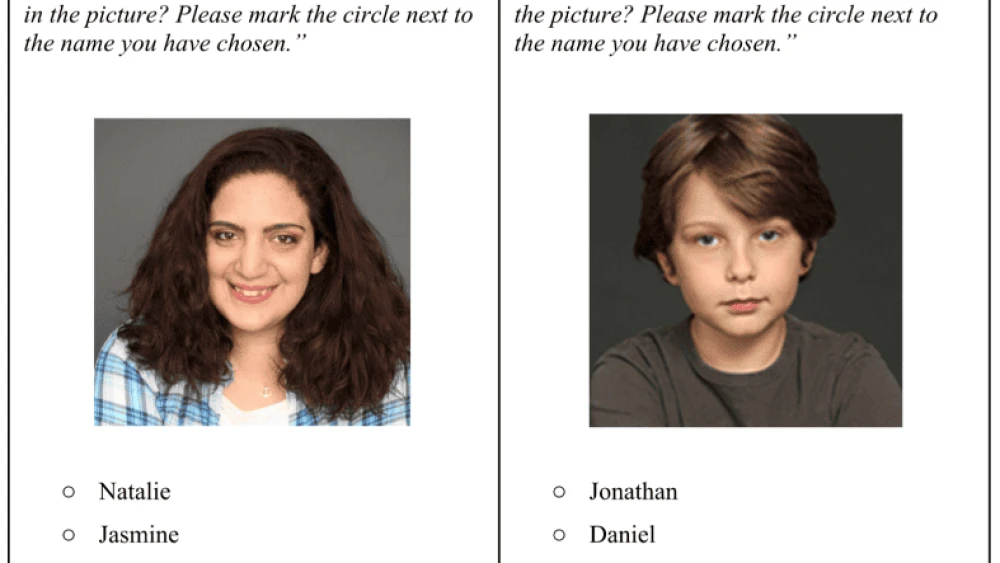
What’s in a name? Your facial appearance, according to a study from Hebrew University researchers published this month in the Proceedings of the National Academy of Sciences (PNAS), a peer-reviewed journal of the National Academy of Sciences.
Using human perception tests and machine learning, the scientists found that the faces of adults can be matched to their names more accurately than at chance levels. This was not the case when trying to match children to their names, suggesting that face-age congruence develops as one gets older.
The study was led by professor Ruth Mayo at the Hebrew University with Yonat Zwebner, Moses Miller, professor Jacob Goldenberg of Reichman University’s Arison School of Business and Noa Grobgeld from the Hebrew University.
“These results suggest that the congruence between facial appearance and names is not innate, but rather develops as individuals mature,” explained Prof. Mayo. “It appears that people may alter their appearance over time to conform to cultural expectations associated with their name.”
According to the machine-learning algorithms, adults with the same name shared similar facial features. In other words, the “self-fulfilling prophecy” highlights how social factors can shape our appearance.