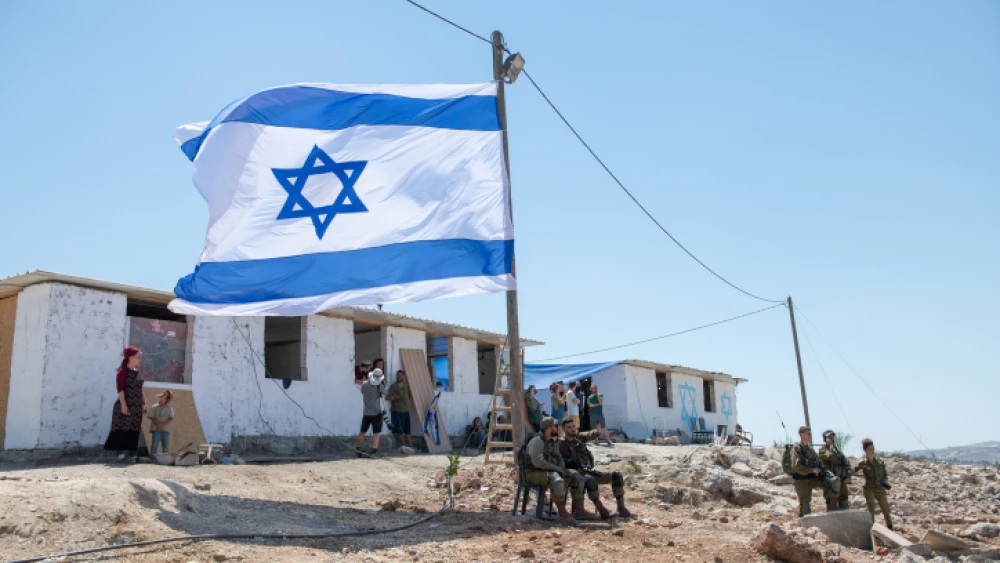
The Israeli military on Thursday evacuated the office set up by Religious Zionism Party lawmaker Tzvi Sukkot at the Evyatar outpost in Samaria, Israeli media reported.
The military had temporarily allowed the legislator to set up his parliamentary office there, while limiting his staff to a single aide.
“It’s time we returned to Evyatar,” Sukkot said from the site, from which Jews have repeatedly been evacuated. “In addition to the security steps taken against terrorism, this is the right and proper settlement answer to all those attempting to uproot us from the Land of Israel,” he added.
“This is one stone on the way to our complete return to the community, as was agreed and as must be,” he Sukkot.
Israeli security forces evacuated Evyatar on Monday, after a group of some 450 Jews entered the outpost the previous day in response to a deadly terror attack that killed Israeli brothers in the village of Huwara.
Upon their entry to Evyatar, the group said in a statement that “the families of Evyatar and dozens of yeshiva students decided to return tonight to the settlement following the attack in the village of Huwara in which Hallel and Yagel Yaniv were murdered, and after about a year and a half in which the government did not fulfill the agreement it signed with the [former] residents.”
Sukkot, one of the founders of Evyatar, spent the night at the abandoned outpost, and visited his old home, which he found had been destroyed.
Evyatar was established in 2013 just days after a shooting attack nearby killed yeshiva student Evyatar Borovsky. After being repeatedly evacuated, it was more formally reestablished in May 2021 in response to the killing of Yehuda Guetta, 19, who was shot at a bus stop by a Palestinian terrorist not far from the community.
What began as a tent encampment quickly gave way to more permanent structures. But in July 2021, 53 families vacated Evyatar under an agreement struck with the government that allowed for the village to remain intact and under permanent supervision of the Israel Defense Forces. In return, the government vowed to carry out a survey of the land in order to determine its status.
If the land is determined to belong to the state, the government agreed to immediately establish a yeshiva in Evyatar and subsequently allow a permanent civilian presence.
The Evyatar families have repeatedly accused the government of dragging its feet with respect to conducting the land survey.