Israeli security agencies on Sunday exposed a Hamas-operated money exchange network based in Turkey and directed by Iran, that transferred hundreds of millions of dollars to Gaza terrorists.
The Israel Defense Forces and Israel Security Agency (Shin Bet) said files they uncovered show that Gazans living in Turkey have been operating the terror group’s money-changing network, “exploiting the country’s financial infrastructure for terrorist purposes,” with Tehran’s help.
According to Avichay Adraee, head of the Arab Media Branch in the IDF Spokesperson’s Unit, the Palestinian financial network has “managed wide-ranging economic operations in the heart of Turkey, including receiving Iranian funds, storing them and wiring them to Hamas.”
The military spokesman released documents apparently documenting several transactions totaling hundreds of thousands of dollars, which Adraee stressed represented just a fraction of the network’s activity.
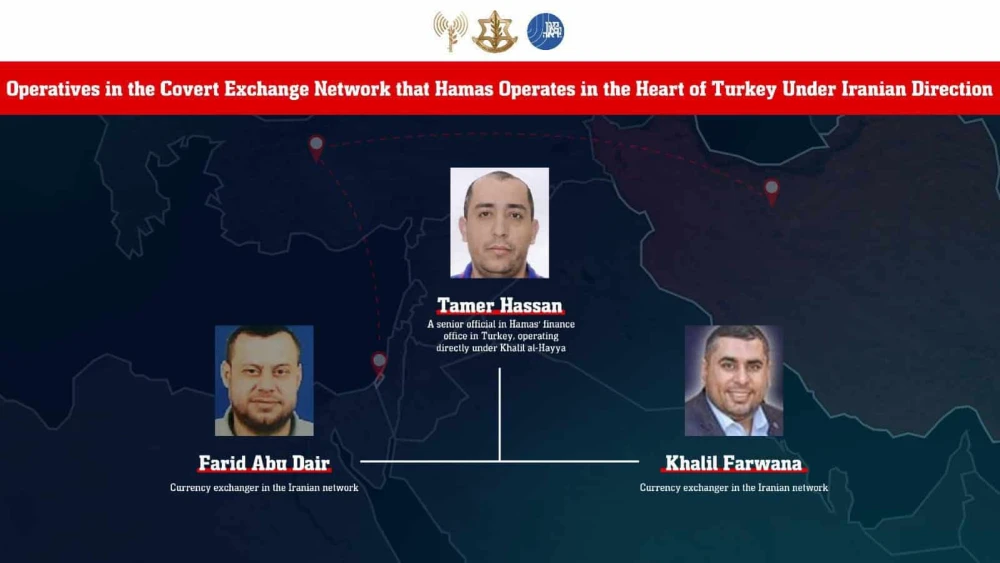
Adraee also identified three operatives: Tamer Hassan, a Turkey-based senior official in Hamas’s “finance ministry” operating under Khalil al-Hayya, along with money changers Khalil Farwana and Farid Abu Dair.
“The Hamas terror group—with support and encouragement from the Iranian regime—after causing the destruction of the Gaza Strip, persists in its pursuit of terrorist plots against the State of Israel and attempts to rebuild its capabilities, including outside the Strip,” Adraee continued.
He reiterated an IDF and Shin Bet warning against “establishing any relations or dealings with this money exchange network or with any other economic arms affiliated with the Hamas terror organization.”
Israeli opposition leader Yair Lapid (Yesh Atid Party) told JNS on Monday afternoon that Ankara’s link to the Hamas money exchange once again proves that “what we need inside Gaza is not Turkey and Qatar, but the Egyptians as the leading force” in re-establishing the Strip after the war.
“Turkey is not a normal broker on this one, and we need somebody we can trust and cooperate with on security issues inside Gaza,” he stated.
On Nov. 27, the Shin Bet revealed that several Israeli Arab citizens, including one based in Turkey, had tried to supply arms and funds to Hamas terrorists in Judea and Samaria.
Turkey-based Israeli citizen Ahmed Tsartsur used “family connections and friendships to establish a network for transferring arms and funds to Judea and Samaria,” the ISA stated. The terror funds, estimated at hundreds of thousands of shekels, may have been intended for attacks.
The money was transferred through cryptocurrency and then converted to cash that was used to purchase weapons from dealers in the Negev. The arms were then transferred to Judea and Samaria, the ISA said.
“This is a serious case that reveals how individuals in Turkey, including Arab Israelis and citizens naturalized under family reunification [laws], are using their contacts in Israel and access to Judea and Samaria to transfer arms and funds that may end up with terrorists,” it added.