The entire jury of the Venice Biennale resigned this week, shortly after announcing the exclusion of the Israeli and Russian pavilions from the event, one of the world’s most prestigious contemporary art happenings.
The international jury of five judges announced the resignation last week in a statement, adding only that it was “in acknowledgment” of their statement the previous week, which said the jury “will refrain from considering those countries whose leaders are currently charged with crimes against humanity by the International Criminal Court.”
The jury did not say what led to the resignation.
Russian President Vladimir Putin and Israeli Prime Minister Benjamin Netanyahu are the only sitting world leaders with an ICC war crimes indictment against them. The art show’s organizers had disagreements in recent days over the decision to readmit Russia after a four-year absence connected to Russia’s war with Ukraine.
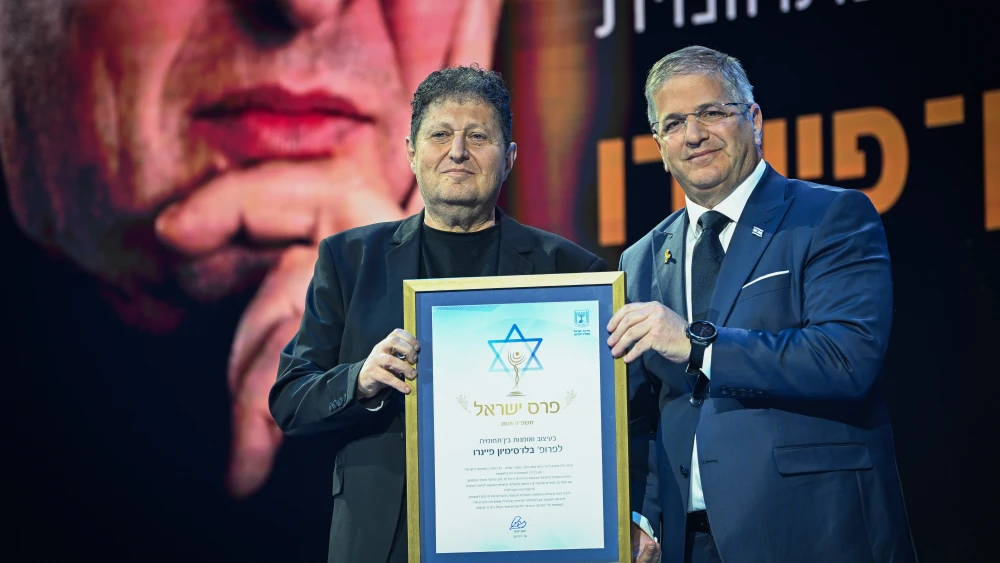
Israel last week condemned the exclusion. “The boycott of Israeli artist Belu-Simion Fainaru by the International Jury of the Venice Biennale is a contamination of the art world,” wrote the Israeli Foreign Ministry. “The political jury has transformed the Biennale from an open artistic space of free, boundless ideas into a spectacle of false, anti-Israeli political indoctrination,” the statement continued. Fainaru, who won last year’s Israel Prize for the arts, wrote last week on Facebook: “Unfortunately, the Biennale may end up being less about the art on display and more about the turbulent world surrounding it.”
The boycott of Israeli artist Belu-Simion Fainaru by the International Jury of the Venice Biennale is a contamination of the art world.
— Israel Foreign Ministry (@IsraelMFA) April 26, 2026
The political jury has transformed the Biennale from an open artistic space of free, boundless ideas into a spectacle of false, anti-Israeli…
The Biennale Foundation, which runs the event and employs the jury, confirmed the jury’s resignation, which followed controversies and internal disagreements about Russian and Israeli participation in the 61st edition of the Biennale, titled “In Minor Keys,” which is due to open on May 9.
Davide Romano, the director of the Jewish Brigade Museum in Milan, criticized the policy that lumped Russia and Israel together.
“The jury is making a vital error in perspective,” Romano told JNS. “It’s the failure to distinguish between dictatorships and democracies,” he continued. While art in authoritarian regimes is often “a tool for propaganda,” Romano added, “in a democracy like Israel, artists are free voices, often critical of their own government. Excluding Israel means censoring autonomy rather than targeting a regime, turning the Biennale into a tribunal that, in seeking arbitrary justice, ends up discriminating against the very expression of freedom.”
Russia was scheduled to return to the Biennale for the first time since its 2022 invasion of Ukraine. The European Commission reportedly warned the Biennale earlier this month that it could lose up to two million euros in E.U. subsidies if it reinstated Russia, which is under E.U. sanctions.
Following the threats, the Biennale Foundation said that the Russian pavilion would open only during press previews on May 5-8, but remain closed during the main event and exhibition, which ends in November.
Italian culture minister Alexander Giuli said he would not attend the opening ceremony and called for the resignation of a board member, Tamara Gregoretti, who reportedly had supported readmitting Russia.
Giuli was among 22 E.U. culture ministers who last month signed a joint letter opposing Russian participation.
Earlier this year, South Africa’s minister of culture, Gayton McKenzie reportedly vetoed a display by South African artists about what they called the “unfolding crisis of displacement and death in Gaza.”
McKenzie’s pro-Israel, right-wing Patriotic Alliance Party is part of the ruling coalition headed by the African National Congress. That party has grown increasingly anti-Israel in recent years, and its politicians are behind the South African government’s disputed lawsuit for genocide against Israel at the International Court of Justice.
The Venice Biennale, which is focused on plastic arts, is sometimes referred to as the art world’s Olympic Games. Governments select the delegations and artists, and fund their projects in what is widely regarded as an opportunity for public diplomacy. For the presenting artists, being shown in Venice is often treated like a career milestone, similar to Cannes for film.