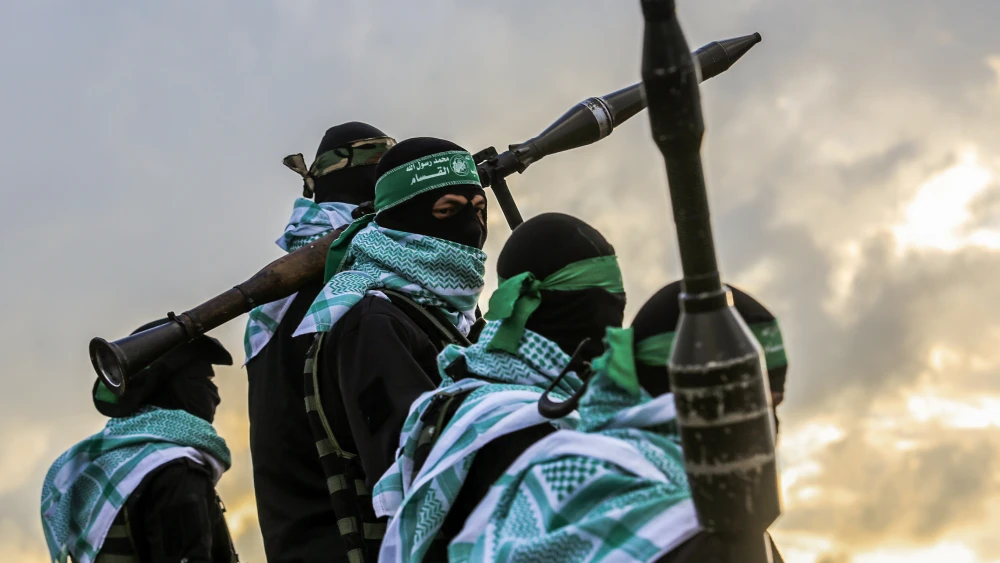
A top-level Israel Defense Forces probe into the March 23 incident that led to the deaths in southern Gaza of at least 14 Palestinians, including several first responders, confirmed that at least six of the fatalities were identified by the military as Hamas terrorists.
The probe by Chief of Staff Lt. Gen. Eyal Zamir “indicated that the troops opened fire due to a perceived threat following a previous encounter in the area, and that six of the individuals killed in the incident were identified as Hamas terrorists,” the IDF announced on Monday.
Zamir ordered the inquiry “be pursued in greater depth” in the coming days by the General Staff’s investigation mechanism—an independent body not subordinate to him, headed by Maj. Gen. (res.) Yoav Har-Even.
“The IDF is conducting an inquiry into the incident, which took place in a combat zone, to uncover the truth,” the army statement emphasized, adding: “All the claims raised regarding the incident will be examined through the mechanism and presented in a detailed and thorough manner for a decision on how to handle the event.”
United Nations officials expressed outrage earlier this month about the incident in Rafah’s Tel Sultan neighborhood, in which the bodies of several Palestinian paramedics, as well as one U.N. employee, were allegedly buried by the IDF in a bulldozed grave in the Gaza Strip.
The U.N. claimed IDF soldiers killed 15 aid workers, struck additional units who followed and buried the personnel and their ambulance. The IDF said the emergency vehicles in question approached its military positions in a suspicious manner and without prior coordination.
An initial IDF probe published on Saturday found that the soldiers were surprised by the convoy stopping next to an abandoned Hamas vehicle, and by several suspects jumping out of the ambulance and running.
The IDF rejected claims that it buried the bodies in an unmarked mass grave without informing anyone, saying troops collected the bodies in one spot, covered them with sand, and notified the United Nations.
The military explained that burying bodies in this way was an approved and common practice during the past 18 months of fighting in the Gaza Strip to prevent wild dogs and other animals from eating the corpses.
On April 4, Danny Danon, the Israeli ambassador to the U.N., decried the world body’s rush to judgment, stating that nine Hamas members, including Mohammad Amin Ibrahim Shubaki, a terrorist who took part in Hamas’s Oct. 7, 2023, massacre, were traveling in the ambulances.
“How did nine Hamas terrorists find themselves traveling inside Red Crescent ambulances? The presence of those terrorists puts everyone’s lives at risk,” Danon said at the U.N. Security Council meeting. “If we truly want to protect civilians and humanitarian workers, the vetting system of such organizations must improve immediately.”
“Every death, including those of U.N. and humanitarian workers that many have discussed today, would have been avoided had Hamas accepted the bridge [ceasefire] proposal on the table last month,” Dorothy Shea, interim U.S. envoy to the U.S., told the council.
Other vehicles passing safely along the same route on March 23 had coordinated their movements with the IDF, Shea said in her remarks.
“Hamas’s reckless decisions have caused enough bloodshed,” she said. “They have no right to represent Palestinians anywhere and must leave Gaza.”
Volker Türk, the U.N. high commissioner for human rights, told the council that “there must be an independent, prompt and thorough investigation into the killings, and those responsible for any violation of international law must be held to account.”