The Israeli government is poised to launch the partial privatization of its largest state-owned defense companies, Israel Aerospace Industries and Rafael Advanced Defense Systems, as the Defense Ministry works with more startups than ever to accelerate the development of new military capabilities.
Israel is preparing to sell minority stakes in both companies within the coming months, according to a report by Reuters.
The sale of shares to the public is expected to generate significant capital. The move comes as the Israeli defense establishment increasingly prioritizes agility and the rapid integration of new technologies to face evolving threats.
Brig. Gen. (res.) Daniel Gold, head of the Defense Research and Development Directorate (DDR&D) at the Ministry of Defense, said on Wednesday that the issue of privatizing IAI and Rafael has been under discussion for many years, and that the move has advantages and disadvantages.
While the companies’ development and fielding processes are already rapid, privatization could further boost efficiency, while enabling them to raise funds, Gold stated during a briefing for the media at the Defense Ministry’s headquarters in Tel Aviv.
Within the industry, the potential privatization is viewed with a degree of optimism regarding the financial implications for the workforce. An industry source said the privatization could create more financially attractive conditions for employees.
Meanwhile, the DDR&D is actively pushing for a shift in how Israel’s three largest defense firms—IAI, Rafael and Elbit Systems—interact with the civilian startup tech sector.
Israeli companies work fast
Gold said he has been encouraging Israel’s large defense companies to work with small startups, rather than to buy them, to further speed development. The goal is to leverage the “faster and cheaper” aspects of Israeli startups, he said, traits that accelerate the arms race in Israel’s favor, and which can also be leveraged to attract venture capital.
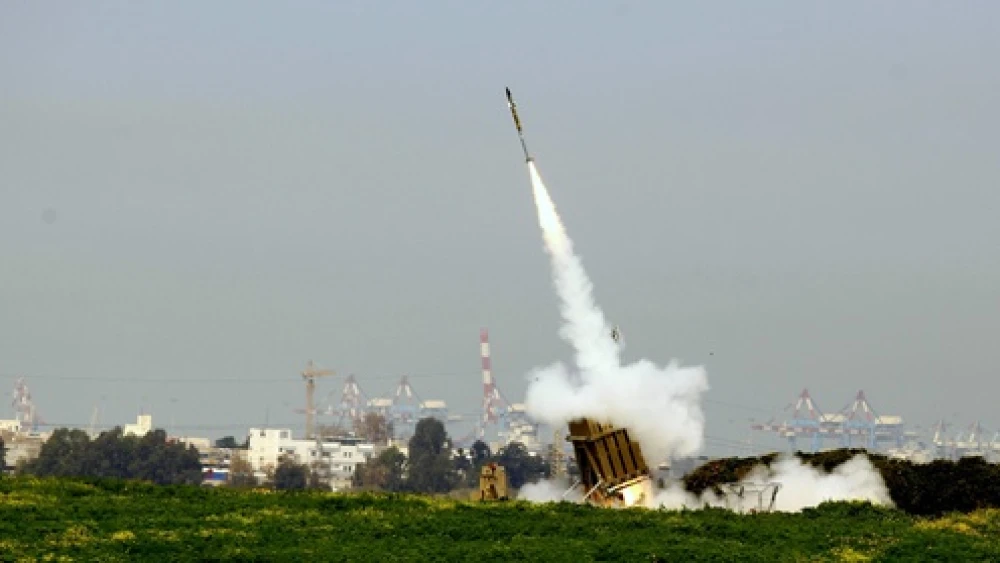
He emphasized that the Israeli defense ecosystem is defined by its speed, a necessity driven by constant and immediate security needs. He cited the testing protocol for the Iron Dome air defense system, made by Rafael, as a prime example.
“Israeli companies work fast. All of these companies are working in the same eco system,” Gold said, describing a process that squeezes a year’s worth of field testing and improvements into a two-week daily process.
“We go into the field at 6 a.m., shoot [Iron Dome interceptors], look at the report, make improvements, and at 6 a.m. [the next day], we shoot again. We do this for two weeks,” Gold said.
This approach is in contrast to the slower approach of going back to the lab for lengthy analytics procedures before making improvements.
This rapid assimilation of improvements and the ability to test technology in actual wars make the Israeli defense industrial base an invaluable partner to the United States, he added.
Gold noted that Israel has made all of its innovations available to the United States’ own Golden Dome national missile defense program, envisioned by President Donald Trump as a multi-layered shield protecting the U.S. homeland against ballistic, hypersonic and cruise missiles.
Simultaneously, Israel is expanding its domestic supply chains. Gold said that Israel has invested billions of shekels in domestic weapons production lines to ensure it can always produce its own high end, battle tested capabilities, and to immunize itself against embargoes or global shortages, as Israel experienced during the recent war.
The DDR&D, which employs some 1,000 personnel and runs approximately 1,800 projects at any given time, is looking toward the next generation of warfare.
The directorate’s goals are to improve classic defense capabilities, innovate new defense technologies, and work even more closely with hundreds of civilian startups to fast-track new capabilities, delivering them to the Israeli defense community’s arsenal of tools.
Gold, who was awarded the Israel National Defense Prize in 2012 for his lead role in bringing Iron Dome online just three years after the program launched, said he is heavily focused on artificial intelligence.
The DDR&D is running AI-infused projects designed to defend Israel from all directions and all borders, increasingly relying on AI to sift through vast quantities of data and flag early alerts, to enhance human decision-making, he said.
To that end, the directorate has established a joint AI development lab that can process all forms of operational data.
This ability will be used to enhance border protection, boost future military ground offensives, tell enemies apart from friendly forces, and manage weapons development programs, according to Gold.
The operational impact of these systems was already felt during the June war against Iran.
During that conflict, the Israeli defense establishment analyzed 12,000 satellite images and used them to plan dozens of urgent intelligence-based missions, enabled by rapid deciphering in minutes to locate targets and protect against attacks. Previously, the process of deciphering satellite intelligence images usually took days.