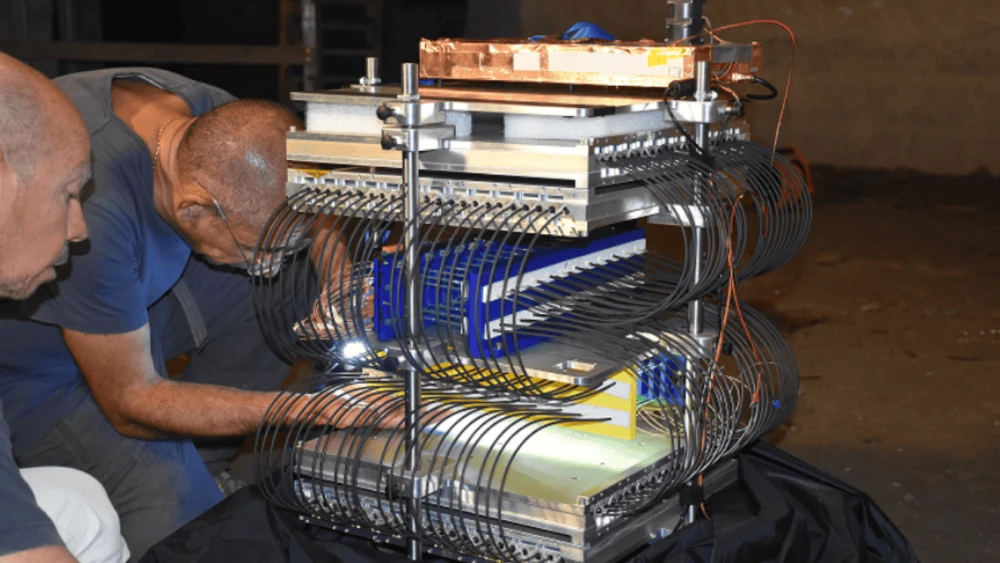
An Israeli university announced on Monday that it has successfully used cosmic radiation detectors to find subterranean spaces, enabling 3D imaging of underground archaeological excavations.
The “technological breakthrough” at Tel Aviv University will facilitate the discovery and mapping of underground spaces beneath rock, which has heretofore been a problem for archaeologists.
“From the pyramids in Egypt, through the Maya cities in South America, to ancient sites in Israel, archaeologists struggle to discover underground spaces,” said Tel Aviv University professor Oded Lipschits.
“Above-ground structures are relatively easy to excavate, and there are also various methods for identifying walls and structures below the surface. However, there are no effective methods for conducting comprehensive surveys of subterranean spaces beneath the rock on which the ancient site is situated,” he explained.
The detectors identify muons—subatomic particles created when cosmic radiation collides with Earth’s atmosphere—to detect hidden voids such as tunnels and channels.
The research team demonstrated the technology’s effectiveness at the City of David archaeological site in Jerusalem, showing how the system successfully maps underground spaces based on changes in the soil’s absorptivity to cosmic radiation particles, the university said.
The results of the study were published in the Journal of Applied Physics.