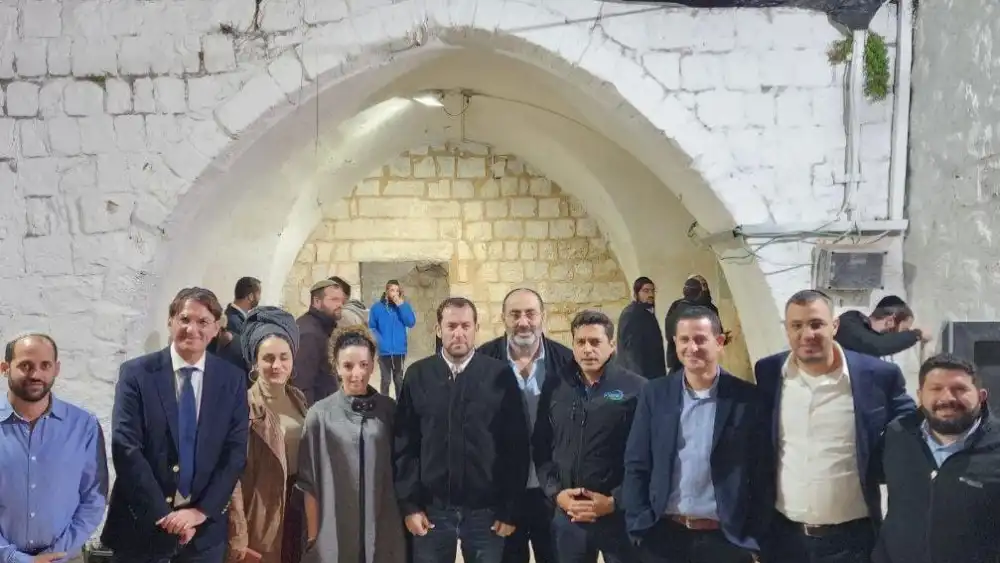
A Jewish morning prayer took place on Thursday at Joseph’s Tomb in Samaria, for the first time in 25 years.
The shrine, which is venerated by Jews, Samaritans, Christians and Muslims, has a decades-long history of violence.
Since the outbreak of the Second Intifada, entry to the complex on the southeastern outskirts of Nablus was permitted only at nighttime, under heavy security.
Hundreds of worshippers, including Religious Zionism lawmaker Zvi Sukkot and Samaria Regional Council head Yossi Dagan, attended the service on Thursday morning under the guard of Israeli security forces, Israel’s public broadcaster Kan reported.
The morning service “is a clear declaration of sovereignty: we are not guests in our own land, and it is time we stop behaving as if we are,” said the Yesha Council umbrella group of Judea and Samaria communities.
The council further commended Sukkot and Dagan for leading the initiative, and thanked Israeli Defense Minister Israel Katz for his approval.
“This morning’s prayer is another step in a process of rectification—restoring a permanent Jewish presence at Joseph’s Tomb,” the spokesperson added.
Dagan in a statement described the event as a “historical correction.”
“After years of entering in the dead of night like thieves in the underground, we are returning home with heads held high and in full daylight. Joseph’s Tomb is an important symbol, and the move to enter in daylight is a significant step within our work plan to establish a permanent and complete foothold at the site... the People of Israel are returning to their land,” he was quoted as saying.
The holy site, which remains under Israeli control according to the 1990s Oslo Accords despite its location in a Palestinian-designated area, had previously been restricted to sporadic nighttime visits until 4 a.m. due to security reasons. Now, it will remain open to Jewish pilgrims until 8 a.m., the Defense Ministry said in a statement last month, with a further potential daytime expansion to be examined in the future.
The decision, which was taken in coordination with political officials, updated policy put in place in 2000 when the Od Yosef Chai Yeshiva at Joseph’s Tomb was evacuated on the orders of then-Prime Minister Ehud Barak, who also served as defense minister, following Palestinian violence at the site that led to the death of an Israeli Border Police officer.
The Druze officer, Madhat Yusuf, succumbed to his wounds at the scene after Palestinian security forces prevented his medical evacuation for more than five hours in an incident that shook the nation.