Newsletter
Newsletter Support JNS

Jordan rejects confederation with Palestinians, says only solution to conflict is Palestinian state

King Abdullah II of Jordan has apparently rejected the U.S.-backed idea of creating a confederacy, including areas of Judea and Samaria containing large populations of Palestinians.

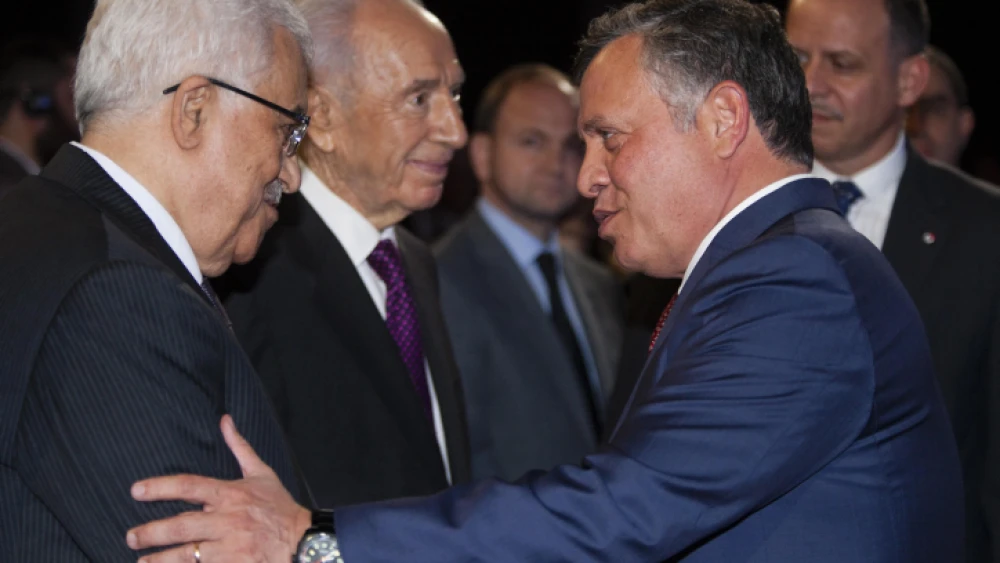
Palestinian Authority leader Mahmoud Abbas (left) speaks with Jordan's King Abdullah II as Israel's President Shimon Peres stands by, at the World Economic Forum on the Middle East and North Africa 2013, in Amman. May 26, 2013. Photo by Flash90.
Palestinian Authority leader Mahmoud Abbas (left) speaks with Jordan’s King Abdullah II as Israel’s President Shimon Peres stands by, at the World Economic Forum on the Middle East and North Africa 2013, in Amman. May 26, 2013. Photo by Flash90.

King Abdullah II of Jordan has apparently rejected the U.S.-backed idea of creating a confederacy, including areas of the West Bank containing large populations of Palestinians, with government spokespersons insisting that Jordan would not be part of a solution to the Israeli-Palestinian conflict.

“Discussing the idea of a confederation with the regions of the West Bank is not possible,” Jordanian government spokeswoman Jumana Ghneimat told the Khaberni news agency on Sunday, affirming the government’s position that the only solution to the conflict with Israel was the establishment of a Palestinian state on the disputed territories of the West Bank, known in Israel as Judea and Samaria.

Jordan’s responses came just hours after Palestinian Authority leader Mahmoud Abbas confirmed his support for a tripartite confederation with Israel and Jordan in a meeting with Peace Now executive director Shaqued Morag (former Peace Now director), Meretz MK Mossi Raz and Zionist Union MK Ksenia Svetlova.

According to P.A. spokesman Nabil Abu Rudeinah, the idea of a confederation between Palestinians and Jordanians has been raised on numerous occasions since 1984.

As many as 70 percent of Jordanians identify as Palestinian.

The author of “The Choice” urged others to choose hope and healing.
“For now, as you know, President Trump doesn’t support that,” said the Israeli foreign minister.
The September attack at the offices of Israeli defense company Elbit caused over $1 million in damage.
Israel deepens Central Asia ties as Western relations strain and regional alliances gain urgency.
The meeting is only a preliminary stage before the president holds a discussion on the pardon request itself.
“Illicit funds funneled through this network support the regime’s ongoing terrorist operations, posing a direct threat to U.S. personnel, regional allies and the global economy,” the U.S. Treasury Department stated.