Even in ordinary times, Israeli President Isaac Herzog’s state visit to Kazakhstan this week would’ve marked a significant step in strengthening the Jewish State’s ties in Central Asia.
That importance was heightened further under current circumstances, Herzog said, as Israel faces growing and global efforts to isolate it—particularly in Muslim-majority countries such as Kazakhstan.
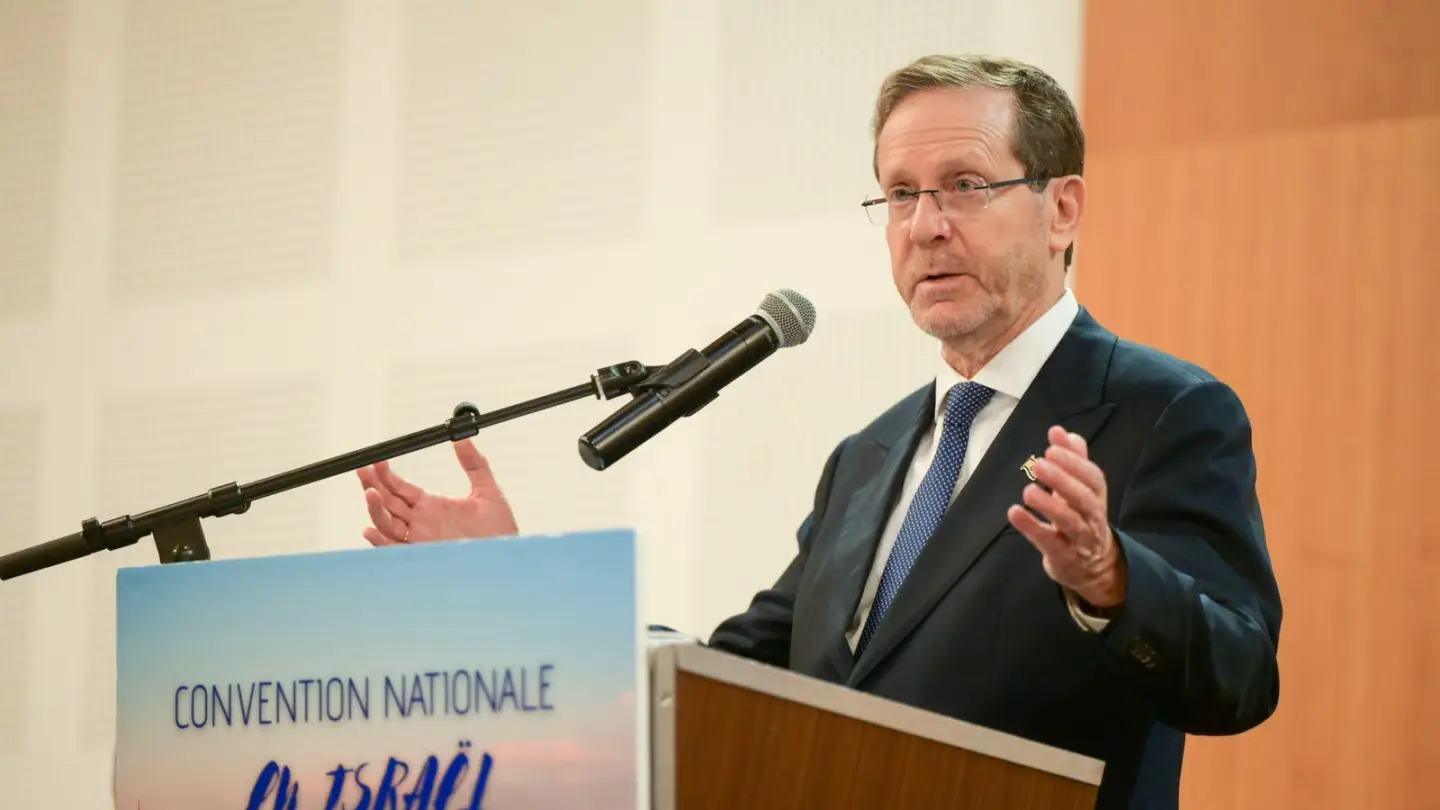
“Especially in the current climate, the fact that Kazakhstan’s president, Kassym-Jomart Tokayev, hosted me so warmly is not self-evident. It’s a testament to the partnership’s depth and this leader’s courage,” Herzog said on Tuesday in a speech before members of the Jewish community of Astana, the capital of Kazakhstan, a mineral-rich country whose territory is the world’s ninth largest.
Longtime observers of Israel’s foreign policy framed Herzog’s two-day Kazakhstan visit, which focused on technology, defense and transportation, as part of a broader pivot by Jerusalem eastward. Israel is diverting attention from hostile Western Europe toward untapped relationships both closer to home and to Israel’s enemies, including Iran.
“The relationship with Western Europe is blocked right now, so diplomacy is turning eastward and Kazakhstan is a great place to boost ties with,” Yitzhak Eldan, a former ambassador and head of protocol at the Israeli Foreign Ministry, told JNS.
He echoed Herzog’s observation on the current climate, adding: “That the visit is happening at all is a major accomplishment. That it’s happening when Israel is being boycotted across Western Europe and much of Asia, well, that gives the visit much more substance.”
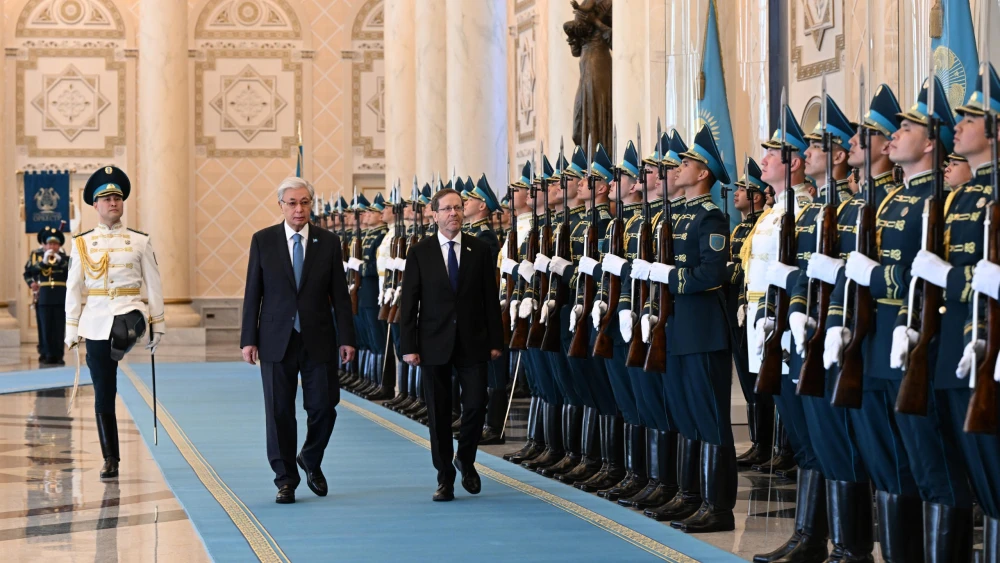
Tokayev gave Herzog an extra warm reception, hosting him once with great pomp at the Akorda Presidential Residence in Astana, and then adding a second meeting to the schedule on Tuesday: The two presidents met at a round-table discussion to discuss cooperation on artificial intelligence and innovation at The Singularity Museum on technology.

Flanked by troops in full dress uniform, women wearing traditional costumes greeted Herzog at the airport. The flags of Israel and Kazakhstan flew along Herzog’s route to his meeting with Tokayev at Akorda.
Kazakhstan joined the Abraham Accords in November, in what was widely seen as a nod to U.S. President Donald Trump’s push to expand on the agreements, that formalized diplomatic relations between Israel and several Arab states.
By upgrading relations with Israel, “Kazakhstan is aligning with Trump and trying to upgrade relations with the United States, which is a fundamental element of policy for Tokayev,” Ze’ev Levin, an expert on Central Asia and research fellow of the Hebrew University’s Harry S. Truman Research Institute, told JNS. But, he and other experts noted, Kazakhstan also has an independent and warm relationship with Israel independently of the United States.
Herzog mentioned during his meeting with Tokayev the need for direct flights between the two countries and for an agreement to avoid double taxation, with an eye to “doubling and even tripling trade,” said Herzog.
The Israeli president’s flight to Astana made a three-hour detour to avoid flying over Turkish airspace, in keeping with the August 2025 ban by Turkey on official or military flights from Israel. The deviation illustrated both a potential complication for direct flights if an increasingly hostile Turkey broadens the ban to commercial flights, and Israel’s need for new partners in the Muslim world.
Observers of Israel-Kazakh bilateral ties said both partners had big plans for the relationship.
Eldan, the former senior diplomat at Israel’s foreign ministry, noted in an interview with JNS that Kazakhstan has ramped up rare-earth mining since 2020, increasing its exports nearly five-fold by 2024. Rare earth materials, whose supply is dominated by China, are key ingredients for producing computer microchips.
Then there’s petrol: Kazakhstan provided Israel 42% of Israel’s crude supply in 2023, the largest share of any single country, according to an article published last year by The Marker.

Defense deals between Israel, a major arms exporter, and Kazakhstan are another shared interest, as evidenced in the Israeli delegation’s military contingent: It included Israel’s defense attaché to the Russian Federation, Col. Yigal Shaposhnik, and Brig. Gen. Gil Elia, the Israeli president’s military secretary.
In recent years, Kazakhstan has beefed up its army: Total spending on security is set to reach about $6.4 billion in 2026, an increase of 12.6% compared with 2025, the Caliber news site of Azerbaijan reported.
Israel has an interest in deepening its presence in Central Asia for geopolitical reasons, to counteract Iran, said Levin of the Hebrew University, noting that Israeli Prime Minister Benjamin Netanyahu had visited Kazakhstan in 2016 and that Israeli Foreign Minister Gideon Sa’ar did so in January.
During Herzog’s visit to Kazakhstan, Iran’s deputy defense minister was in neighboring Kyrgyzstan for meetings that Herzog said he suspected were meant to secure a route “for smuggling materials we are trying to prevent,” and possibly to circumvent financial sanctions through cryptocurrency.
“The Iranians definitely noticed the president’s visit to Kazakhstan, and they are not happy about it,” a diplomatic source told JNS. Kazakhstan maintains “basic” diplomatic relations with Iran, he said, but Astana also condemned Iran’s targeting of Gulf states during “Operation Roaring Lion.”
Kazakhstan-Israel relations have potential for growth, but also limitations “that often occur in a bureaucratic government,” said one senior diplomat serving in Kazakhstan, a former Soviet state with an authoritarian regime and a low democracy index score.
The volume of bilateral trade between Kazakhstan and Israel remains limited, amounting to a few hundred million dollars.
Kazakhstan’s voting pattern at the U.N. is largely hostile to Israel, Levin also noted, despite some abstentions on anti-Israel resolutions.

In his speech at the reception for Herzog, Tokayev said: “One thing I would like to mention, it’s about first of all our interest in developing or enhancing contacts on such important matters like artificial intelligence, digitalization.”
This year is “the year of digitalization and artificial intelligence” in Kazakhstan, he said, adding, “I’m focusing on this particular matter.”
Notably, Tokayev did not mention Iran, Gaza, Lebanon or Syria in his address, touching on the subject of conflicts involving Israel only indirectly, in saying that the Abraham Accords “reconfigured the Middle East’s geopolitical architecture, creating a strategic framework for regional stability.”
The Israeli push in Kazakhstan is occurring amid a recalibration of foreign relations under Netanyahu that focuses on investing in eager but poorer partners in Asia and Africa.
This push comes instead of trying to accommodate European former allies, such as Spain, France, the Netherlands and Belgium, whose governments are demanding Israeli concessions to its Arab enemies as a condition to developing bilateral ties.
The change is transforming relations with Japan, Azerbaijan, Zambia, Uganda and, crucially, also India, the world’s most populous country. Indian Prime Minister Narendra Modi visited Israel for a second time in February amid what Israeli Minister of Innovation, Science and Technology Gila Gamliel said was a deliberate policy shift toward bolstering Israel’s Indo-Pacific ties.
In his remarks following a meeting with the Israeli delegation, Tokayev did not elaborate on any of the points discussed, but spoke in general, warm terms about Israel and his guest.

“We have achieved so many positive results with regard to our economic cooperation and ties as well as political contacts” since 1992, when diplomatic relations were established between the two countries, Tokayev said, “And we can achieve much more.”