Newsletter
Newsletter Support JNS

Lapid: Israel will ‘act alone’ against Iran ‘if necessary’

Israel doesn’t oppose all deals with Tehran, “only one that has no possibility of genuine oversight,” says Foreign Minister Yair Lapid.

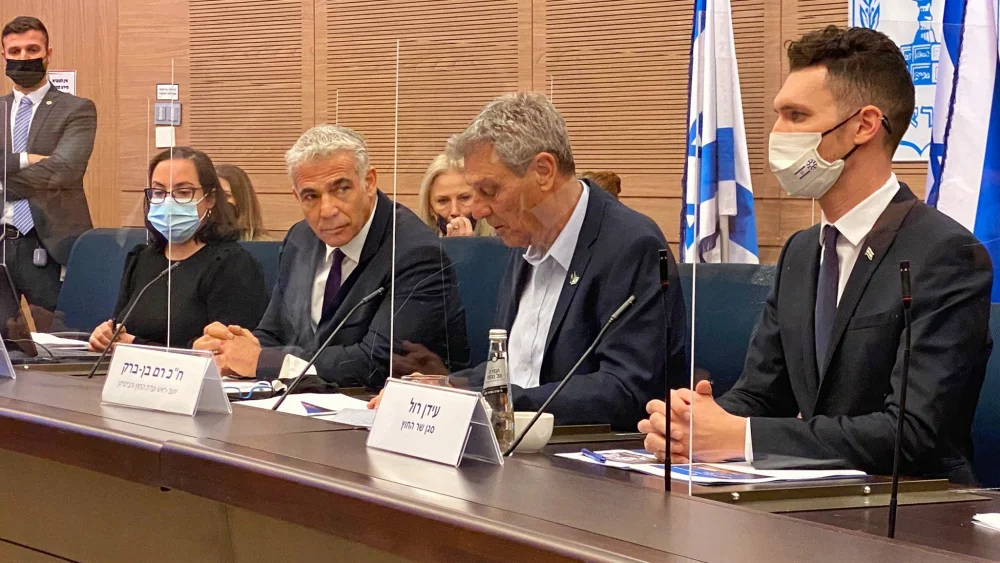
Israeli Foreign Minister Yair Lapid (third from right) at a meeting of the Knesset's Foreign Affairs and Defense Committee on Dec. 27, 2027. Source: Twitter.
Israeli Foreign Minister Yair Lapid (third from right) at a meeting of the Knesset’s Foreign Affairs and Defense Committee on Dec. 27, 2027. Source: Twitter.

Israel will “act alone” to prevent Iran from becoming a nuclear-threshold state “if necessary,” Israeli Foreign Minister Yair Lapid said on Monday, as negotiations between Tehran and world powers were set to resume in Vienna.

Tweeting that Israel “would prefer international cooperation,” but must protect its security, he stated that Jerusalem isn’t opposed to the reaching of a deal per se; only one that has “no possibility of genuine oversight on the nuclear program, Iranian money or the Iranian terrorist network.”

The Joint Comprehensive Plan of Action (JCPOA), the 2015 nuclear agreement from which former U.S. President Donald Trump withdrew in 2018, “did not block Iran’s path to the bomb,” said former Israeli Ambassador to the United States Ron Dermer last Tuesday.

It “basically guarantees that Iran is going to become a military nuclear power,” Dermer said in a Zoom seminar held by the Jewish Institute for National Security of America (JINSA). The JCPOA, he said, has “put us on cruise control heading over a cliff.”

In a draft report delivered to the U.S. president, the commission also called for improved religious accommodations for U.S. service members.
Salah Salem Sarsour, accused of concealing Israeli military court convictions on immigration forms, argued his detention was part of a Trump admin effort to target the pro-Palestinian movement.
CENTCOM stated that the strikes targeted missile, drone and radar facilities after the Islamic Republic attacked a cargo ship in the Strait of Hormuz, calling the assault a violation of the ceasefire.
Now that the primaries are over, “we hope that everyone will come together and be united,” Christine Quinn, chair of the executive committee of the New York State Democratic Party, told JNS.
An Iranian official warned on Friday that the safety of ships passing through the Strait of Hormuz without Iran’s permission “cannot be guaranteed.”
“We have put the train back on the tracks and going in the right direction,” said Yechiel Leiter, Israeli ambassador in Washington. “Final destination? Peace between our two countries.”
Benny Gantz, JNS editor-in-chief Jonathan S. Tobin, Gilad Erdan, Mosab Hassan Yousef, Nissim Black and leading voices in security, diplomacy, media, law and Jewish communal affairs headline the summit’s third day in Jerusalem.

