Newsletter
Newsletter Support JNS

Netanyahu convenes War Cabinet ahead of broader Security Cabinet session

“The State of Israel is strong. The IDF is strong. The public is strong,” said the Israeli prime minister,

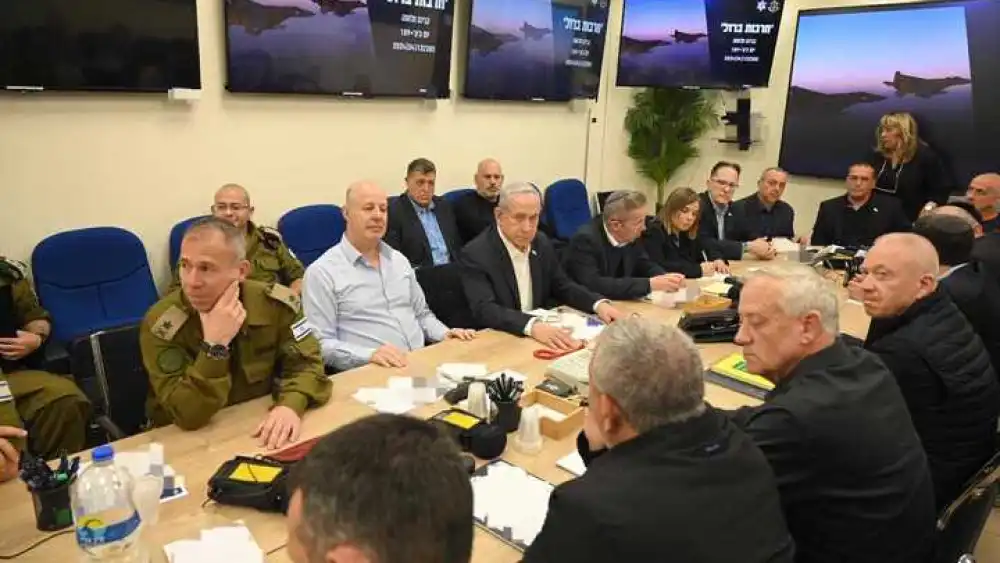
Prime Minister Benjamin Netanyahu convenes the War Cabinet, April 14, 2024. Credit: GPO.

Israeli Prime Minister Benjamin Netanyahu on Saturday night decided to convene the War Cabinet and then the broader Security Cabinet.

The move comes after Iran dispatched dozens of unmanned aerial vehicles from its territory towards Israel, in a much-anticipated response to the April 1 killing of several IRGC officers in Syria.

The drones were expected to take several hours to reach their targets in the Jewish state.

“Citizens of Israel, in recent years, and especially in recent weeks, Israel has been preparing for a direct attack by Iran. Our defensive systems are deployed; we are ready for any scenario, both defensively and offensively,” said Netanyahu.

“The State of Israel is strong. The IDF is strong. The public is strong,” he added.

The War Cabinet has three members—Netanyahu, Defense Minister Yoav Galant and Minister-without-Portfolio Benny Gantz—and three observers: Minister-without-Portfolio Gadi Eizenkot, Shas Party chairman Aryeh Deri and Strategic Affairs Minister Ron Dermer.

The missing person wasn’t identified until a hospital staffer recognized her from a post on Facebook.
StandWithUs stated that “some Jewish students at UC Law San Francisco already feel compelled to conceal their Jewish identity out of concern for their safety.”
“It is critical that we work across party lines to stop and reverse this dangerous trend,” stated Sen. Jacky Rosen, co-chair of the Senate Bipartisan Task Force for Combating Antisemitism.
“I believe very much in the state of Israel and its right to exist,” East Brunswick mayor Brad Cohen told JNS. “It’s critical to me that it remains a Jewish state in the Middle East.”
Russia-Iran trade on the northern route has grown to bypass the U.S. blockade of the Persian Gulf.
The site was also used by Hamas for the manufacture of explosive devices.