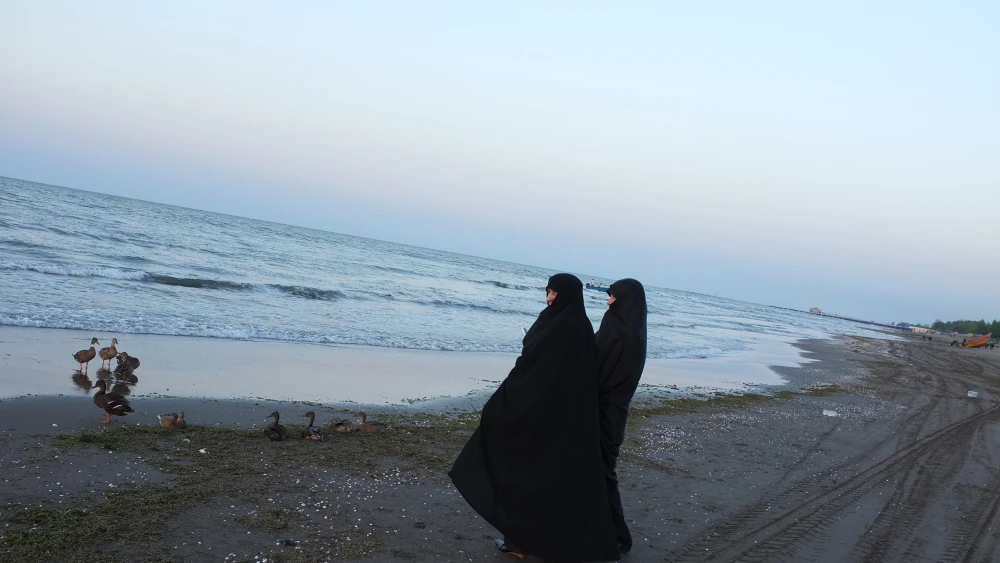
Iran is circumventing the U.S. naval blockade by importing supplies from Russia via the Caspian Sea, including drone components, The New York Times reported on Saturday, citing U.S. officials with knowledge on the matter speaking under conditions of anonymity.
With the Strait of Hormuz largely barred for transit by the U.S. Navy, Tehran has been working “rapidly” to open alternative trading routes, the paper reported.
Four Iranian ports along the Caspian, north of Tehran, are operating tirelessly to bring in wheat, corn, animal feed, sunflower oil and other supplies, according to the officials.
Russia has four main ports on the sea, at Astrakhan, Olya, Makhachkala and Kaspiysk.
The report noted that Mohammad Reza Mortazavi, head of the Association of Iran’s Food Industries, told Iran’s IRIB public broadcaster that the regime is rerouting essential food imports through the Caspian.
The Caspian Sea is the world’s largest inland body of water, bigger than Japan.
Unlike in the Persian Gulf, the United States cannot prevent the navigation of vessels on the Caspian, to which only Iran, Azerbaijan, Russia, Kazakhstan and Turkmenistan have access.
“If you’re thinking about the ideal place for sanction evasion and military transfers, it’s the Caspian,” the Times cited as saying Nicole Grajewski, a professor specializing in Iran and Russia at Sciences Po in Paris.
U.S. officials said that the shipment of drone components can help Iran to quickly rebuild its UAV arsenal, which has been reduced by roughly 60% in the recent war.
“Russia and Iran have found ways around the sanctions regime,” Anna Borshchevskaya, an expert on Russia’s Middle East policy at the Washington Institute for Near East Policy, told newspaper.
“And that’s exactly why the Israelis bombed the port. Because they understood that through this small, very important trade route, Russia can provide a lot of help to Iran,” she added.
The Israel Defense Forces struck Iranian naval infrastructure at the Bandar-e Anzali port on the Caspian Sea in March during “Operation Roaring Lion,” targeting a Russian-Iranian smuggling route, according to The Wall Street Journal. (“Bandar” means “port” in Persian.)
Israeli officials at the time confirmed that the strikes targeted Iranian Navy vessels in the port. The strike expanded the war’s maritime arena beyond the Persian Gulf and the Strait of Hormuz, reaching the Caspian Sea for the first time.