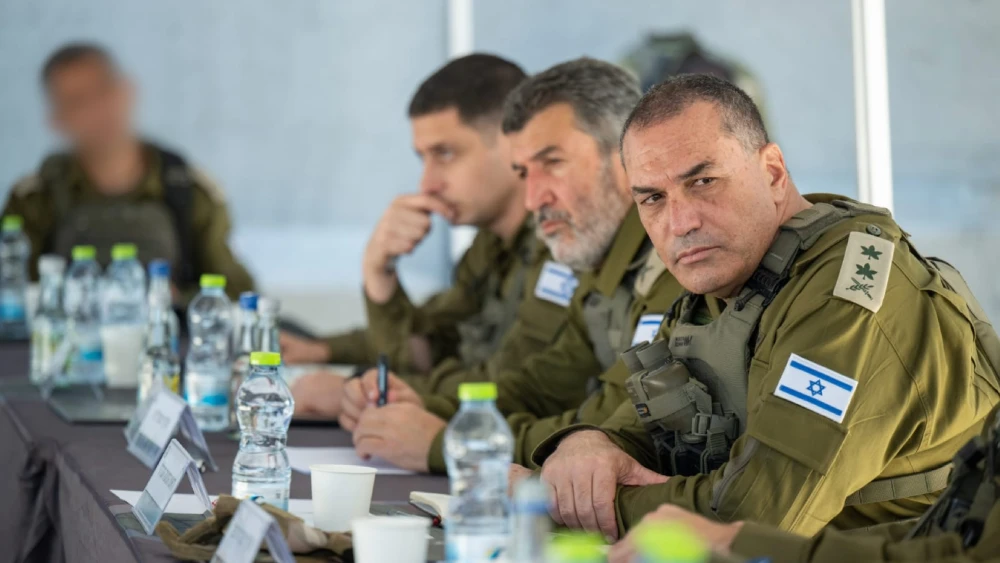
The Israel Defense Forces remains at full readiness for attack and defense “from Judea and Samaria to Tehran,” IDF Chief of Staff Lt. Gen. Eyal Zamir said on Wednesday.
“The operation is not over—the IDF is prepared to renew fighting if required and remains in a state of constant readiness,” Zamir declared during a visit to troops in northern Samaria.
“The northern Samaria area is undergoing a significant transformation,” Zamir said in his remarks, praising the military’s Central Command for “leading extensive offensive and counter-terrorism activity alongside preparations for optimal defense of the area.”
“This is a period in which the scope of terrorism in Judea and Samaria is among the lowest in recent years—thanks to continuous, proactive, and offensive counter-terrorism operations. We continue operating without pause to thwart terrorism, including operations in densely populated areas,” the chief of staff continued.
“The Nahal Brigade, which completed intense operations in Lebanon only a month ago, immediately reported for duty afterward in Judea and Samaria. I am confident it will achieve results here as well,” he said.
The IDF continues to operate “in all arenas with determination” as part of a new security reality it created across the region, Zamir noted.
In Southern Lebanon, ground troops are “eliminating dozens of terrorists and terror infrastructure sites every day” in operations around the Litani River and other areas, he stated.
“In Gaza as well, we are operating offensively and eliminating terrorists,” added the military leader.
“There is no containment—only initiative,” he declared.
Israeli Prime Minister Benjamin Netanyahu told CBS News in an interview that aired on Sunday night that the war with Iran “accomplished a great deal, but it’s not over.”
Speaking with correspondent Major Garrett, Netanyahu listed Tehran’s enriched uranium, enrichment facilities that are still operative, proxies in the Middle East such as Hezbollah and the Houthis and Tehran’s ballistic missiles as problems that have not yet been fully resolved.
“Now, we’ve degraded a lot of it. But all that is still there, and there’s work to be done,” Israel’s longest-serving prime minister told Garrett.
The premier further said that while toppling the Islamic regime cannot be guaranteed, it could lead to a positive chain reaction in the region.
“If this regime is indeed weakened or possibly toppled, I think it’s the end of Hezbollah, it’s the end of Hamas, it’s probably the end of the Houthis, because the whole scaffolding of the terrorist proxy network that Iran built collapses if the regime in Iran collapses,” he said.