In London, there is Charles Dickens House. Frankfurt has Goethe House. Vienna preserves the home of Sigmund Freud, while Tel Aviv honors Hayim Nahman Bialik.
In Jerusalem, tucked away on Klausner Street in the Talpiot neighborhood, Beit Agnon (a.k.a. Agnon House) is devoted not only to preserving the legacy of Shmuel Yosef Agnon, Israel’s only Nobel laureate in literature, but also to ensuring that Hebrew literature remains alive, accessible and relevant.
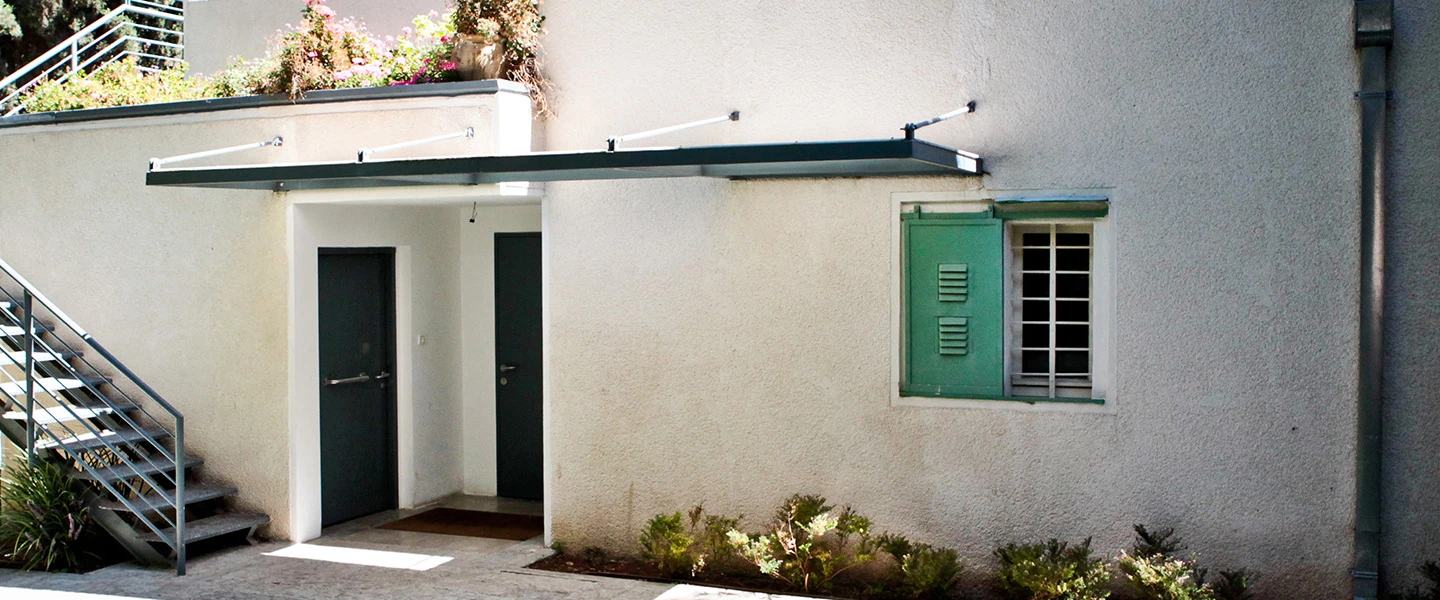
The modest Bauhaus-style house where S.Y. (Shai) Agnon, as he is now known, wrote some of the most important works of modern Hebrew literature, is today a National Heritage Site.
Visitors entering the home can still absorb the atmosphere of the place where the Nobel Prize-winning author lived and worked. In the compact, book-lined study on the second floor where Agnon wrote, shelves overflow with his eclectic library, containing religious texts alongside works of secular literature and philosophy in several languages.
The shtender (lectern) where Agnon wrote still stands before the window, and the room remains almost exactly as it was when he died in 1970.
Several manuscripts written longhand in pencil remain tucked inside a desk drawer, even though Agnon’s full archive is now housed at the National Library of Israel.
“We’re not just preserving a writer here,” Rabbi Jeffrey Saks, research director at Beit Agnon, told JNS in a recent interview ahead of Jerusalem Day on May 15. “We’re preserving a way to engage with our entire tradition—from the Bible and rabbinic literature through medieval poetry and into modern Jewish experience. Agnon takes all of it and distills it into modern literature.”
He paused, then added, “That’s why it’s such a rich mine to excavate.”
Hebrew’s modern awakening
That mission has become increasingly important as classical literature and Hebrew cultural literacy continue disappearing from educational curricula in both Israel and the Diaspora.
Agnon’s work grapples with displacement, identity, faith and rupture—themes that continue to shape Jewish life today. While many of his stories are set in the shtetls of Eastern Europe or pre-state Palestine, Saks believes their emotional core remains universal.
“The experience he’s writing about,” Saks said, “is universal. Leaving one world and entering another is something people everywhere understand.”
Born in Buczacz, in what is today Ukraine, Agnon arrived in Ottoman Palestine in 1908 at the age of 20 as part of the Second Aliyah, the pioneering wave that helped lay the cultural and intellectual foundations of modern Israel.
At the time, spoken Hebrew itself was still in the early stages of revival.
“Eliezer Ben-Yehuda had begun the process,” Saks explained, “but Hebrew was only beginning to move from the study hall into daily life.”
“Agnon stood at the crossroads of Jewish history—not only literary history, but the enormous transformations of the early 20th century that included the revival of Hebrew, the rise of Zionism and the return to the Land of Israel.”
Unlike modern street Hebrew, Agnon’s language drew deeply from biblical, rabbinic and medieval sources.
“People call it a revival,” Saks told JNS. “But to revive something, it first has to be dead. Hebrew was never dead—it was more like Sleeping Beauty, waiting to be awakened.”
Rebuilding after destruction

Agnon’s life was shaped by repeated loss.
A fire destroyed his home and library in Germany, while the 1929 Arab riots in Jerusalem led to the looting of his home and the destruction of much of his collection once again.
The Talpiot house, completed in 1931, was built partly in response to those experiences: solid, enclosed and almost fortress-like. At the time, the neighborhood stood at the edge of Jerusalem, with views stretching toward the Old City and the Dead Sea.
In one of his stories, Agnon describes building a house and planting a garden “in a place where the enemy sought to banish us,” consciously presenting it as a symbolic counterpart to the destroyed Temple.
“This is his third library,” Saks said during a private tour. “The others were destroyed. So he rebuilt—not just physically, but culturally.”
Agnon and his wife, Esther, lived in the house until he died in 1970. After Agnon’s death, the future of the house remained uncertain.
Then-Jerusalem Mayor Mordechai Ish-Shalom recognized its cultural significance and ensured that the city purchased the property. For years, however, the building remained largely unused and at one point even housed an institute founded by Rabbi Adin Steinsaltz.
Only in the late 1970s, when a nonprofit organization was established to operate the site, did Beit Agnon begin evolving into the cultural institution it is today.
“The mandate never was to be all Agnon all the time,” Saks said. “We have programming that deals broadly with Jewish literature and Jewish culture, even though the heart of things is Agnon and classic Hebrew literature.”

Engaging through education
Today, Beit Agnon hosts lectures, classes in English and Hebrew and literary tours in Israel and abroad.
Saks’s English-language lecture series regularly fills to capacity, while tours connected to Agnon’s stories and broader Jewish historical themes often maintain waiting lists.
“During COVID, we started activities on Zoom,” Saks said, “and we were delighted to discover that not just people from all over Israel, but people from all over the world joined us.”
Education remains central to the institution’s mission. “We have school groups and IDF soldiers coming through,” Saks said. “For many of them, this is their one opportunity to encounter Agnon.
“Kids come in and see the library, and they’ve never seen anything like it. The generation of the screen is enchanted by books.”
The U.S.-born Saks has also played a leading role in making Agnon accessible to English-speaking audiences in Israel and around the world.
As series editor of 16 annotated English editions published by Toby Press, he has helped open Agnon’s work to readers who might otherwise find it inaccessible because of its dense biblical, rabbinic and literary references.
Now, Saks is overseeing a new project already more than halfway complete: a full English edition of Agnon’s collected works for Koren Publishers’ “Library of the Jewish People.”
“That’s something that’s never existed in English before,” he said.
The project reflects the conviction that Agnon belongs not only to Israeli culture, but to the broader Jewish world.
“People say, ‘How can you read Agnon in translation?’” Saks noted. “But we all read in translation. The question isn’t whether you lose something—you always do. The question is whether you can still access the depth. And you can.”
That depth continues to resonate in surprising places.
Saks described Chinese university students from rural villages identifying with Agnon’s stories about leaving traditional worlds behind and entering modernity. Scholars in Saudi Arabia study his work in Hebrew, while Agnon reading groups continue meeting in synagogues, JCCs and private homes across North America.
“Jews of all backgrounds should engage with Agnon,” Saks said. “It’s one of the richest ways to connect with the tradition and the journey that has brought us here.”
Outside, Jerusalem has grown around the historic building. The once-isolated street is now part of a changing residential neighborhood undergoing extensive renovation.
Plans to expand Beit Agnon with additional exhibition and meeting space have been slowed by funding challenges, as well as disruptions caused by the pandemic and the war.
Agnon once suggested that any story not worth reading twice was probably not worth reading at all.
At Beit Agnon, there is an ongoing effort to ensure not only that Agnon’s stories continue to be read, but that Hebrew literature itself remains an essential part of contemporary Jewish life.