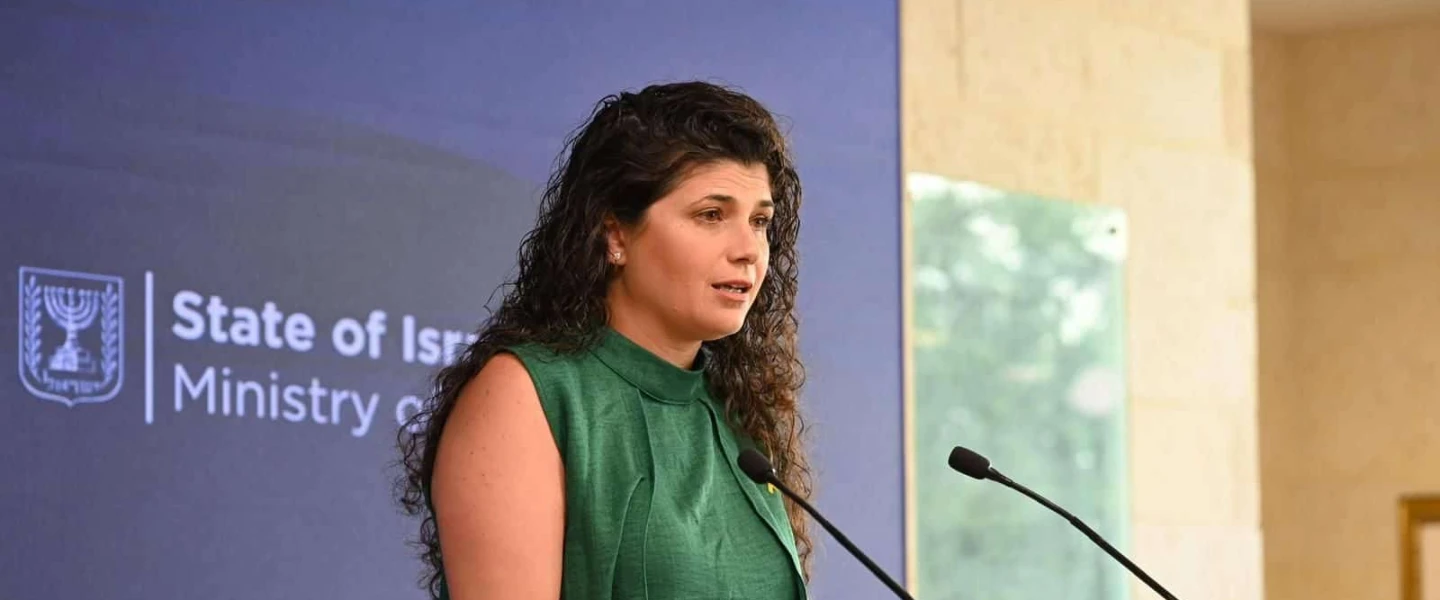
The Lebanese government has a once-in-a-generation opportunity to free itself from the Islamic Republic’s influence, Israeli Deputy Foreign Minister Sharren Haskel (New Hope Party) told JNS this week.
“I think they truly understand the danger Iran poses. For decades, they have seen how Iran has destroyed their country from a security and economic standpoint, how it damaged the cultural fabric of their society, corrupted the judicial system and undermined the political system,” Haskel said on Monday.
“They are occupied by Iran, and until they choose to liberate themselves, it will be difficult to move to the next stage,” she added.
Haskel said there is broad recognition that Hezbollah has served as Iran’s controlling force in Lebanon over the past several decades. The key question now, she said, is what concrete steps Lebanese authorities are willing to take to push Iran out.
“Those are the actions we need to see over the next few months to understand how serious they are,” she said. “And if you ask me about France, it simply needs to stay as far away from the process as possible for it to succeed.”
Haskel argued that the campaign against Iran is being fought on two fronts: military and economic.
“The Iranian regime has suffered dramatically from a military standpoint, and right now the strain around the Strait of Hormuz is creating economic pressure on Iran,” she said. U.S. President Donald Trump “is economically suffocating the Iranian regime. If they refuse negotiations and reject what is necessary to keep the world safe, the military option remains on the table,” she added.
“They are on the verge of economic collapse, and if they do not reach an agreement that guarantees the future security of humanity—without nuclear enrichment, ballistic missile programs or the development of proxies around the world—they are in serious trouble,” she said.
Born in Toronto in 1984, Haskel immigrated to Israel with her family a year later. She enlisted in the Israel Border Police and served in Jerusalem during the Second Intifada.
Haskel entered the Knesset in 2015, during the 20th Knesset. She served on the Knesset Foreign Affairs and Defense Committee and led the Israel-Tajikistan and Israel-Chile parliamentary friendship groups up to 2019.
Before becoming deputy foreign minister, Haskel promoted several legislative initiatives, including efforts to legalize medical cannabis. In a country with a growing number of post-traumatic stress disorder patients, she said medical cannabis could help many people in distress.
“I pushed legislation to ensure we moved in the right direction on this issue, and after becoming deputy foreign minister, I handed the bill to a colleague in parliament who is continuing the effort,” she said. “I have also worked on other issues, including creating a special committee on PTSD to address the surge in cases since Oct. 7 and the start of the war.”
Another bill Haskel championed granted the Israeli Education Ministry authority to dismiss teachers found guilty of sexual harassment or sexual assault.
“Unfortunately, there were cases in Israel where teachers who committed sexual abuse or violence against students could not be fired,” she said. “Students would move to another school while the teacher continued teaching in the same institution. I am very proud I was able to legislate on this issue.”
Haskel also founded a Knesset caucus in 2017 aimed at reforming the United Nations Relief and Works Agency for Palestine Refugees in the Near East (UNRWA). Since then, she has campaigned internationally against what she describes as the agency’s exploitation by terrorist organizations.
“With the caucus, I traveled to several countries to brief parliamentarians and senior officials on what UNRWA does and to remove the mask,” she said. “About eight years ago, I drafted legislation to reform UNRWA, and I was very happy we were able to pass it together with several colleagues in the current Knesset.”
At the Foreign Ministry, Haskel said she has focused heavily on Africa, seeking to rebuild Israel’s relationships across the continent.
“Israel once had very strong ties with Africa, but unfortunately, they gradually deteriorated,” she said. “I made it my mission to strengthen those bonds and build new bridges with African countries.”
On security cooperation, Haskel said parts of Africa are facing challenges similar to those in the Middle East, with extremist organizations such as the Muslim Brotherhood, Iran’s Islamic Revolutionary Guard Corps, Lebanese Hezbollah, Palestinian Hamas, ISIS, Boko Haram in West Africa and the Somali Al-Shabaab expanding their influence, destabilizing governments and fueling violence.
“That creates grounds for cooperation and for exploring how Israel can help save lives, protect minorities and defend Christian communities,” she said.
One moment she described as especially meaningful was the recognition of Somaliland.
“This proves that when there is a sustainable country with an economy, elections and a Muslim society seeking stability and good relations with its neighbors, this is the kind of positive outcome we want to encourage,” she said.
“For generations, Jews experienced persecution, expulsion and unimaginable horrors. If there is any way we can stand in solidarity, provide assistance, and build mutual interests, that is deeply meaningful to me,” she added.
Haskel said strengthening ties with Christian communities worldwide has also become a major priority, leading her to engage with numerous Christian leaders, including many across Africa.
In April, the Foreign Ministry announced the appointment of diplomat George Deek as special envoy to the Christian world. Haskel said the ministry maintains a dedicated department responsible for relations with Christian communities and institutions, including the Vatican, the Greek Orthodox Church and the Armenian Church.
“We are very proud that there is now a special envoy working to build these bridges and represent Israel in many international forums,” she said.
On antisemitism, Haskel said Israel cooperates with foreign governments on intelligence-sharing to help prevent attacks.
“We do it because we know it saves Canadian lives, British lives and Jewish lives. We have been doing that for a very long time,” she said.
Haskel argued governments are not doing enough to combat antisemitism and warned that people are “paying the price in blood.”
“This is the reality in Canada, the United Kingdom, Australia and France,” she said. “Unfortunately, not only are governments not acting quickly and forcefully against antisemitism, but they are silent in the face of provocations, demonstrations supporting Hamas, and calls to globalize the intifada, which means bringing death and destruction into Jewish communities in their cities.”
“When you see neighborhoods in London with cars driving by with loudspeakers calling to kill women and rape girls, and nobody is prosecuted, that legitimizes violence against Jewish communities,” she added. “That is not drawing a red line or deterring violence, and when you do not draw a red line, people keep pushing further.”
In December, Haskel marched 45 miles from Kfar Saba to Jerusalem in protest against the government’s haredi (ultra-Orthodox) draft bill, which she opposes.
“I don’t think the bill will recruit the ultra-Orthodox, and we won’t know whether it recruits even one person for another two and a half years,” she said. “That is absolutely unacceptable when the army chief says he needs troops now, and when many Israelis have pushed themselves to the limit to defend and protect the country.”
Haskel said she has discussed compromise proposals, including creating yeshiva-based military frameworks where ultra-Orthodox men could both study and serve in border security roles, freeing manpower for combat units.
Looking ahead to Israel’s next election, scheduled for October, Haskel predicted the central political debate would revolve around whether Benjamin Netanyahu remains prime minister.
“Focusing on personal politics instead of values-based politics has not only created challenges but damaged our society,” she said. “We should be discussing other issues, but I know the political system and I can see that is where things are heading.”
Haskel said she does not intend to join the opposition camp, which she described as left-wing.
“I haven’t made my final decision, but I can promise my supporters and voters that wherever I run, it will be with a right-wing party that represents those who contribute, work and give the most to our country,” she said. “I don’t feel I can do that from within Likud, which is why I refused to join Likud with the rest of my friends, but that is where things stand right now.”
Haskel was set to travel to Greece on Tuesday to attend two conferences, one focused on maritime shipping routes and another on energy and infrastructure.
“The prime minister has been working to strengthen the Hellenic triangle between Israel, Greece and Cyprus on energy, security, transportation, infrastructure and more,” she said. “I am glad to go there and see how we can continue advancing that cooperation.”