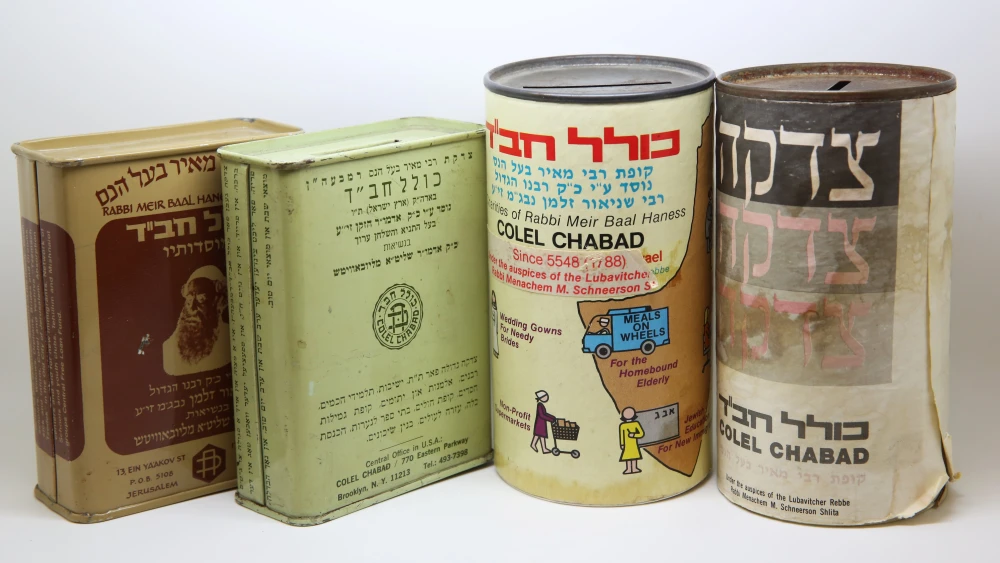

The conversation that changed my thinking about Jewish identity started simply enough. I was discussing hasbara—messaging, media and how to reach the next generation of Jews with a genuine love of Israel—when the topic turned to the tzedakah box.
The pushka. That small tin box. The one that sat on the kitchen counter in so many Jewish homes. The one your grandmother had, perhaps next to her Shabbat candles. The one every child in a Jewish home once knew; the weight of it, the sound of a coin dropping in, the satisfying clunk of something small doing something significant.
It seems almost quaint to talk about it now. But the more I reflected on it, the more I became convinced that that humble box may be one of the most powerful Jewish education tools ever invented. And we’ve largely let it collect dust.
The pushka’s roots run deep. In the late 1700s, the Alter Rebbe—Rabbi Schneur Zalman of Liadi, founder of the Chabad-Lubavitch movement—established Colel Chabad, now the oldest continuously operating tzedakah organization in the Land of Israel. He created a system of regular giving, dispatching emissaries to hundreds of towns and villages so that Jews everywhere could support their brethren in Eretz Yisrael.
His son, the Mitteler Rebbe Rabbi Dovber, took it further. In a letter to his Chassidim in 1813, he urged every family to install a tzedakah pushka—a home charity box—specifically at the table where the family ate.
As Chassidic researcher Rabbi Amram Blau of Jerusalem documented in his extensive research on the origins of the Colel Chabad pushka, it was precisely the introduction of the home tzedakah box that transformed giving for Eretz Yisrael into a daily act of devotion.
No app replicates the developmental power of a 3-year-old putting a coin in a slot and hearing it drop. That tactile moment, repeated daily, is where Jewish identity quietly takes root.
A century later, a small-town bank clerk in Galicia had a similar idea. He wrote a letter to the Zionist newspaper Die Welt suggesting that every Jewish home should have a charity box geared for contributions designated for the Land of Israel. That idea became the Jewish National Fund “Blue Box.”
By the time of World War II, more than 1 million of those blue tin boxes sat in Jewish kitchens, schools and synagogues around the world. Children went door to door collecting coins. Mothers dropped in change before lighting Shabbat candles. Families watched the box fill up, felt its weight, and knew they were part of something.
Those boxes weren’t just collecting money. They were building Jewish support.
They were teaching children, through action rather than lecture, that they had a stake in Israel’s existence. That giving was a reflex, not a decision. That being Jewish meant doing something for Israel every single day.
What happened to that habit?
But somewhere along the way, the box disappeared from many Jewish kitchens. It was replaced by annual campaigns, year-end appeals and digital checkout buttons. Giving became something adults did, in response to a fundraising email, rather than something children did regularly.
The result is not just a fundraising gap. It is an identity gap.
We live in a moment when Jewish communal leaders are genuinely alarmed by how many young American Jews feel disconnected from, or actively hostile toward, Israel. We pour resources into advocacy, into campus programming, into social-media content. These efforts matter. But we may be missing something foundational.
Identity isn’t built by arguments. It isn’t built by information campaigns or public relations talking points. Identity is built by habits. And habits, as every parent and educator knows, are most powerfully formed in early childhood, when the world is still being defined by what we do with our bodies, our hands, our daily rituals.

The Alter Rebbe wrote that how often we give is more important than how much we give. The Baal Shem Tov taught, “Don’t let a day go by without its own act of giving.”
These weren’t just spiritual maxims but behavioral ones. They understood, centuries before behavioral psychology confirmed it, that repeated small actions shape who we are.
A child who learns to give every day is not just learning generosity. They are learning that they are someone who gives. That identity—“I am a person who cares for my people”—is far more durable than any argument. It is the difference between a Jew who defends Israel because they understand the geopolitics, and a Jew who defends Israel because they can’t imagine not doing so.
The Colel Chabad Tzedakah pushka page offers guidance that sounds almost radical in its simplicity: as soon as a child can hold a coin, they can begin learning tzedakah. Around age 3, children begin to understand the concept of helping others. By 5, many have their own pushka and take pride in their daily giving.
Think about what that means developmentally. A 3-year-old who drops a coin into a box does not yet understand hasbara. They cannot follow a debate about U.N. resolutions. But they can feel the coin in their fingers. They can hear it land. They can feel the box get heavier. And their parents can say, “We’re helping families in Israel.”
That is the beginning of a relationship. Not an intellectual one—an embodied one. And embodied relationships are the ones that last.
We have spent enormous communal energy debating how to win the ideological argument about Israel on college campuses. Perhaps we should spend more energy ensuring that the young people arriving on those campuses already have an identity rooted in practice, in daily action, in the habit of caring.
After all, you cannot argue someone into loving Israel. But you might—just might—be able to raise them into it.
Two generations, two tools
The question is not nostalgic. It is forward-looking: How do we bring this habit back? The answer, I believe, is not one-size-fits-all.
Thousands of teenagers and adults—Jews of all backgrounds—are already giving daily through the Colel Chabad Tzedakah Pushka App, a digital tzedakah platform that recreates the experience on a smartphone.
You fill it up one small tap at a time. You watch your giving accumulate. When you hit your goal, you empty it. It builds streaks, creates habits and brings the ancient rhythm of daily giving into a digital age. For teens and adults, it is exactly the kind of frictionless, habit-forming tool that behavioral science tells us works.
But children, especially young children, need something different. They need the physical box. The weight of the coin. The ritual of the hand. No app can replicate the developmental power of a 3-year-old putting a coin in a slot and hearing it drop. That tactile moment, repeated daily, is where Jewish identity quietly takes root.
The good news is that Colel Chabad makes this easy. Free pushkas are available for every Jewish home, school and family—the same organization, the same mission, tracing its direct lineage back to the Alter Rebbe’s original call more than 200 years ago to support the Jewish people in Eretz Yisrael.
Start thinking inside the box
We talk a great deal about the future of the Jewish people. About how to keep young Jews connected to their heritage, to Israel, to each other. We invest in Birthright trips, in educational content, in advocacy training. All of it matters.
But some of the most powerful Jewish education happens not in a conference room or a classroom. It happens at a kitchen counter, in the 60 seconds before Shabbat, when a mother places a few coins in a tin box and her young child reaches up a hand to help.
That child will grow up. They will encounter a world full of voices telling them that their connection to Israel is a choice they need to justify. And somewhere in their muscle memory, in the habit installed before they had words for it, they will know: This is not a choice. This is who I am.
That is what a tzedakah pushka does. That is what it has always done.
It’s time we brought it back.