Israel’s Foreign Ministry on Saturday decried protests at the Israeli pavilion of the Venice Biennale art show, whose opening last week caused the jury to resign.
The protests weren’t activism but “intimidation,” the ministry said on X, adding: “Attempts to silence, isolate or harass Israeli artists and cultural representatives have no place in a democratic society or in the world of art. Culture should build bridges, not fuel hatred and exclusion.”
Hundreds of people were seen protesting outside the Israeli pavilion, which the event’s managers had tried to ban along with Russia’s, but which opened to the public after Italy’s culture minister expressed opposition to the boycott.
The targeting of the Israeli pavilion at the Venice Biennale is not “activism” - it is intimidation.
— Israel Foreign Ministry (@IsraelMFA) May 9, 2026
Attempts to silence, isolate or harass Israeli artists and cultural representatives have no place in a democratic society or in the world of art.
Culture should build bridges,…
The five-member jury quit last week, saying only that the move was connected to the decision to ban Russia and Israel. Before it was reversed, the ban announced by management said that countries whose leaders are under investigation at the International Criminal Court. Currently, Israeli Prime Minister Benjamin Netanyahu and Russian President Vladimir Putin are the only world leaders under investigation at the ICC.
The pavilion of Russia, which is the subject of E.U. sanctions, remains closed to the public and was open only during the press preview stage of the event, which opened last week, and where the artworks will remain on display until November.
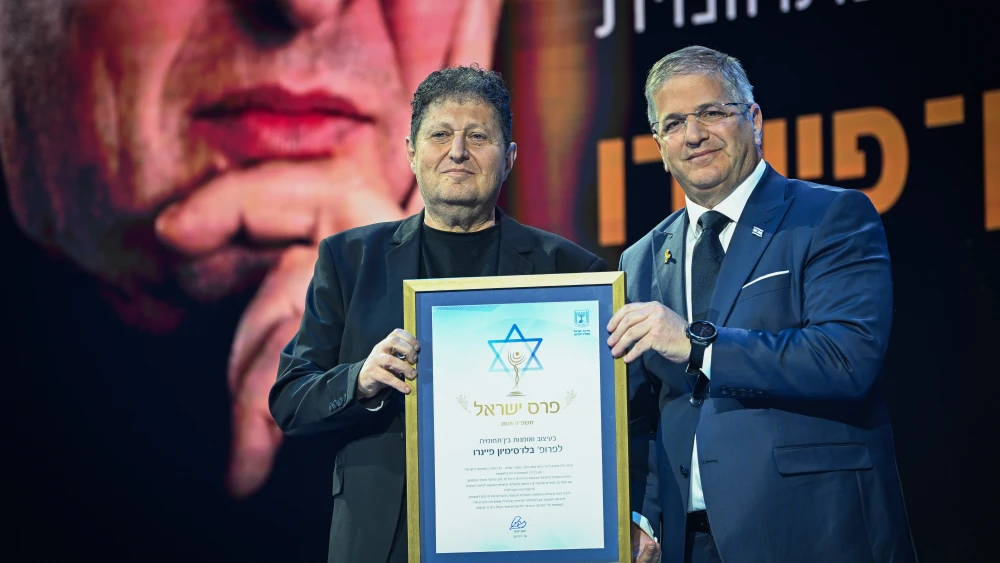
Italian Culture Minister Alessandri Giuli on April 29 had a phone call with the Israeli pavilion’s artist, Belu-Simion Fainaru, to express solidarity in the face of “recent attacks.” Giuli also “confirmed the Italian government’s commitment against every form of discrimination and antisemitism in Italian cultural institutions,” his office said in a statement.
The contrast between the attitude of the Italian government, which funds the Venice Biennale, and the event’s managers has led to speculation that Giuli’s office intervened to reverse the boycott.
The government’s attitude was key to the boycott’s reversal, according to Ari Ingel, the Executive Director of Creative Community for Peace (CCFP), a non-profit organization consisting of cultural and entertainment industry leaders committed to artistic freedom and coexistence.
“Once the Italian government stepped in, the jury’s campaign to boycott Israel collapsed, which is why they resigned,” Ingel told JNS. “Given that Israel had a public pavilion, and that only Israeli artists would truly have been affected by the jury’s decision, it was clear this was an attempt to boycott Israel and Israeli artists by politicizing one of the world’s premier cultural events,” he said.
CCFP, founded in 2012, has worked to counter cultural boycott campaigns targeting Israel across music, film, television, literature and the arts. The attempt to bar Israel from the Biennale was a “test case” for the boycott movement, Ingel added.
“Had it succeeded, the boycott movement almost certainly would have tried the same tactic at the Venice Film Festival, which operates under the same Biennale umbrella,” Ingel said. “We likely would have seen efforts to discriminate against Israeli films and artists from awards consideration there as well. This was a moment where we needed to step in and make clear that such discrimination was unacceptable, and thankfully, the Italian government agreed.”
Boycott campaigns are far more likely to succeed in countries whose governments are more hostile toward Israel, Ingel said. “Unfortunately, in places like Spain or Ireland, you could very well see efforts to exclude Israel from major cultural events,” he told JNS.